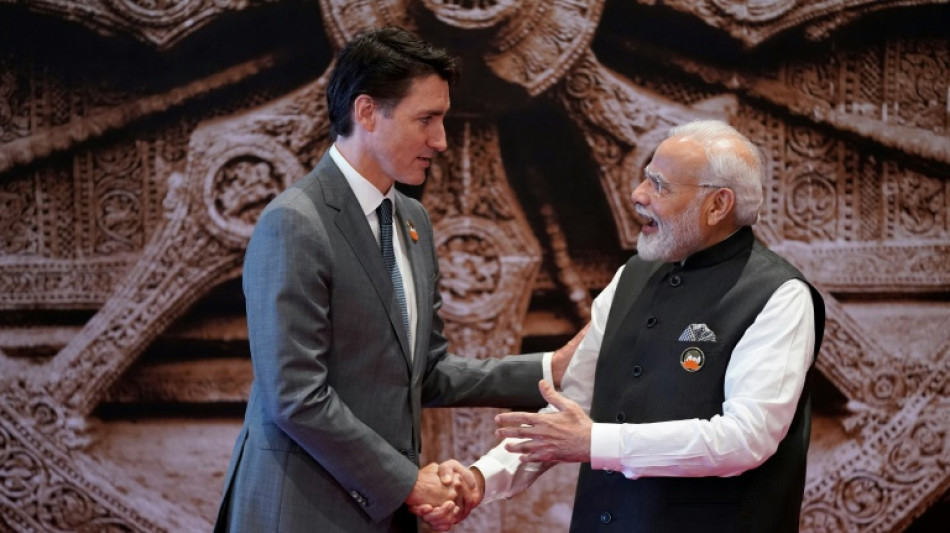
After China, India crisis tests 'naive' Canadian diplomacy / Photo: Evan Vucci - POOL/AFP

 Malaysia Sues Google for $146m Over Harmful Content

 Black Wind Turbine Blades Reduce Bird Deaths by 74% in Spain Study

 Brazil’s Landless Movement Partners with China to Build Affordable Tractors for Family Farms

 Raheem Sterling Receives Suspended Sentence After Lamborghini Crash

 Luxembourg Pay Rise Delayed as Regional and World Headlines Develop

 Audience to Choose the Set List at Luxembourg's First FAMIL Jukebox Night

 Twickenham Grounds Team Prepares Pitch for Six Matches in Three Days

 Black Friday Discounts Cut Prices on Two Top-Rated Wiper Blades

 Arizona Gun Regulation Battle Intensifies Under New Democratic Legislative Majority

A diplomatic crisis bogging down Ottawa and New Delhi highlights Canada's lack of "seriousness" on national security as foreign countries interfere on the North American nation’s soil, according to several experts.
Indo-Canadian relations, already tense, deteriorated further earlier this week when Canada raised the possible involvement of the Indian government in the June killing of a Sikh separatist near Vancouver.
"The crisis with India is a huge, huge slip-up," said Charles-Philippe David, a strategic and diplomatic studies professor at the University of Quebec in Montreal.
He told AFP that Ottawa has been receiving warning signals for a "long time" about foreign interference on its territory.
The global context, "transformed in recent years and accelerated by Ukraine," is forcing Canada, according to David, to "choose camps and take tougher and firmer positions."
But so far the country has been in a state of "dormancy," manifested in a lack of ambition, resources and leadership, he said.
"We must treat international relations and foreign policy with much more seriousness than we have done for a long time," insists David.
One of his peers at the University of Ottawa points out that Canada has not reviewed its foreign policy in the last "one or two generations."
"That is a failure of our government, regardless of which political party was in power. We need a defense policy that is appropriate," public and international affairs professor John Packer told AFP.
He believes that a growing number of autocracies are exerting influence on Canadian soil.
"Canadians have felt safe (surrounded by) three oceans and a friendly neighbor to the south," he said. "But that's long gone. Those oceans are no longer impenetrable."
- 'Naive' Canada -
Tensions with India prove, according to Packer, that "the world has changed and we have to get up to speed with that."
"We have been perhaps a little naive, perhaps not sharp in defending our sovereignty," he continued.
In addition to India, Ottawa has had equally tense relations with China.
The arrest of a senior Chinese telecom executive on a US warrant in Vancouver in December 2018 and Beijing's retaliatory detention of two Canadians on espionage charges plunged relations into a deep freeze.
All three were released in September 2021 after a deal with US prosecutors was struck on the charges against the Huawei executive.
National security expert and former senior Canadian intelligence official Michel Juneau-Katsuya believes that Canada now finds itself "at a crossroads."
"We have become so naive when it comes to national security that we border on stupidity," he said in an interview with AFP. "Now it's catching up with us."
The former head of the Asia-Pacific bureau at the Canadian Security Intelligence Service in the 1990s claims that Indian interference dates back several decades.
Earlier this month, Ottawa officially launched a public inquiry into foreign interference -- notably by China -- in its electoral and democratic institutions, after months of controversy and delay.
"Canada was a polite, kind student. We didn't speak loudly, we didn't bang on the table, we didn't slam the doors," says Juneau-Katsuya.
Some countries, he believes, have taken advantage of this attitude and "transgressed by going too far."
Juneau-Katsuya said that inaction by governments across party lines has led to the severe deterioration of relations with New Delhi.
Collective awareness of these issues -- which are shaking up Canadian diplomacy -- is necessary, he says. "It's really undermining our democracies."
F.Ferraz--PC

