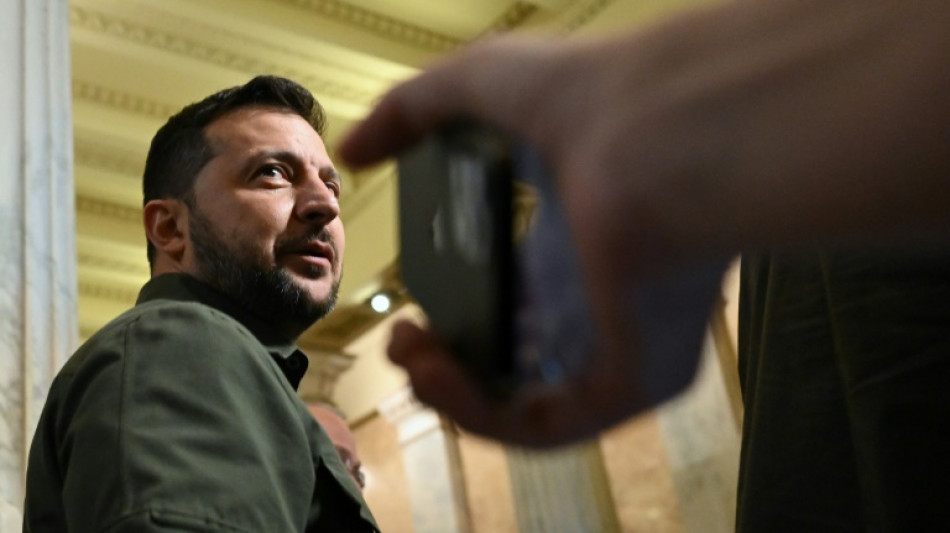
Diplomatic challenges multiply for Zelensky / Photo: Andrew Caballero-Reynolds - AFP

 Malaysia Sues Google for $146m Over Harmful Content

 Black Wind Turbine Blades Reduce Bird Deaths by 74% in Spain Study

 Brazil’s Landless Movement Partners with China to Build Affordable Tractors for Family Farms

 Raheem Sterling Receives Suspended Sentence After Lamborghini Crash

 Luxembourg Pay Rise Delayed as Regional and World Headlines Develop

 Audience to Choose the Set List at Luxembourg's First FAMIL Jukebox Night

 Twickenham Grounds Team Prepares Pitch for Six Matches in Three Days

 Black Friday Discounts Cut Prices on Two Top-Rated Wiper Blades

 Arizona Gun Regulation Battle Intensifies Under New Democratic Legislative Majority

President Volodymyr Zelensky, who once enjoyed enthusiastic support from his allies in the defence of Ukraine, is encountering more diplomatic setbacks than at any point since Russia's 2022 invasion.
Zelensky went to the US Congress on Thursday to face sceptical Republicans threatening to cut off massive aid for his country's fight against Russia and to reassure his American backers that Ukraine can win.
The United States has spearheaded Western support for Ukraine, with Congress having approved more than $100 billion in aid, including $43 billion in weaponry.
But over the last year, "different interest groups have argued for reducing or even stopping assistance", said Mick Ryan, a retired Australian armed forces general.
"There are a range of imperatives quoted by advocates for such action, including a focus on 'China first' to much less noble and more isolationist reasons," he said.
House Speaker Kevin McCarthy already announced that he had "questions" for the Ukrainian guest, such as "Where's the accountability on the money we already spent?" and "What is the plan for victory?"
Even if Zelensky carries the day with "smart public diplomacy", said Ivan Klyszcz, at the Estonian International Centre for Defence Studies (ICDS), it can "only go so far" in containing growing Republican scepticism.
The existing trend of Ukraine's "growing reliance on Europe" will therefore continue, the expert told AFP.
- 'A war likely to continue' -
Disillusion in some parts is also a reflection of impatience with Ukraine's military progress against Russia whose defensive lines have proved more resilient than forecast in the face of Kyiv's counteroffensive.
"It is very probable that Russia will take the time to dig in even more, to build new fortifications and prepare for the spring," Estonian military intelligence services chief Margo Grosberg told The Insider, a strategy website.
Even optimists no longer believe that the war could be over soon.
"It is clear to even the most exuberant of Ukraine's supporters that this is a war likely to continue into 2024 and probably 2025 as well," said Ryan.
While Ukraine is "probably in a better strategic position now than it was in December 2022", he said, "it is perceptions of success, and failure, in Washington DC and other Western capitals that are just as vital".
Meanwhile, voices calling for negotiations with Russia have become more confident.
Last month, Stian Jenssen, the director of the private office of the NATO secretary general, suggested that Ukraine could be granted NATO membership in exchange for ceding some of its territory to Russia.
He later walked back the comments and his boss, Jens Stoltenberg, said that "it's up to Ukrainians, and Ukrainians alone, to decide when the conditions for negotiations are in place", but analysts said the damage was done.
- 'Essential partner' -
A surprising challenge meanwhile emerged from Poland this week, when the government said it would no longer arm Ukraine and instead focus on its own defence, against the backdrop of a mounting row over grain exports from Ukraine.
Poland has been one of Ukraine's staunchest supporters after Russia invaded in February 2022, and is one of Kyiv's main weapons suppliers.
Experts said any signs of weakening solidarity with Ukraine serves Russian President Vladimir Putin's interests.
"No doubt Russian propaganda channels will make much of this," said Theresa Fallon, director of the Centre for Russia Europe Asia Studies (CREAS) in Brussels, adding on X, formerly Twitter, that "perhaps better communication with Kiev" could have helped.
But analysts also cautioned against reading too much into the spat.
"The fundamentals of the relationship remain in place," said Klyszcz. "In the end, Kyiv regards Poland as an essential partner and Warsaw wants to prevent a Ukrainian defeat."
A.Magalhes--PC

