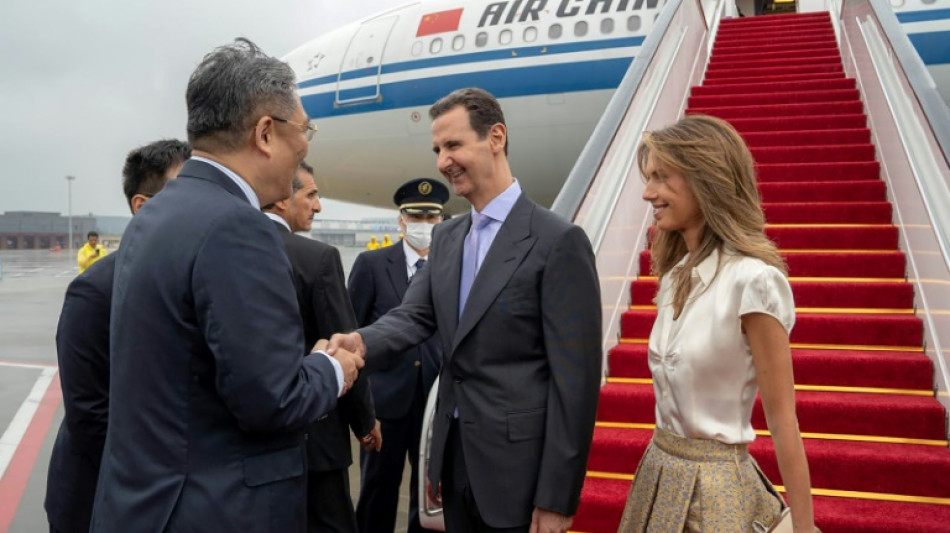
China announces 'strategic partnership' with Syria / Photo: - - SANA/AFP

 Malaysia Sues Google for $146m Over Harmful Content

 Black Wind Turbine Blades Reduce Bird Deaths by 74% in Spain Study

 Brazil’s Landless Movement Partners with China to Build Affordable Tractors for Family Farms

 Twickenham Grounds Team Prepares Pitch for Six Matches in Three Days

 Luxembourg Pay Rise Delayed as Regional and World Headlines Develop

 Audience to Choose the Set List at Luxembourg's First FAMIL Jukebox Night

 Raheem Sterling Receives Suspended Sentence After Lamborghini Crash

 Black Friday Discounts Cut Prices on Two Top-Rated Wiper Blades

 Arizona Gun Regulation Battle Intensifies Under New Democratic Legislative Majority
Chinese President Xi Jinping announced a "strategic partnership" with Syria on Friday during talks with President Bashar al-Assad, who is seeking financial support to help rebuild his devastated country.
The leaders met on the eve of the Asian Games opening ceremony, which Assad will attend as part of his first visit to China since 2004.
China is one of only a handful of countries outside the Middle East that Assad has visited since the 2011 start of a civil war that killed more than half a million people, displaced millions and battered Syria's infrastructure and industry.
Assad is the latest in a string of leaders ostracised by the West to be feted by Beijing, with Venezuelan leader Nicolas Maduro and Iran's President Ebrahim Raisi visiting this year, as well as top Russian officials.
"Chinese President Xi Jinping and his Syrian counterpart Bashar al-Assad on Friday jointly announced the establishment of the China-Syria strategic partnership," according to Chinese state news agency Xinhua.
The leaders were each flanked by nine aides at a large rectangular wooden table, a CCTV video showed, as two flags from each country were set in front of a Chinese painting in the meeting room.
Relations between the two countries "have withstood the test of international changes", Xi said.
"China supports Syria in opposing foreign interference, opposing unilateral bullying, safeguarding national independence, sovereignty, and territorial integrity," the Chinese leader added.
Assad, in turn, said he "thanked the Chinese government for everything you have done to stand alongside the Syrian people in their cause and their trials", according to a readout from Syrian state news agency SANA.
"This visit is extremely important due to its timing and circumstances because a multipolar world is being formed today which will restore balance and stability to the world," he said.
"I hope that our meeting today will lay the foundations for broad-based and long-term strategic cooperation in all areas," he added.
- 'New level' -
Beijing's foreign ministry has said Assad's visit will serve to take ties to a "new level".
Beijing has long provided Damascus with diplomatic support, particularly at the UN Security Council where China is a permanent member.
Analysts say that Assad's visit represents an important step towards returning to the international fold after years of US-led isolation of his regime.
Syria's war began after Assad's repression of peaceful pro-democracy protests escalated into a deadly conflict that pulled in foreign powers and jihadists.
Assad's trip also comes as China expands its engagement in the Middle East.
This year, Beijing brokered a deal that saw longtime regional rivals Saudi Arabia and Damascus-backer Iran agree to restore ties and reopen their respective embassies.
The detente was followed by Syria's return to the Arab fold at a summit in Saudi Arabia in May, ending more than a decade of regional isolation.
A.Motta--PC

