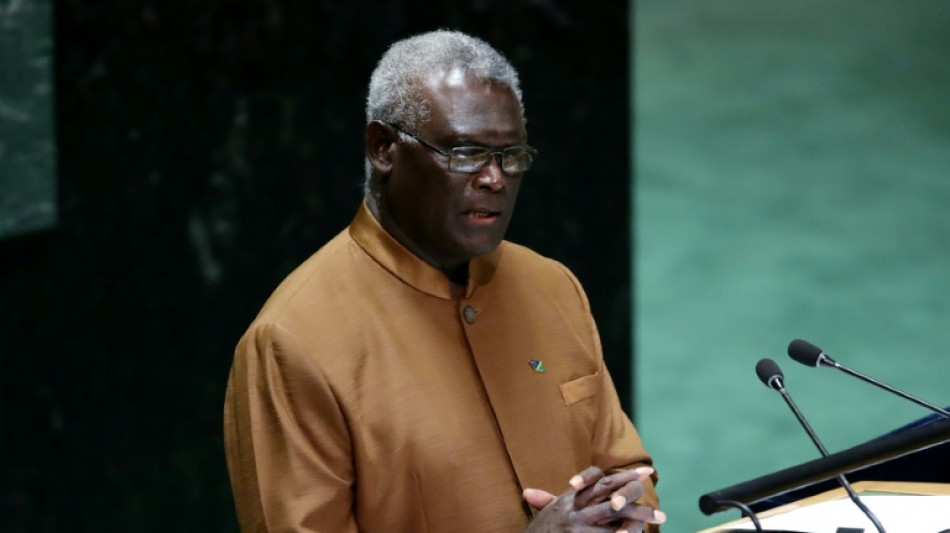
Solomon Islands leader 'appalled' by Japan on Fukushima water / Photo: Leonardo Munoz - AFP

 Malaysia Sues Google for $146m Over Harmful Content

 Black Wind Turbine Blades Reduce Bird Deaths by 74% in Spain Study

 Brazil’s Landless Movement Partners with China to Build Affordable Tractors for Family Farms

 Twickenham Grounds Team Prepares Pitch for Six Matches in Three Days

 Luxembourg Pay Rise Delayed as Regional and World Headlines Develop

 Audience to Choose the Set List at Luxembourg's First FAMIL Jukebox Night

 Raheem Sterling Receives Suspended Sentence After Lamborghini Crash

 Black Friday Discounts Cut Prices on Two Top-Rated Wiper Blades

 Arizona Gun Regulation Battle Intensifies Under New Democratic Legislative Majority
The leader of Solomon Islands, who has developed close ties with China, on Friday joined Beijing in denouncing Japan's release of wastewater from Fukushima's crippled nuclear plant.
Addressing the United Nations General Assembly, Prime Minister Manasseh Sogavare said he was "appalled" at the move and warned of effects on his South Pacific archipelago.
"If this nuclear wastewater is safe, it should be stored in Japan. The fact that it's dumped into the ocean shows that it is not safe," he said.
"The effect of this act is transboundary and intergenerational and is an attack on global trust and solidarity," he said, calling on Japan to stop "immediately" and find other options.
Japan began on August 24 discharging into the Pacific some of the 1.34 million tonnes of wastewater that had collected since a tsunami devastated the facility in 2011.
Japan insists that the discharge is safe, a view backed by the UN atomic agency, and Western countries including the United States have voiced understanding.
But China, which has longstanding tensions with Japan, accused Tokyo of treating the ocean as a "sewer." China banned all Japanese seafood imports and Chinese citizens have thrown bricks and eggs at Japanese schools and consulates.
There have also been scattered protests in South Korea, although the Seoul government, which is seeking to improve ties with Japan, has not raised objections to the Fukushima plan.
Sogavare last year reached a secretive security pact with China that the United States and Australia fear could give Beijing a military foothold in the South Pacific.
In his UN address, Sogavare hailed China's Belt and Road Initiative of infrastructure investment, saying that "South-South cooperation" was "less restrictive, more responsive and is aligned to our national needs."
O.Salvador--PC

