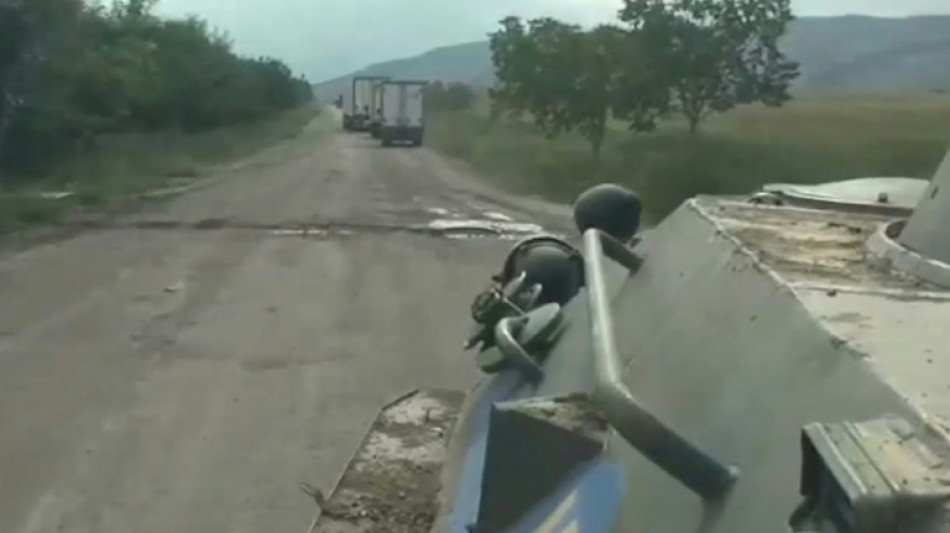
Karabakh rebels hand in arms and negotiate withdrawal / Photo: Handout - Russian Defence Ministry/AFP

 Malaysia Sues Google for $146m Over Harmful Content

 Black Wind Turbine Blades Reduce Bird Deaths by 74% in Spain Study

 Brazil’s Landless Movement Partners with China to Build Affordable Tractors for Family Farms

 Twickenham Grounds Team Prepares Pitch for Six Matches in Three Days

 Luxembourg Pay Rise Delayed as Regional and World Headlines Develop

 Audience to Choose the Set List at Luxembourg's First FAMIL Jukebox Night

 Raheem Sterling Receives Suspended Sentence After Lamborghini Crash

 Black Friday Discounts Cut Prices on Two Top-Rated Wiper Blades

 Arizona Gun Regulation Battle Intensifies Under New Democratic Legislative Majority
Nagorno-Karabakh separatists were negotiating the end of their long struggle against Azerbaijani rule on Saturday, surrendering their weapons after a lightning government offensive.
If the ceasefire holds it will mark the end of a conflict between Caucasus rivals Armenia and Azerbaijan that has raged, off and on, through the three decades since the collapse of the Soviet Union.
On Friday, Moscow confirmed that the rebels had surrendered their first weapons and the process is expected to continue through the weekend, with the help of Russian peacekeepers.
Germany meanwhile called for the rights of the residents of the mountainous region to be guaranteed, as concern grew in the international community over the plight of the mainly Armenian-speaking civilians there.
A US congressional delegation was expected to meet Armenian leader Prime Minister Nikol Pashinyan to, in the words of the US embassy, discuss "the impact of Azerbaijan's recent military actions on the Armenian population of Nagorno-Karabakh".
The years of fighting in Nagorno-Karabakh have been marked by abuses on both sides and there are fears of a new refugee crisis. This week's Azerbaijani offensive left tens of thousands of ethnic Armenians cut off from electricity in the disputed enclave.
In the Armenian border town of Kornidzor, civilians have been gathering, some of them waiting for days, at the last checkpoint before Azerbaijani territory hoping for news of relatives stuck in the embattled enclave.
- Situation 'horrible' -
"I've been here for three days and nights, sleeping in my car," said 28-year-old Garik Zakarian, as displaced Armenians borrowed a soldier's telescope to scan a village on the other side of the valley.
It was shelled by Azerbaijani forces on Tuesday. No-one was killed, but witnesses who managed to escape report that 150 inhabitants were forced to take refuge close to a Russian peacekeeper base a kilometre from the last Armenian positions.
Zakarian got his family out in December, three days before Azerbaijan blockaded the area, but he is worried for friends and family still across the border.
"I don't have much hope of seeing them soon, but I couldn't just do nothing. Just being here, being able to see the Russian base, I feel better," he said.
A spokeswoman for the Nagorno-Karabakh breakaway region said Friday that fearful civilians in the main city Stepanakert were hiding in their basements, with Azerbaijan's forces camped on the outskirts.
The situation there was "horrible", said Armine Hayrapetyan.
An AFP reporter in the separatist stronghold said food, water, medicine and fuel for the panicked population were scarce and displaced people had arrived in the city from surrounding villages.
International pressure has mounted on Azerbaijan to re-open the only road leading to Armenia, dubbed the Lachin Corridor, so supplies and people can move in and out.
The separatists have said they are in Russian-mediated talks with Baku to organise the withdrawal process and the return of civilians displaced by the fighting.
They say they are discussing how citizens' access to and from Nagorno-Karabakh, where up to 120,000 ethnic Armenians live, will work.
Baku said it had started sending in urgently needed aid on Friday as it seeks to cement its grip over the region it lost control over in a war in the 1990s.
- Pashinyan under pressure -
While the surrender of the separatists, after an offensive they said left 200 dead, has sparked jubilation among Azerbaijanis, it has put Pashinyan under increasing pressure.
He has faced criticism for making concessions to Azerbaijan since losing swathes of territory in a six-week war in 2020. Police said 98 people were arrested as anti-government demonstrators blocked streets in Yerevan for a third day on Friday.
Pashinyan himself has blamed peacekeepers from traditional regional power broker Russia -- stationed around Karabakh since 2020 -- for failing to avert Azerbaijan's offensive.
Moscow is currently bogged down with its war on Ukraine, but has still played a role in mediating the ceasefire and peace talks.
S.Caetano--PC

