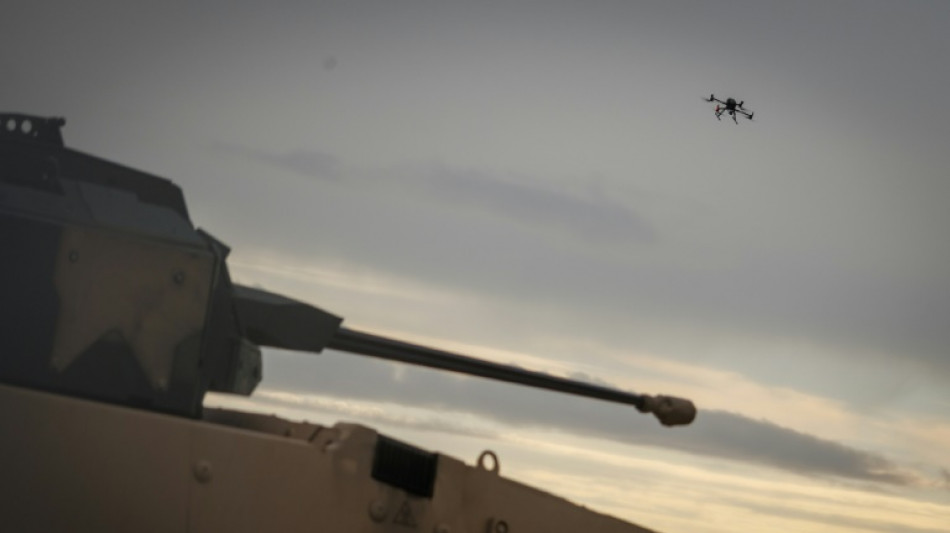
Ukraine war pushes NATO to bolster drone-tackling expertise / Photo: Simon Wohlfahrt - AFP

 Lula, Bolsonaro in final push for votes ahead of knife-edge election

 Boisterous fashion week barnstorms 'sleepy' Nigerian capital

 UAE investigators say flydubai co-pilot was planning 'terrorist act'

 Rahul smacks century in India v Windies ODI

 Daryz seeks to join exclusive club of dual Arc winners

 Russia warns diplomats to leave Kyiv over new strikes threat
 Olympic champ Zheng rebukes rowdy home crowd at China Open

 World No.1 Sinner pulls out of Shanghai Masters to delay return

 Red Bull's Verstappen grabs pole position for Bahrain GP

 India beat Pakistan in blockbuster as golfer Kim wins 'crazy' gold

 India beat arch-rivals Pakistan to win Asian Games cricket gold

 Ethiopia's Tigray rebels abandon regional capital as govt advances: journalist

 Tom Kim powers to Games gold and exemption from military service

 Split loyalties for Indian football fans at Brazil friendly
 India-Pakistan blockbuster brings cricket fever to Japan baseball field

 Wong waiting on Rafa after winning Asian Games tennis gold

 With Russia next door and rising costs, Latvia goes to the polls

 Penalty hero rues empty seats as Games hosts Japan win football gold

 North Korea fires ballistic missile after Seoul's apology demand

 US regulator finds Boeing 737 MAX software bug 'not a safety concern'

 Ohtani 'managing' injuries as Dodgers launch MLB post-season

 Botched US execution leaves murderer unconscious on ventilator: lawyers
 Cornell rape case exposes sexual violence at US colleges

 France held by Italy in Zidane's homecoming after Olise stunner

 Ethiopian pro-government militia claims Tigray airport as regional tensions spike

A small drone flits over opened earth, and an explosion appears on the video feed.
The drone has just dropped a grenade into a trench in Ukraine. The images were being projected on a giant screen in the Netherlands, in front of NATO military officers and defence company executives.
These drones being used against Ukrainian forces are "small, fast" and finding a way to defend against them is "complex", says Willem Koedam, a former Dutch air force officer turned expert for NATO's C-UAS unit, which looks at anti-drone defences.
The solution may be complex, but it's not impossible.
Representatives from 57 companies visited a military base in the Dutch town of Vredepeel to present their systems to the NATO brass.
The systems they offer are designed to counter threats ranging from off-the-shelf drones available to the public to the Iranian Shahed drones used by Russia's forces.
- Using nets -
"The best way to kill a Shahed is a jet" -- meaning a jet-propelled drone -- said Ludwig Fruhauf, head of DDTS, a German firm specialised in anti-drone defences.
A jet-powered drone flying at 500 kilometres (310 miles) per hour would be able to intercept a propellor-driven Shahed-136 travelling at 180 kilometres per hour, he explained. And jet devices are cheaper than the rocket-type defences usually employed.
But threats persist from much smaller drones, which can be deadly or destructive for critical infrastructure such as power stations, said Matt Roper of the NATO Communications and Information (NCI) Agency, the alliance's tech and cyber hub.
In some cases, the best method is not to blow a drone out of the sky, which could cause collateral damage, but to catch or redirect it.
Argus Interception, another German company, has developed a sort of "fishing net" to be used against enemy devices
The target first has to be detected by radar, camera or by monitoring frequencies used to guide it.
Once located, an interceptor drone is launched that fires the net over the hostile drone, allowing it to be captured. It is especially useful in protecting airports, Argus Interception boss Christian Schoening said.
For Romanian air force captain Ionut-Vlad Cozmuta, however, that method may not be best against drones deployed by the Russian military close to Romanian airspace -- Debris from some of them has been found in Romanian territory in recent weeks.
Romania, a NATO member, is keen to find ways to protect itself against possible drone attacks, and Cozmuta was carefully following the drone-defence exercises at the Vredepeel base.
He said signal "jamming" would be a solution, sending the device off-course rather than capturing it.
- 'Big benefits' -
More aggressive than jamming is technology to seize control of an enemy drone and guide it to a new target or another destination.
But for that, NATO needs to establish a common standard allowing different anti-drone defence systems to speak to each other. That looks to now be in place with the adoption of a British system called Sapient.
Its use will bring "big benefits" to the alliance, a senior NATO officer in the NCI Agency, General Hans Folmer, told reporters.
No Ukrainian officer was present for the anti-drone exercises.
But NATO has "ongoing discussions" with the besieged country on these issues, said Claudio Palestini, a NATO science expert.
And the Ukrainians themselves "innovate on the ground all the time," he said.
H.Portela--PC