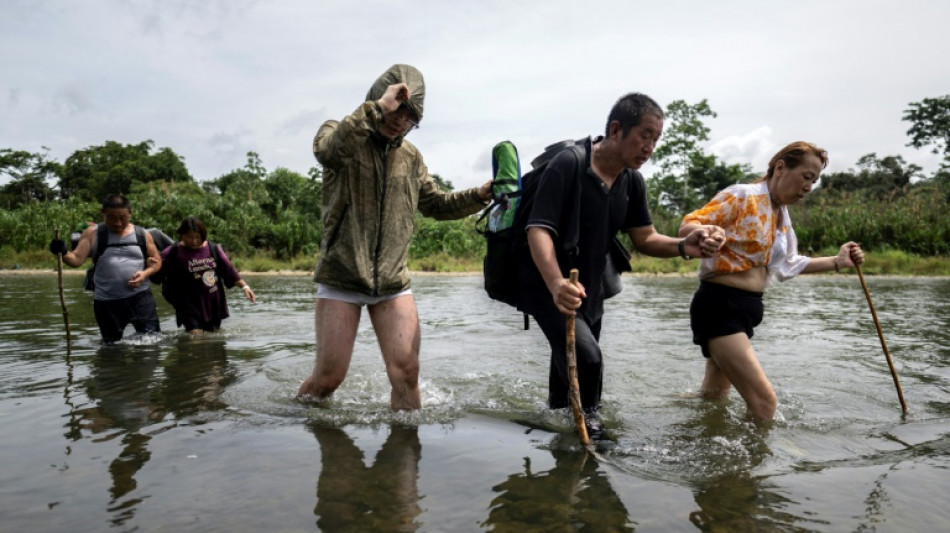
A migrant rest stop in Panama after brutal crossing of the Darien Gap / Photo: Luis ACOSTA - AFP/File

 Malaysia Sues Google for $146m Over Harmful Content

 Black Wind Turbine Blades Reduce Bird Deaths by 74% in Spain Study

 Brazil’s Landless Movement Partners with China to Build Affordable Tractors for Family Farms

 Twickenham Grounds Team Prepares Pitch for Six Matches in Three Days

 Luxembourg Pay Rise Delayed as Regional and World Headlines Develop

 Audience to Choose the Set List at Luxembourg's First FAMIL Jukebox Night

 Raheem Sterling Receives Suspended Sentence After Lamborghini Crash

 Black Friday Discounts Cut Prices on Two Top-Rated Wiper Blades

 Arizona Gun Regulation Battle Intensifies Under New Democratic Legislative Majority
Once Marcel Maldonado had finally made it across, he broke down in tears. The Venezuelan migrant, limping on a prosthetic leg, had survived the infamous trek through the Darien jungle from Colombia and, having crossed the Tuquesa River, he was now in Panama.
Perched on the riverside is Bajo Chiquito, the first Panamanian village where migrants -- some 3,000 a day, most of them Venezuelans, many with children -- arrive after the tortuous journey northward. Most are headed to the US and, they hope, a better life.
After an exhausting slog of three to five days across the Darien Gap, they reach the village under crushing heat, but cheered by the prospect of a hot meal and a safe place to sleep -- even if it is under the stars. NGOs like the Red Cross and Doctors Without Borders are there to help.
The migrants had survived the natural obstacles of the jungle -- the rivers, torrential rain, treacherous climbs and cliffs -- but also the criminal gangs who often rob, kidnap or rape them.
Maldonado lost his right leg in a motorcycle accident 10 years ago but has not let that stop his quest for a better life.
"The only thing I want is to let my parents spend their last years with at least something to eat," the 30-year-old Venezuelan told AFP. "That is my dream."
Otherwise, he added, "I would not be here. Because this is terrible."
- 'Risky but necessary' -
The Darien jungle, 165 miles (265 kilometers) long, has become a necessary, if hugely trying, passage for thousands of migrants from South America trying to reach the US via Central America and Mexico.
Most of them are Venezuelans, but there are also Ecuadorans, Haitians, Chinese, Vietnamese, Afghans and even Africans from Cameroon or Burkina Faso.
"It's very dangerous. There are rapes and all the rest," Reina Torres told AFP. The 77-year-old Venezuelan had crossed the jungle with 12 family members.
The trip is "very dangerous, risky, but necessary," added Mechu Falceinord, a 28-year-old Haitian who had come from French Guyana. "My dream is to work, to have money, to be independent, to have a house, a dog, a child."
In Bajo Chiquito, police search new arrivals and confiscate any potential weapons, while officials register everyone's personal information.
- Robbed of everything -
Nearly 390,000 migrants have entered Panama via the Darien Gap so far this year, up sharply from last year's 248,000, Panamanian officials say. In 2008, the first year arrivals were tallied, there were only 28.
From Bajo Chiquito, migrants can pay $25 each to be taken in long canoes on a three-hour trip up the Tuquesa to Lajas Blancas. From there, they can take buses to the Costa Rican border.
When they first emerge from the Darien jungle, many migrants say the gangs robbed them of everything.
Nazaret Puerta, a 28-year-old Venezuelan, said her group was held hostage for eight hours. "They put their fingers in my vagina and in my anus to see if I had any hidden money."
The passage took four days for a migrant from Burkina Faso. "The forest was dangerous," said the man, who identified himself only as Utsman. "We had no water to drink, there was no food."
- 'Trail of trash' -
Migrants making the grueling trek have left a trail of trash, casting aside items no longer needed or too heavy to carry: boots, plastic bottles, toothbrushes, diapers. The castoffs line the banks of the Tuquesa.
Residents of Bajo Chiquito have opened food stands, they rent hammocks and camping sites, and they offer charging stations and Internet access to the migrants.
But for Panama, the flood of arrivals poses a security problem.
"Three hundred ninety thousand just this year," said regional police chief Edgar Pitti Valdes.
"This massive influx of migrants is upsetting people's normal lives."
O.Gaspar--PC

