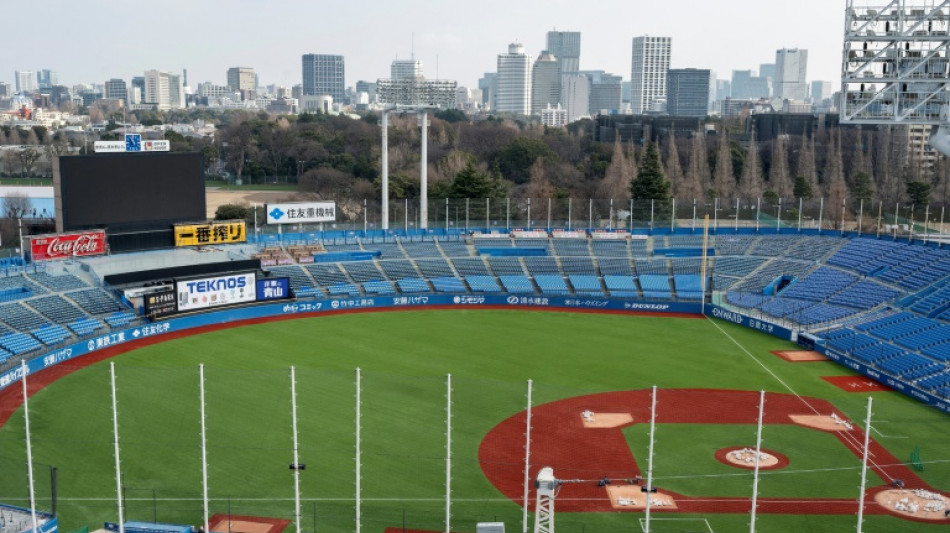
Petition against felling trees in historic Tokyo park area / Photo: Richard A. Brooks - AFP/File

 Malaysia Sues Google for $146m Over Harmful Content

 Black Wind Turbine Blades Reduce Bird Deaths by 74% in Spain Study

 Brazil’s Landless Movement Partners with China to Build Affordable Tractors for Family Farms

 Twickenham Grounds Team Prepares Pitch for Six Matches in Three Days

 Luxembourg Pay Rise Delayed as Regional and World Headlines Develop

 Audience to Choose the Set List at Luxembourg's First FAMIL Jukebox Night

 Raheem Sterling Receives Suspended Sentence After Lamborghini Crash

 Black Friday Discounts Cut Prices on Two Top-Rated Wiper Blades

 Arizona Gun Regulation Battle Intensifies Under New Democratic Legislative Majority
Campaigners filed a fresh petition with almost 225,000 signatures on Monday against plans to fell large numbers of trees and tear down a historic baseball stadium in a rare green area of central Tokyo.
Lush with trees donated to honour Emperor Meiji a century ago, Meiji Jingu Gaien offers respite and shade -- Japan saw its hottest recorded summer this year -- in one of the world's biggest urban areas.
The park area is also home to Jingu Stadium where US baseball star Babe Ruth wowed spectators in 1934 and where celebrated Japanese author Haruki Murakami says he was inspired to become a writer.
Also on the site is a stadium dubbed the spiritual home of Japanese rugby.
But the redevelopment project, due to start this month, will see the sports facilities razed and rebuilt alongside several new high-rises to add to Tokyo's thicket of tall buildings.
According to the petition submitted on Monday to the government, 1,000 trees will be cut down.
The new baseball stadium will also endanger a boulevard of gingko trees, just six metres (20 feet) away, whose stunning autumn leaves attract huge crowds, campaigners say.
"These are all huge beautiful trees," said Rochelle Kopp, a management consultant who organised the petition -- one of several -- and who is also involved in a lawsuit against the project.
"The online petition numbers continue to grow because the more members of the public learn the details of the plan, the more people are unhappy about this plan to cram as many skyscrapers as possible into a small space and forever change a beloved landscape," Kopp told AFP.
- 'Heritage alert' -
The International Council on Monuments and Sites (ICOMOS) this month put the number of trees in danger at around 3,000 in a "heritage alert" issued by the advisory body to UNESCO.
The redevelopment "will lead to the complete destruction of the urban forest that has been formed and nurtured over the past 100 years," ICOMOS said.
"Urban parks are places for people's recreation and also contribute to maintaining rich biodiversity. They mitigate the heat island effect in cities and provide shelter in case of natural disasters such as major earthquakes," it said in a September 7 statement.
According to the Tokyo Metropolitan Government's web page, the developers said in January last year they plan to cut down 892 trees.
The number has since been reduced to 743 trees after further efforts to preserve trees, said a spokeswoman for Mitsui Fudosan, one of the major developers.
"We continue studying how to preserve trees," she told AFP.
The developers and the Tokyo government say that after work is complete, the number of trees and the amount of green space will in fact increase.
At just 7.4 percent as of 2015, Tokyo has one of the lowest percentages of public green spaces such as parks and gardens, according to data compiled by World Cities Culture Forum.
This compares to New York's 27.0 percent in 2010, 27.9 percent in Seoul in 2019 and London's 33.0 percent in 2022.
E.Borba--PC

