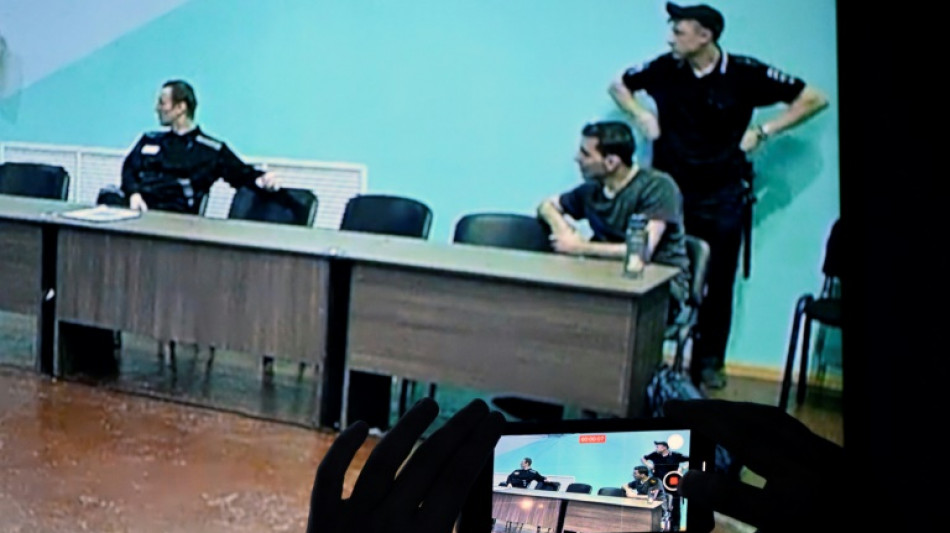
Russia court rejects Navalny appeal against 19-year sentence / Photo: Alexander NEMENOV - AFP

 Malaysia Sues Google for $146m Over Harmful Content

 Black Wind Turbine Blades Reduce Bird Deaths by 74% in Spain Study

 Brazil’s Landless Movement Partners with China to Build Affordable Tractors for Family Farms

 Twickenham Grounds Team Prepares Pitch for Six Matches in Three Days

 Luxembourg Pay Rise Delayed as Regional and World Headlines Develop

 Audience to Choose the Set List at Luxembourg's First FAMIL Jukebox Night

 Raheem Sterling Receives Suspended Sentence After Lamborghini Crash

 Black Friday Discounts Cut Prices on Two Top-Rated Wiper Blades

 Arizona Gun Regulation Battle Intensifies Under New Democratic Legislative Majority
Russia on Tuesday rejected an appeal lodged by Kremlin critic Alexei Navalny against a court decision to jail him for 19 years in a maximum security prison on extremism charges.
The First Court of Appeal of General Jurisdiction ruled "to uphold the decision" last month by Moscow City Court, announced judge Viktor Rogov.
Navalny, who is Russia's most prominent opposition politician, galvanised huge anti-government rallies before he was jailed in 2021 on fraud charges that his allies at home and abroad say are punitive.
In August, a court in his prison outside Moscow handed him a 19-year jail term, accusing him of having created an organisation that undermined public security by carrying out "extremist activities".
The 47-year-old trained lawyer threatened the Kremlin by establishing a network of political offices across the country and a corruption watchdog that brought credible graft allegations against political elites.
He was jailed in 2021 after arriving in Moscow from Germany, where he had been recovering from a poisoning attack with Novichok, a Soviet-designed nerve agent, he blamed on the Kremlin.
The ruling last month came a year and a half into Russia's assault on Ukraine, which brought with it an unprecedented crackdown on dissenting voices.
"You are being forced to surrender your Russia without a fight to a gang of traitors, thieves and scoundrels who have seized power. Don't lose the will to resist," Navalny said in a statement.
- Solitary confinement -
Navalny, who has complained of a series of health complications and undertook a weeks-long hunger strike, communicates with the outside world through his lawyers.
Since the Kremlin sent troop to Ukraine last year, he has repeatedly spoken out against the offensive.
Russia has detained thousands of people including high-profile political activists for speaking out against the conflict and highlighting alleged Russian military atrocities.
Navalny is being held in the maximum security IK-6 penal colony, 250 kilometres (155 miles) east of Moscow.
But the court in August ruled to send Navalny to a "special regime" colony, a maximum security facility reserved for dangerous criminals that will all but cut him off from the outside world.
Сampaigners say Russian prisons have not significantly changed since the Soviet era.
Navalny usually appears at court hearings via grainy video connections in prison uniforms looking considerably leaner than when he addressed thousands of supporters at rallies across Russia.
He spends much of his time in jail in the so-called "punishment cell".
Navalny remains a fringe figure for many in Russia, who back the Kremlin's official portrayal of him as a Western stooge and convicted criminal.
Most of his allies have been forced into exile since Russia launched its Ukraine offensive last February. Many of those who remained have been put on trial or are in jail.
Lilia Chanysheva, Navalny's ally in the central Bashkortostan Republic, was handed seven and a half years in prison this summer.
Another ally in the Siberian city of Tomsk, Ksenia Fadeyeva, is currently on trial, accused of creating an extremist organisation.
P.Mira--PC

