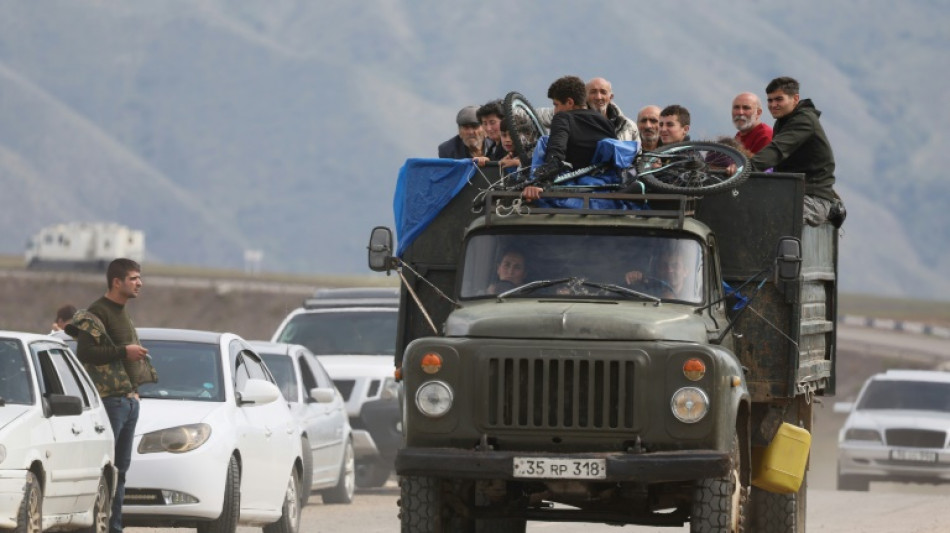
Uncertain future for tens of thousands fleeing Nagorno-Karabakh / Photo: Alain JOCARD - AFP

 Malaysia Sues Google for $146m Over Harmful Content

 Black Wind Turbine Blades Reduce Bird Deaths by 74% in Spain Study

 Brazil’s Landless Movement Partners with China to Build Affordable Tractors for Family Farms

 Twickenham Grounds Team Prepares Pitch for Six Matches in Three Days

 Luxembourg Pay Rise Delayed as Regional and World Headlines Develop

 Audience to Choose the Set List at Luxembourg's First FAMIL Jukebox Night

 Raheem Sterling Receives Suspended Sentence After Lamborghini Crash

 Black Friday Discounts Cut Prices on Two Top-Rated Wiper Blades

 Arizona Gun Regulation Battle Intensifies Under New Democratic Legislative Majority
A continuous stream of vehicles crept along the only road out of Nagorno-Karabakh towards Armenia, carrying tens of thousands of refugees now faced with an uncertain future.
Cars were laden down with belongings reminiscent of a former life in the impoverished and historically disputed region, with roofs piled high with blankets, bags and children's toys.
"I left my house to stay alive," said one woman who made the journey along the mountainous Lachin Corridor. "Let the world know that we are homeless dogs from now on!"
More than 19,000 Armenian refugees have now fled Nagorno-Karabakh after Baku claimed control of the separatist statelet in a lightning offensive last week.
Most of those crossing the border were women, children and the elderly.
Many said it took them 24 hours to cover the 80 kilometres (50 miles) between the rebel stronghold of Stepanakert and the border.
Nagorno-Karabakh has been under an Azerbaijani blockade for months, meaning that many were forced to make the journey with little food or water.
As they approached the last Azerbaijani border post, the few Armenian men making the crossing were asked to get out of their vehicles and stare into an identification camera.
An Azerbaijani government source told AFP the process was intended to spot possible perpetrators of "war crimes".
"Azerbaijan intends to apply an amnesty to Armenian fighters who laid down their arms in Karabakh," the source said. "But those who committed war crimes during the Karabakh wars must be handed over to us."
After identification, the men then had to walk the final few metres to the Armenian border.
"They've expelled us," said one man as he walked past Azerbaijani soldiers.
-'Already seen so much'-
At the border crossing, some refugees described how they had been ordered to leave and were already longing to return to Nagorno-Karabakh.
"The Armenians told us to leave. I'm going to Yerevan, I have children there. But I want to take them and go home," said 83-year-old Hrant Haroutounian, clutching his Armenian passport.
Several men said they had been urged to leave by Armenian soldiers before Azerbaijani forces reached their towns or villages.
Five kilometres away in the Armenian village of Kornidzor, Sveta Moussaielian was sat in the house of a friend she met back in 2020, when she had taken refuge during previous fighting between Armenian and Azerbaijani forces.
At 50, this was the fourth time she had been forcibly displaced.
"I'm not that old, but I've already seen so much," she said.
Moussaielian described how out of five sisters, four were war widows. Her two sons were soldiers and were in the process of leaving Nagorno-Karabakh.
"Losing my country, my home, it's not serious," she said. "It's for the victims that I cry."
-Uncertain future-
Further along the road, hundreds of cars were haphazardly parked as Armenians came to fetch their loved ones.
"I'm waiting for my sister's family. They've been on the road since yesterday," said 36-year-old Artak Soghomonian.
He said his brother also wanted to leave Stepanakert but he was looking for petrol and hadn’t managed to leave.
A massive explosion at a fuel depot in the rebel stronghold on Monday evening killed 20 people and injured more than 200.
Most of the victims were stocking up on fuel for the trip to the Armenian border.
On the road leading from Kornidzor to the nearby town of Goris, refugees refuelled and carried out repairs to their vehicles.
Many of the drivers flagged down Armenian policemen to ask for directions to the town of 20,000 people, before heading on their way towards an uncertain future.
X.Brito--PC

