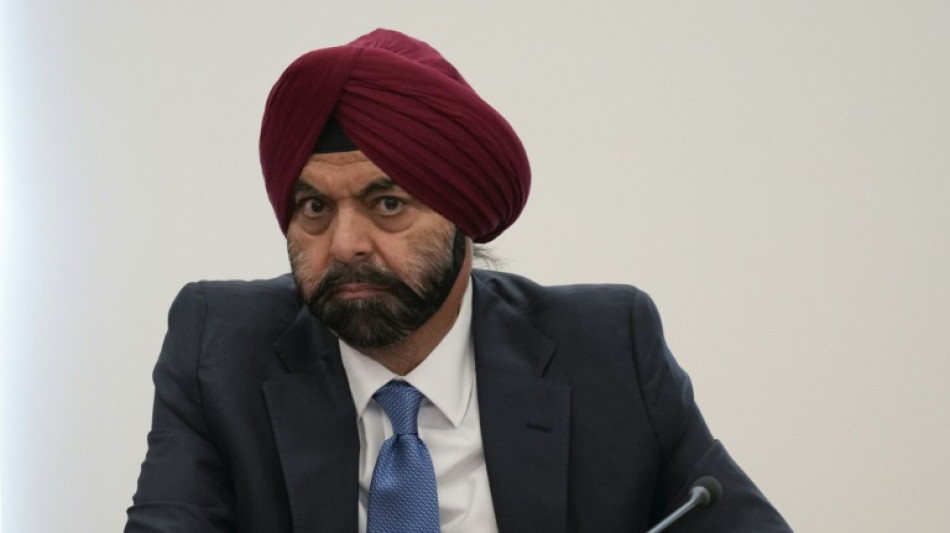
World Bank chief pledges to reform 'dysfunctional' development lender / Photo: Seth Wenig - POOL/AFP

 Malaysia Sues Google for $146m Over Harmful Content

 Black Wind Turbine Blades Reduce Bird Deaths by 74% in Spain Study

 Brazil’s Landless Movement Partners with China to Build Affordable Tractors for Family Farms

 Twickenham Grounds Team Prepares Pitch for Six Matches in Three Days

 Luxembourg Pay Rise Delayed as Regional and World Headlines Develop

 Audience to Choose the Set List at Luxembourg's First FAMIL Jukebox Night

 Raheem Sterling Receives Suspended Sentence After Lamborghini Crash

 Black Friday Discounts Cut Prices on Two Top-Rated Wiper Blades

 Arizona Gun Regulation Battle Intensifies Under New Democratic Legislative Majority
World Bank President Ajay Banga said Tuesday that he is working to reform the "dysfunctional" development lender, and pledged to refocus its mission to better address the challenges posed by climate change.
The former Mastercard chief executive told the Council on Foreign Relations in New York that the bank should alter its current twin mandate of poverty alleviation and boosting shared prosperity to include climate change.
"I think the twin goals have to change to being elimination of poverty, but on a livable planet, because of the intertwined nature of our crises," he said.
He added that he was working to redefine the World Bank's business around what he called five key "verticals": people, prosperity, planet, infrastructure and digital.
- Fixing the plumbing -
Banga, an Indian-born naturalized US citizen, was nominated to lead the World Bank earlier this year by President Joe Biden, and began his new role in June.
The bank has historically been led by an American, while the IMF has been run by a European -- a controversial arrangement that has existed since the two institutions were founded in the aftermath of the second World War.
Banga has already made a number of changes to the bank's management since taking over, setting up a new 15-person private sector advisory board, and pledging deeper cooperation with regional development banks to tackle shared challenges.
On Tuesday, Banga vowed to "fix the plumbing" at the bank, which he called a "dysfunctional" institution.
"I want people to say when I’m gone that I left the bank working much better than when I got it, because then my successor will not have to deal with what I’m dealing with," he said.
- Climate change -
Proposals to reform the World Bank's balance sheet from countries including the US and Saudi Arabia could add as much as $125 billion in extra lending capacity if they come to pass, Banga told the audience in New York.
This would be a significant increase for the development lender, which mobilized just over $100 billion in financing last year.
Banga has previously called on the World Bank to collaborate more closely with the private sector to meet the enormous costs associated with climate change mitigation and adaptation.
On Tuesday, Banga said the bank should carefully target where it wants to encourage private investment to help cap carbon emissions in order to have the biggest impact.
"We need to focus on 10 countries where the growth of emissions will be so high if we don't change to renewables that all the work we do in the developed world to reduce the use of emission-heavy energy will be lost," he said, without naming them.
These middle-income countries are states "where there is some hope for the private sector, both in terms of scalable models and the like, that renewable energy could make money," he added.
In order to invite the private sector to participate, the World Bank should offer to manage some of the political risks associated with climate-related investments in these countries, along with the risk of currency fluctuations, Banga said.
The World Bank group already has a political risk agency, but the foreign exchange risk is an issue that still needs to be resolved, he told the audience in New York.
"That's the way to involve the private sector," he added.
L.Mesquita--PC

