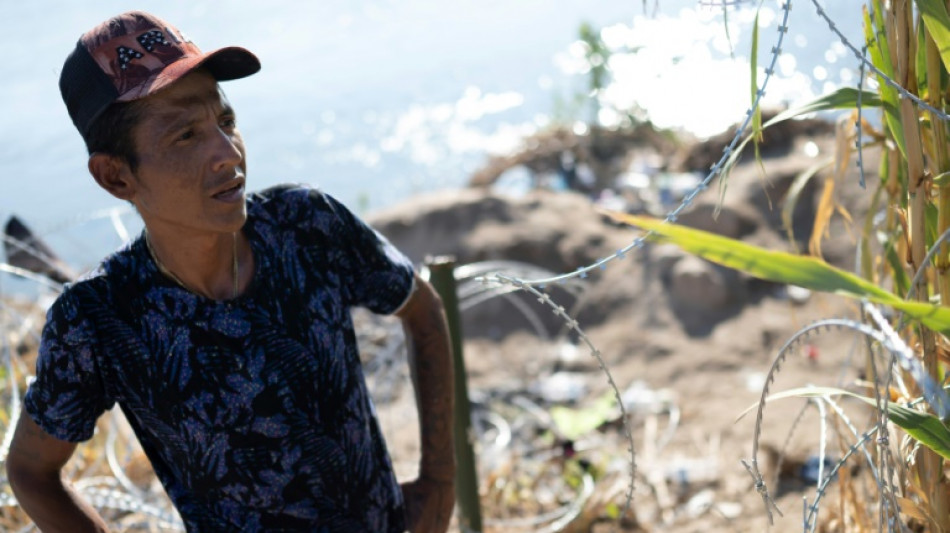
Foragers and popsicle sellers: a micro-economy among US migrants / Photo: ANDREW CABALLERO-REYNOLDS - AFP

 #IAmJaneDoe: online support campaign in US university rape case

 Brazil shine on Selecao's first visit to India

 Zverev sets up Djokovic quarter-final at China Open, Rybakina out

 Happier at home, Bordeaux hammer Lyon in Top 14

 Lula, Bolsonaro in final push for votes ahead of knife-edge election

 Boisterous fashion week barnstorms 'sleepy' Nigerian capital

 UAE investigators say flydubai co-pilot was planning 'terrorist act'

 Rahul smacks century in India v Windies ODI

 Daryz seeks to join exclusive club of dual Arc winners

 Russia warns diplomats to leave Kyiv over new strikes threat

 Olympic champ Zheng rebukes rowdy home crowd at China Open

 World No.1 Sinner pulls out of Shanghai Masters to delay return

 Red Bull's Verstappen grabs pole position for Bahrain GP

 India beat Pakistan in blockbuster as golfer Kim wins 'crazy' gold

 India beat arch-rivals Pakistan to win Asian Games cricket gold

 Ethiopia's Tigray rebels abandon regional capital as govt advances: journalist

 Tom Kim powers to Games gold and exemption from military service

 Split loyalties for Indian football fans at Brazil friendly

 India-Pakistan blockbuster brings cricket fever to Japan baseball field

 Wong waiting on Rafa after winning Asian Games tennis gold

 With Russia next door and rising costs, Latvia goes to the polls

 Penalty hero rues empty seats as Games hosts Japan win football gold

 North Korea fires ballistic missile after Seoul's apology demand

 US regulator finds Boeing 737 MAX software bug 'not a safety concern'

 Ohtani 'managing' injuries as Dodgers launch MLB post-season

Marco Gonzalez used to fish the river between Mexico and Texas, but now he has a more lucrative harvest -- possessions abandoned by the thousands of migrants crossing the border from the south.
Crowds of people reach the border every day, after long, dangerous and difficult journeys from Africa, Asia or South America.
Their discarded backpacks, clothes or blankets sustain a cottage industry of foragers, part of a micro-economy that feeds off the stream of humanity desperate to get into the United States.
"Once, when I was fishing, I found $100 in a bag, and so I started coming here," 37-year-old Gonzalez told AFP on the banks of the Rio Grande.
"And since now there's a ton of clothes here all over... I thought, I'm staying."
- 1.8 million -
In the last 11 months, at least 1.8 million people have reached the southern US border, many of them searching for safety and economic opportunity they could not find in their own countries.
The soaring numbers are a political headache for President Joe Biden, whose Republican opponents are hammering the issue, a year out from an election.
Thousands enter the country illegally every day, some swimming across the perilous waters of the Rio Grande. As they do, they often abandon possessions that weigh them down.
"I only kept my papers and some shoes," Venezuelan Francis Ibarra told AFP.
"I left the clothes from the river there because they were all wet."
For officers patrolling the US side of the banks and islands on the Rio Grande, the scavenging is now just part of the daily landscape.
"It's become a way of life for people who live on the border," one Texas National Guardsman told AFP, on condition of anonymity because he was not authorized to speak to the media.
"You see them in cities -- they come to look for things to sell or exchange. Some make a living from it; others do it to help migrants."
Clothes and bags dot the island that lies halfway between the Mexican city of Piedras Negras and Eagle Pass in Texas, cast off by people who stopped to rest after their first dash into the current.
As an AFP team watched, a man and two children picked through the detritus, looking for anything worth having.
Even more accumulates on the US side of the river, where migrants believe they will be ordered to leave their possessions if they meet Customs and Border Protection officers on the other side of the razor wire.
For Gonzalez, it is here that offers the richest pickings.
What he gathers, he can give to an NGO that helps migrants in Piedras Negras.
"The woman there, since she already knows me, gives me a good meal, rice, beans, oil, and toilet paper," he said.
More enterprising still is Sixto Gomez, who used to sell popsicles in Piedras Negras, but now plies his trade on the river.
"I sell more here than in the city, and no one bothers me, who is going to come here?" he asks.
On the island in the middle of the river he asks 15 pesos (85 US cents) for a popsicle, but on Sunday when a logjam formed at the razor wire, he crossed to the US bank to peddle his wares -- and raised his price to 20 pesos.
"Here it is more expensive," he told AFP. "This is America."
E.Borba--PC