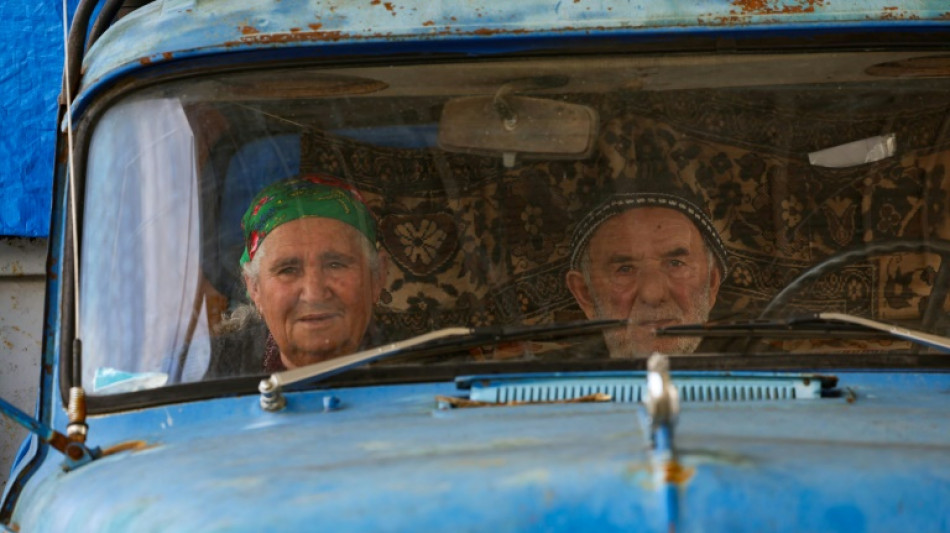
Armenia and Azerbaijan: ex-Soviet neighbours and enemies / Photo: EMMANUEL DUNAND - AFP

 Malaysia Sues Google for $146m Over Harmful Content

 Black Wind Turbine Blades Reduce Bird Deaths by 74% in Spain Study

 Brazil’s Landless Movement Partners with China to Build Affordable Tractors for Family Farms

 Twickenham Grounds Team Prepares Pitch for Six Matches in Three Days

 Luxembourg Pay Rise Delayed as Regional and World Headlines Develop

 Audience to Choose the Set List at Luxembourg's First FAMIL Jukebox Night

 Raheem Sterling Receives Suspended Sentence After Lamborghini Crash

 Black Friday Discounts Cut Prices on Two Top-Rated Wiper Blades

 Arizona Gun Regulation Battle Intensifies Under New Democratic Legislative Majority
The fate of the breakaway region of Nagorno-Karabakh has poisoned relations between fellow ex-Soviet neighbours Armenia and Azerbaijan since the 1990s.
Armenia supported the bid by the region's ethnic Armenian majority to win independence from Azerbaijan -- a three-decade quest that ended last week in a lightning offensive by Baku.
Here are some key differences between the Caucasus rivals:
- Revolts vs dynasty -
Armenia, a predominantly Christian country, has been rocked by political and economic instability since it gained independence from the Soviet Union.
The country's post-Soviet leadership repressed opposition to its rule and was largely beholden to the interests of Russia.
Street protests in 2018 brought current Prime Minister Nikol Pashinyan to power.
He cracked down on corruption but infuriated Armenians by agreeing in 2020 to return parts of Nagorno-Karabakh that had been in the hands of ethnic Armenian separatists since the early 1990s.
Azerbaijan, a predominantly Muslim country with a secular tradition, has been under the authoritarian grip of a single family since 1993.
Heydar Aliyev, a former officer of the Soviet's KGB security services, ruled the oil-rich country until October 2003.
He handed over power to his son, Ilham, weeks before his death.
Like his father, Ilham has quashed all opposition to his rule but Azerbaijan's victory over Armenia in the 2020 Karabakh war boosted his popularity.
- Turkey vs Russia -
Turkey, with ambitions to be a regional power broker in the Caucasus, has thrown its weight behind historical ally Azerbaijan.
Their alliance is fuelled by a mutual mistrust of Armenia, which harbours hostility towards Ankara over the killings of some 1.5 million Armenians by Turkey during the dying days of the Ottoman Empire.
More than 30 countries have recognised the killings as genocide, though Ankara fiercely disputes the term.
Russia, which maintains close ties with Armenia, is the major power broker in the region. After the 2020 war, Moscow deployed 2,000 peacekeepers to Nagorno-Karabakh.
Yerevan relies on Russian support and military guarantees because its own defence budget is overshadowed by Azerbaijan's spending on arms.
But bogged down in its Ukraine war, Russia is losing its influence in the post-Soviet space -- and Moscow's failure to help Yerevan in the face of the Azerbaijani threat has fuelled anti-Russian sentiment among Armenians.
- Oil vs celebs -
Azerbaijan has in recent years used its oil wealth to try to boost its standing on the world stage.
It has invested in massive sponsorship deals including the UEFA Euro 2020 football championship, in which it hosted games.
Azerbaijan has also cashed in on the war in Ukraine to try to replace Russia as a major supplier of gas to Europe.
Armenia, for its part, has a vast and influential diaspora that fled during the Ottoman-era repressions.
Reality TV star Kim Kardashian, the late singer Charles Aznavour, and pop star and actress Cher all trace their roots to Armenia.
V.Dantas--PC

