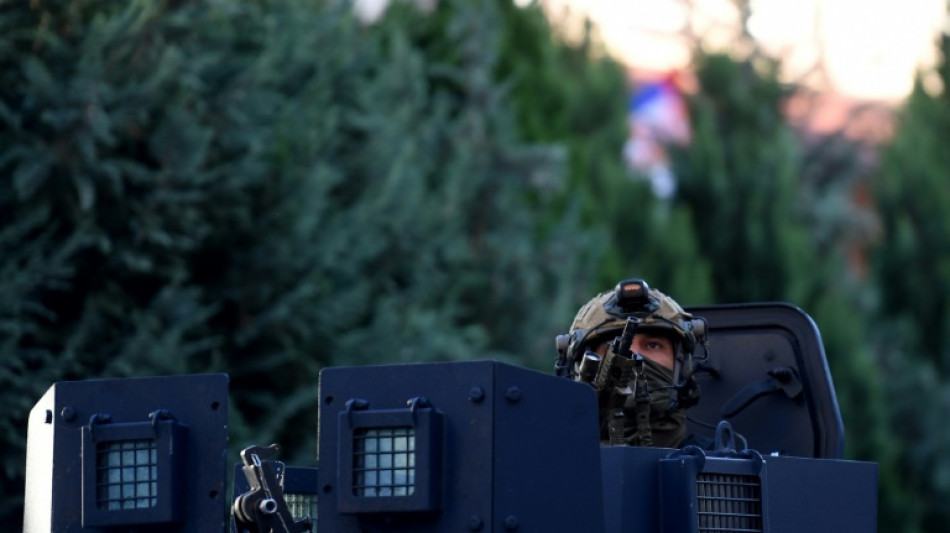
US warns of large Serbian military build-up near Kosovo / Photo: STRINGER - AFP

 Filmasia 2026: 16 Films Across Prague, Brno, and České Budějovice

 Kojey Radical Launches Burger Collaboration at Dallas Burger Joint in Shoreditch

 Kelly Stafford Reflects on Matthew's Lions Thanksgiving Era Ahead of Rams' Netflix Debut

 World Experiences First Six Consecutive Days Above 2C Preindustrial Threshold

 Luxembourg Housing Petition Passes Threshold for Parliamentary Consideration

 Raheem Sterling Receives Suspended Sentence After Lamborghini Crash

 Audience to Choose the Set List at Luxembourg's First FAMIL Jukebox Night

 Luxembourg Pay Rise Delayed as Regional and World Headlines Develop

The United States called on Belgrade to pull its forces back from the border with Kosovo on Friday after detecting what it called an unprecedented Serbian military build-up.
Serbia had deployed sophisticated tanks and artillery on the frontier after deadly clashes erupted at a monastery in northern Kosovo last week, the White House warned.
The violence in which a Kosovo policeman and three Serb gunmen were killed marked one of the gravest escalations for years in Kosovo, a former Serbian breakaway province.
"We are monitoring a large Serbian military deployment along the border with Kosovo," White House National Security Council spokesman John Kirby told reporters.
"That includes an unprecedented staging of advanced Serbian artillery, tanks, mechanized infantry units. We believe that this is a very destabilizing development."
He added: "We are calling on Serbia to withdraw those forces from the border."
The build up had happened within the last week but its purpose was not yet clear, Kirby said.
US Secretary of State Antony Blinken had telephoned Serbian President Aleksandar Vucic to urge "immediate deescalation and a return to dialogue," he added.
And National Security Advisor Jake Sullivan spoke to Kosovo's prime minister.
Serbia's leader Vucic did not directly deny there had been a recent build-up but rejected claims that his country's forces were on alert.
"I have denied untruths where they talk about the highest level of combat readiness of our forces, because I simply did not sign that and it is not accurate," Vucic told reporters.
"We don’t even have half the troops we had two or three months ago."
- 'Worrisome' -
Serbia said on Wednesday that the defense minister and head of the armed forces had gone to visit a "deployment zone" but gave no further details.
The clashes on Sunday began when heavily armed Serb gunmen ambushed a patrol a few miles (kilometres) from the Serbian border, killing a Kosovo police officer.
Several dozen assailants then barricaded themselves at an Orthodox monastery, sparking an hour-long firefight in which three gunmen were killed and three were arrested.
Kosovo's government has accused Belgrade of backing the entire operation, while a member of a major Kosovo Serb political party admitted to leading the gunmen, his lawyer said Friday.
Kirby said the attack had a "very high level of sophistication", involving around 20 vehicles, "military-grade" weapons, equipment and training.
"It's worrisome. It doesn't look like just a bunch of guys who got together to do this," he said.
NATO would be "increasing its presence" of its peacekeeping force known as KFOR following the attack, Kirby added.
In Brussels, NATO chief Jens Stoltenberg confirmed that the US-led alliance was ready to boost the force to deal with the situation.
Kosovo broke away from Serbia in a bloody war in 1998-9 and declared independence in 2008 -- a status Belgrade and Moscow have refused to recognise.
It has long seen strained relations between its ethnic Albianian majority and Serb minority, which have escalated in recent months in northern Kosovo.
Ferreira--PC


