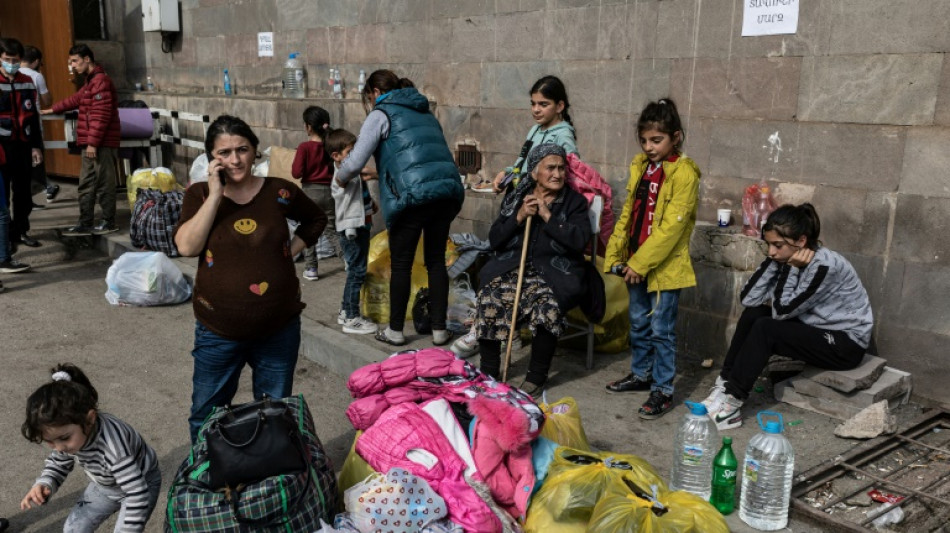
'How can we live with them?' Terrified Armenians flee Karabakh / Photo: Diego Herrera Carcedo - AFP

 Filmasia 2026: 16 Films Across Prague, Brno, and České Budějovice

 Kojey Radical Launches Burger Collaboration at Dallas Burger Joint in Shoreditch

 Kelly Stafford Reflects on Matthew's Lions Thanksgiving Era Ahead of Rams' Netflix Debut

 World Experiences First Six Consecutive Days Above 2C Preindustrial Threshold

 Luxembourg Housing Petition Passes Threshold for Parliamentary Consideration

 Raheem Sterling Receives Suspended Sentence After Lamborghini Crash

 Audience to Choose the Set List at Luxembourg's First FAMIL Jukebox Night

 Luxembourg Pay Rise Delayed as Regional and World Headlines Develop

Since Azerbaijan's army overran the Nagorno Karabakh enclave in a lightning offensive last week, nearly 90 percent of the region's ethnic Armenian population have fled out of fear of the victorious force.
Ofelya Hayrapetyan didn't hesitate for a second when her son managed to reach Khachmach village and confirmed Karabakh's border with Armenia had opened.
"I just took my jewellery. Women, children and the elderly, everyone left in the first vehicle they could find," she said as she rested in Vayk.
In the Armenian town on the road to Yerevan, the authorities have set up a reception centre to relieve congestion in the border town of Goris.
Removed from Nagorno Karabakh, the atmosphere seemed calmer -- but refugees were unified in their revulsion at the Azerbaijani takeover.
"They are cruel! I don't want to live with those dogs," said Ofelya Hayrapetyan.
"It's genocide pure and simple," her husband added.
Sitting nearby, Spartak Harutyunyan played with his ten-month-old baby.
"The 'Turks' say we can stay, but they always lie. How can we live with them?" he said, using a derogatory shorthand for Azerbaijani forces.
By Saturday evening, separatist Karabakh was almost entirely deserted by its inhabitants.
According to a count by the Armenian authorities, 100,417 people have entered Armenia since September 24.
According to official figures, 120,000 Armenians lived in Nagorno-Karabakh before the Azerbaijani lightning offensive of September 19 and 20.
- Widespread rumours -
They arrived after fleeing, often without even having taken the time to pack a suitcase.
"A woman from the village stayed behind and they slit her throat," says Hayrepetian, recounting an anecdote from two separatist soldiers.
Steps away, Alina Alaverdyan, 69, grimaces as she mentions the rumour "of the rape of the daughter-in-law" of an acquaintance.
"The kind of things that get into your mind," she says.
"They're not human. They're dogs."
Every family in Nagorno-Karabakh has heard such rumours, impossible to confirm and almost always obtained second-hand.
There are numerous accounts of babies being decapitated or young women being raped.
Yet most of the refugees admit that they did not encounter any Azerbaijani soldiers before fleeing.
According to the testimonies gathered by AFP, Baku's army generally did not enter towns and villages, confining itself to the strategic heights and roads.
An exodus followed, sometimes spontaneously and sometimes at the instigation of local authorities.
"We were told to leave and in 15 minutes it was done," says Marine Poghosyan, 58, insisting they would not return to Karabakh under any circumstance.
"I'd rather live here in a tent than go back there."
- Serial bloodshed -
A territory of less than 3,200 square kilometres -- a little larger than Luxembourg -- Karabakh has suffered four conflicts in recent history.
The first, between Armenia and Azerbaijan lasted from 1988 to 1994, and resulted in 30,000 deaths and the exodus of hundreds of thousands of Azerbaijanis and Armenians.
That was followed by numerous outbreaks of violence and wars in 2016, and then in 2020 when 6,500 died in six weeks and Armenia suffered a crushing defeat -- and now the brief war in 2023.
Each refugee spoke of having lost at least one brother, son or husband in combat.
Images of alleged war crimes and atrocities, for which each side blamed the other, have begun to spread online.
"We talk about all this amongst ourselves. We're going out of our minds," said Alina Alaverdyan, a former military caterer who recalled that in Soviet times, "the Azerbaijanis were nice".
"There will always be wars, sometimes overt, sometimes covert."
A.Magalhes--PC


