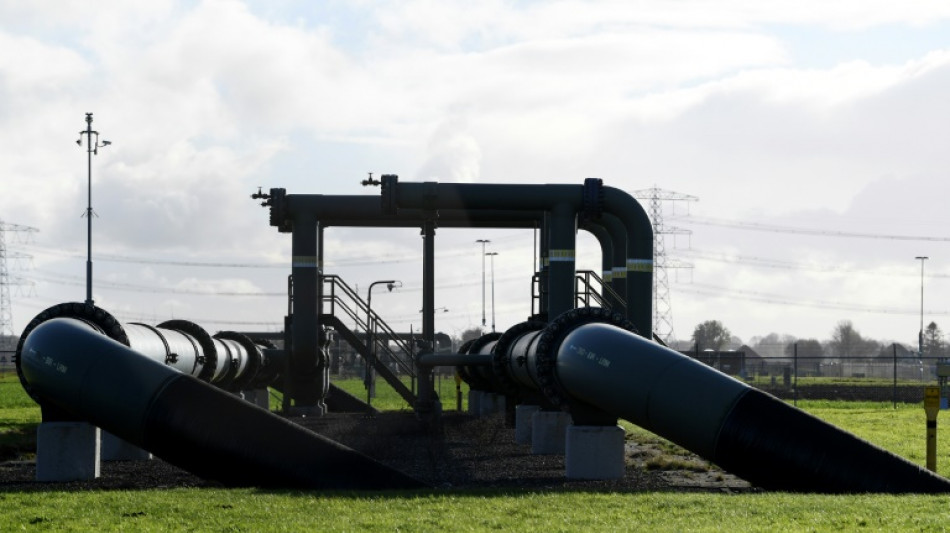
Netherlands halts extraction from Europe's biggest gas field / Photo: JOHN THYS - AFP

 Filmasia 2026: 16 Films Across Prague, Brno, and České Budějovice

 Kojey Radical Launches Burger Collaboration at Dallas Burger Joint in Shoreditch

 Kelly Stafford Reflects on Matthew's Lions Thanksgiving Era Ahead of Rams' Netflix Debut

 World Experiences First Six Consecutive Days Above 2C Preindustrial Threshold

 Luxembourg Housing Petition Passes Threshold for Parliamentary Consideration

 Raheem Sterling Receives Suspended Sentence After Lamborghini Crash

 Audience to Choose the Set List at Luxembourg's First FAMIL Jukebox Night

 Luxembourg Pay Rise Delayed as Regional and World Headlines Develop

The Netherlands halted extraction from Europe's biggest gas field on Sunday, which was resulting in earthquakes that have shaken local residents for decades and threaten to persist.
Authorities are keeping 11 extraction wells open at the Groningen gas field for another year, however, in case of a severe winter, before shutting its gates for good against a backdrop of geopolitical tensions.
People living near the site, which opened in the early 1960s, have complained for more than 20 years of being terrorised by quakes directly attributed to drilling operations.
The local population had been experiencing low-magnitude, near-surface quakes caused by vacuum pockets formed during gas extraction, which caused widespread damage to homes and other buildings.
Residents welcomed the news in 2018 that the field would be closed, but have been warned by experts that the earthquakes could continue for years.
Although gas extraction from the field has been almost cut to zero over the last few years, the government kept the site operational due to the global energy uncertainties prompted largely by Russia's invasion of Ukraine in February 2022.
"An enormous number of people in the province are suffering psychological problems due to the extraction of gas," Jan Wigboldus, president of an association representing local people, told AFP.
Many have also been caught in bureaucracy, receiving only a trickle of compensation.
A report by a parliamentary commission in February accused the Dutch authorities of having paid "barely any attention to the long-term risks" while extraction was successful, adding that the government had a moral obligation to remedy the situation.
Around 2,300 billion cubic metres (81,223 billion cubic feet) of gas have been extracted from the field over the years, according to Shell.
Groningen gas generated some 429 billion euros ($450 billion), adjusted for inflation, between 1963 and 2020, 85 percent of which went into state coffers.
For months, mountains of debris of old pipes have littered the site from sections of the field already dismantled.
Many houses in the Groningen area have now been renovated or rebuilt to incorporate earthquake-resistant structures.
Dutch Prime Minister Mark Rutte said on Friday during a visit to the site that there were tens of thousands of children living in a terrible situation in the region, according to Dutch agency ANP.
H.Silva--PC


