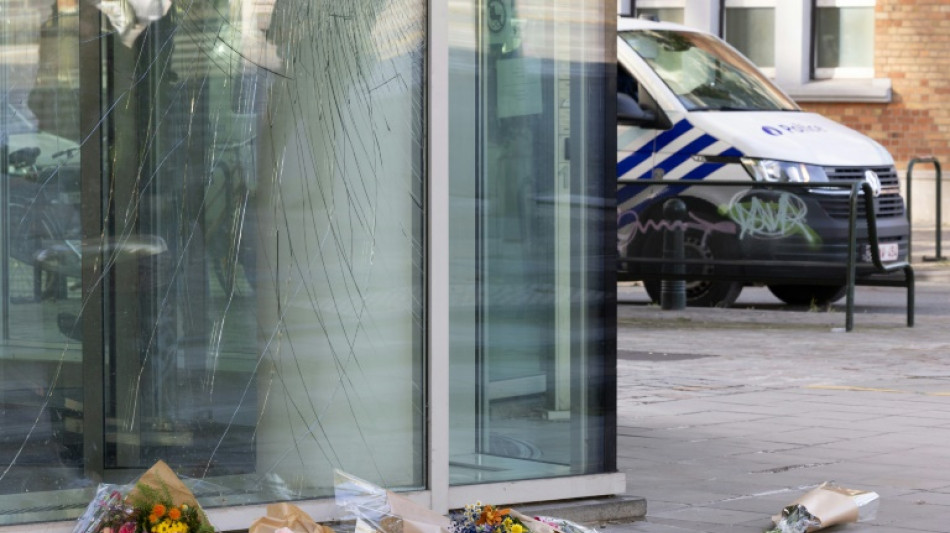
Deadly attacks put response of Europe's spies under spotlight / Photo: BENOIT DOPPAGNE - Belga/AFP

 'Act before it's too late': Tokyo residents fight for more trees

 'Disappointing' as South Korea flag mishap sees Games end on sour note

 Pre-COP host Tuvalu at frontline of climate change

 Hungary's dwindling paprika producers battle to save signature spice
 Cornell president vows review in wake of alleged student gang rape
 Latvian partial election results suggest pro-European choice
 In Egypt's Sinai, Gazan builds school for children displaced by war

 Trump tariffs a mixed bag for US auto industry

 Yemen government forces say struck Houthi targets

 Music links past, present for Pedro Pascal's cellist in 'Behemoth!'
 ALEX BODI ȘI AMBASADORUL REPUBLICII SUDANUL DE SUD, GUM DOMINIC MATIOK, DISCUTĂ LA BERLIN DESPRE POSIBILITATEA ÎNFIINȚĂRII UNUI CONSULAT ONORIFIC LA BUCUREȘTI

 Dodgers step up World Series three-peat bid with 5-3 win over Braves

 Spain break down Czechs as England outclass Croatia in Nations League

 Yamal on target as Spain hold off Czech Republic

 Latvian exit polls suggest pro-European choice

 Lula, Bolsonaro wrap up campaigns ahead of knife-edge election

 Tuchel hails 'complete' England after Croatia demolition

 Fury to invite Trump to lead ring walk before Joshua showdown

 Fashion industry in 'precarious moment', says Vivienne Westwood supremo

 Seventh heaven for England in Nations League rout of Croatia

 Storms, flooding cause chaos on Greek holiday island of Crete

 #IAmJaneDoe: online support campaign in US university rape case

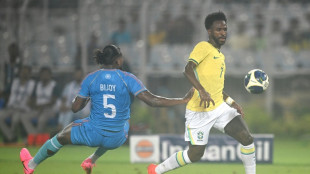 Brazil shine on Selecao's first visit to India
 Zverev sets up Djokovic quarter-final at China Open, Rybakina out
 Happier at home, Bordeaux hammer Lyon in Top 14
Two attacks in recent days in Belgium and France have come against a backdrop of tension in European societies over the war between Israel and Hamas, posing serious challenges for Europe's intelligence services.
First a schoolteacher was stabbed to death in northern France, with the attacker claiming the act in the name of the Islamic State extremist group.
Then, days later, two Swedes were killed in Belgium, prompting Swedish Prime Minister Ulf Kristersson to label it a terror attack and say his country was facing its biggest threat in modern times.
The country has sparked a wave of anger from Muslim countries after allowing protesters to burn copies of the Koran, Islam's holy book.
Analysts are warning that intelligence services now have their work cut out.
"It is likely that these attacks will be followed by several more as a snowball effect," said Tore Hamming, an analyst at the International Centre for the Study of Radicalisation in London.
"So far, all attacks appear to have been carried out by a single perpetrator and lacking sophistication. That could change, however."
- Germany arrests -
Each attack is all the more impactful because of the images posted on social media and the praise from sympathisers.
Hans-Jakob Schindler, director of the Counter Extremism Project NGO, pointed out that violence online can lead to violence on the streets.
He said Sweden was the focus of an online campaign by Islamists that was intensifying risks for the Nordic country.
The German authorities arrested two brothers from Syria in April, the eldest of whom had allegedly planned to "carry out an attack on a church in Sweden where many people (were) assembled".
"This demonstrates that this ongoing Islamist online campaign against Sweden has effects and motivates individuals towards violence," he said, pointing out that the Israel-Hamas conflict could have a similar effect.
Europe is not alone in facing such threats.
Last week, an employee of the Israeli embassy in China was assaulted in Beijing. A foreign suspect was arrested and authorities have not said anything about the case since.
On Sunday, a 71-year-old man stabbed a Muslim woman and a six-year-old boy near Chicago in the United States, an attack police said was linked to the Israel-Hamas conflict.
- 'Moment of reconfiguration' -
Schindler highlighted that Europe had a solid infrastructure in place to keep each other's agencies in the loop.
EUROJUST, the European Union Agency for Criminal Justice Cooperation, looks after the judicial side and EUROPOL the police side.
In theory, this allows a quick transfer of information around the bloc and a coordinated approach.
On Tuesday, though, European countries were applying their own criteria to the threat level.
Sweden and France are both on high alert.
Italy said it had "strengthened preventive measures" following the events in Israel, without elaborating.
In Denmark and Spain, the threat level has not been changed, official sources told AFP, but Spanish police said they had increased their presence "near places of interest such as synagogues".
A European judge, who spoke to AFP on condition of anonymity, said one-off cases generally led to a "fluid exchange of details in real-time" between EU countries.
But the judge warned that intelligence agencies were not overly keen to share widely, saying it was "often done bilaterally".
Among the biggest concerns, she said, were the Europeans who left to join the Islamic State group in Syria and Iraq in 2014.
Although they were convicted on their return, many have now served their sentences and intelligence agencies are worried they are re-forming old networks.
"It feels like a moment of reconfiguration," she said.
N.Esteves--PC