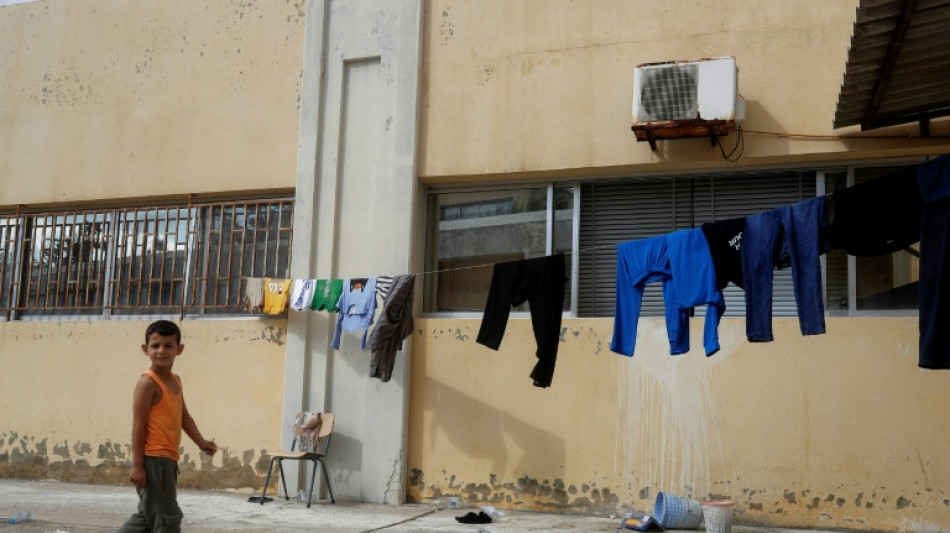
Fleeing Israel strikes, south Lebanon families move into schools / Photo: Mahmoud ZAYYAT - AFP

 Asian Games set to close after records, rancour and rain

 Cry for help as French-Swiss lake dries up

 Sabalenka swept out of China Open in third round

 US urges 'restraint' as Ethiopia's Tigray crisis rocks region

 Teens on target again as USA down Mexico 3-0

 World records prove Asian Games were a hit, says top official

 US prison chief who oversaw botched execution resigns

 'Chaotic' Asian Games threaten Japan hopes of hosting Olympics again

 Finnish town braces for change from Google data centres

 What is fuelling French school protests?

 Without lawyers, migrant children face deportation from the US
 Three-peat seeking Dodgers open playoffs with a win, Rays hold off Yankees

 Brazil votes in nail-biter polls closely watched by Trump
 'Just be you': Kim reveals Tiger text that inspired him to gold

 Myanmar migrants returned to war-torn nation from Malaysia

 ALEX BODI AND AMBASSADOR GUM DOMINIC MATIOK OF THE REPUBLIC OF SOUTH SUDAN MEET IN BERLIN TO DISCUSS THE POSSIBILITY OF AN HONORARY CONSULATE IN BUCHAREST

 Lula, Bolsonaro wrap up campaigns ahead of Brazil's knife-edge vote

 Toulouse edge Castres in Top 14 derby

 Murakami homer propels White Sox to MLB playoff win over Guardians

 Israel targets top Hamas leader in deadly Gaza strike on anniversary

 Houthis say struck oil facility near Riyadh, as Saudis hit Sanaa

 AI needs safety layers like nuclear plants: ex-OpenAI engineer

 MVP Judge will miss Yankees' MLB playoff series against Rays

 New lizard species discovered in Peru

 Fernandes hails Portugal's 'greatest symbol' Ronaldo, calls for unity

Shocked by images of dead children in Gaza, Mustafa al-Sayyid quickly whisked his family to the closest shelter when Israeli strikes began near his village in southern Lebanon this week.
"What we are seeing on television -- the massacres happening in Gaza, the children -- it cuts your heart to pieces," said the 53-year-old from Beit Lif, barely six kilometres (3.7 miles) from the Israeli border.
"If I wasn't afraid this would happen to us, I wouldn't have left my home," said Sayyid, who has two wives and 11 children, around half of whom are under 10.
The family is among nearly 4,000 people who have fled flashpoint areas near the Israeli frontier and flocked to the southern city of Tyre, according to local officials.
Around half are staying in three public schools that have been converted into makeshift shelters, while the rest hunker down with relatives or friends.
The scale of displacement has gradually swelled since the Palestinian militant group Hamas launched a massive October 7 assault on southern Israel, killing at least 1,400 people, mostly civilians, and kidnapping more than 200 in the deadliest attack in Israel's history.
Since then, some 4,385 Palestinians, mainly civilians, have been killed in relentless Israeli bombardments, according to Gaza's Hamas-run health ministry.
The tensions have spread to the Lebanese-Israeli border, where near-daily tit-for-tat attacks have emptied out entire villages.
At least 22 people, including four civilians, have been killed on the Lebanese side, according to an AFP tally. And at least three soldiers and one civilian have died in Israel.
Sayyid, whose brother was killed in the 2006 war between Israel and Hezbollah, said he wants to avoid any more family deaths.
"All my children are young. If the apocalypse comes, how will I get them all out in one go?" he wondered inside a classroom stripped of desks and dotted with thin mattresses.
"So I thought, better to leave now."
- 'Shelters at full capacity' -
Fears of a spillover loom large in Lebanon's border villages, which were occupied by Israeli forces for 22 years before their withdrawal in 2000.
A steady stream of families, mostly from the pummelled village of Aita al-Shaab, queued at the Tyre municipality this week to secure a spot in one of the classrooms.
"We have reached full capacity in all of our shelters," said Tyre mayor Hassan Dbouk. "Now we are looking for a place to open a fourth centre."
In the border village of Dhayra, farms and olive groves have been abandoned at the height of the harvest season.
Farmers already crushed by a four-year-long economic crisis in Lebanon are bracing for an uncertain fate -- even if the fighting abruptly stops.
"Everyone in Dhayra relies on farming. We have nothing but God and agriculture," said Mussa Suwaid, 47, speaking outside the Tyre shelter where he has been staying for a week.
"I have five sheep, each worth around $500. I left them without food and ran away," he added.
He also was forced to leave behind his 88-year-old father and his cow.
"He told me he would rather die than abandon the cow and his home," Suwaid said.
- 'Sadness underneath' -
Ravaged by an economic crisis that has been widely blamed on official corruption and ineptitude, Lebanon has not implemented an evacuation plan.
Instead, the villagers have left under their own steam, strapping bags to motorcycles or hitching rides with neighbours.
Yulla Suwaid, unrelated to Mussa, said she waited for two hours in a pool of her own blood before her brother came to save her during an Israeli bombardment that destroyed their Dhayra home last Wednesday.
The 43-year-old school teacher was running down the stairs when the strike sent part of the wall crashing down on her legs, leaving her badly wounded.
"If I had completely lost my legs, what would I have done? Who would have taken care of me?" she asked at a shelter in Tyre, both legs fully bandaged after surgery.
In a nearby school, Ahmad from Beit Lif said he had planned to get married this month.
Instead, the 26-year-old buried his father, who died of cancer, as the Israelis shelled nearby. He then fled to Tyre with his fiancee's family.
Declining to provide his surname due to security concerns, Ahmad fought back tears as he recalled one of his father's last actions.
"I made him go to my fiancee's family to ask for her hand in marriage," he told AFP.
"I smile, but there is a lot of sadness underneath."
G.M.Castelo--PC