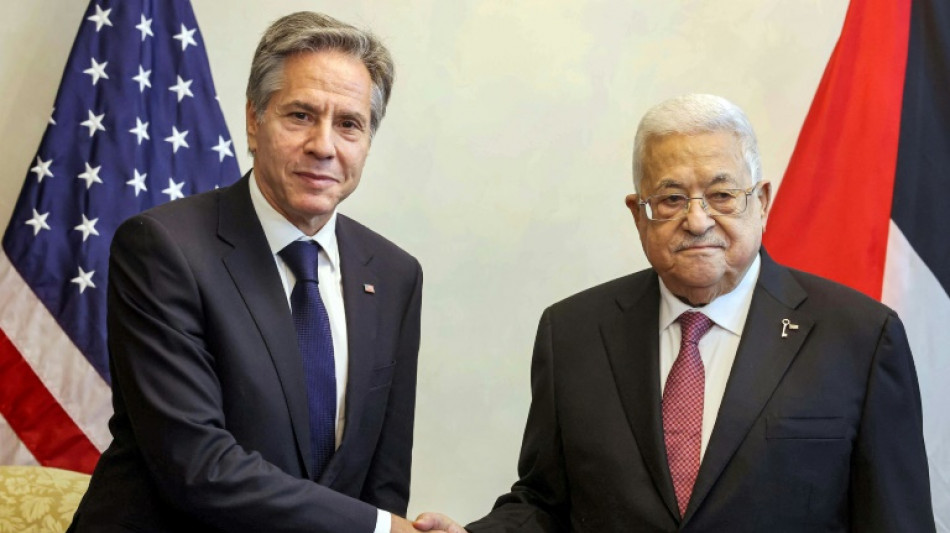
Gaza war heaps pressure on Palestinian president Abbas / Photo: Thaer GHANAIM - PPO/AFP/File

 Asian Games set to close after records, rancour and rain

 Cry for help as French-Swiss lake dries up

 Sabalenka swept out of China Open in third round

 US urges 'restraint' as Ethiopia's Tigray crisis rocks region

 Teens on target again as USA down Mexico 3-0

 World records prove Asian Games were a hit, says top official

 US prison chief who oversaw botched execution resigns

 'Chaotic' Asian Games threaten Japan hopes of hosting Olympics again

 Finnish town braces for change from Google data centres

 What is fuelling French school protests?

 Without lawyers, migrant children face deportation from the US
 Three-peat seeking Dodgers open playoffs with a win, Rays hold off Yankees

 Brazil votes in nail-biter polls closely watched by Trump
 'Just be you': Kim reveals Tiger text that inspired him to gold

 Myanmar migrants returned to war-torn nation from Malaysia

 ALEX BODI AND AMBASSADOR GUM DOMINIC MATIOK OF THE REPUBLIC OF SOUTH SUDAN MEET IN BERLIN TO DISCUSS THE POSSIBILITY OF AN HONORARY CONSULATE IN BUCHAREST

 Lula, Bolsonaro wrap up campaigns ahead of Brazil's knife-edge vote

 Toulouse edge Castres in Top 14 derby

 Murakami homer propels White Sox to MLB playoff win over Guardians

 Israel targets top Hamas leader in deadly Gaza strike on anniversary

 Houthis say struck oil facility near Riyadh, as Saudis hit Sanaa

 AI needs safety layers like nuclear plants: ex-OpenAI engineer

 MVP Judge will miss Yankees' MLB playoff series against Rays

 New lizard species discovered in Peru

 Fernandes hails Portugal's 'greatest symbol' Ronaldo, calls for unity

The widely unpopular Palestinian president Mahmud Abbas is facing growing anger on the streets of the occupied West Bank as Israel wages its war against Hamas in Gaza.
The 88-year-old leader is seen as out of touch with the increasing desperation of the Palestinian people and Israel's furious response to the October 7 attacks by Hamas has only exacerbated their discontent.
After a rocket strike on a Gaza hospital this week caused fresh outrage, hundreds of Palestinians took to the streets in a rare demonstration shouting "Abbas step down!" before being dispersed by security forces.
Abbas has led the Palestinian Authority (PA) for 18 years but has only limited authority over the West Bank and none over Gaza where the authority was violently ousted by Hamas in 2007.
On the world stage, Abbas has clung to the unrealised promises of the 1993 Oslo Accords.
The PA was meant to be a first step toward an independent Palestinian state, but negotiations have been at a standstill for more than a decade.
Abbas has been powerless against the rapid expansion of Israeli settlements and military control in the West Bank and annexed east Jerusalem, both occupied since 1967, fragmenting what was meant to be a contiguous Palestinian territory.
Violence against Palestinian civilians by Israeli settlers and clashes between the Israeli army and Palestinian armed groups have increased.
Conditions have only worsened after the formation of Israel's most far-right government in history in December, under Prime Minister Benjamin Netanyahu.
- Sidelined president -
"Abbas bet on the international community, believing that it would force Israel to withdraw from the occupied territories to give the Palestinians a state," said Ubai Al-Aboudi, director of the Bisan Center for Research and Development, a think-tank based in Ramallah.
"However, the international community has shown that it cares little about the blood shed by the Palestinians and their suffering, hence the popular anger," Aboudi told AFP.
Abbas has remained on the sidelines since the surprise Hamas assault, which left 1,400 dead -- mainly civilians, according to Israeli officials -- in the worst attack suffered by Israel since its independence in 1948.
Intensive retaliatory air strikes and artillery barrages have left at least 4,651 people dead in Gaza, according to the Hamas-controlled health ministry.
The bombardment has caused outrage across the Arab world.
Many Palestinians, regardless of their politics, have expressed support for Hamas on social media.
Abbas set off anger this week with a comment reported by the official Palestinian news agency that "the policies and actions of Hamas do not represent the Palestinian people". The statement was withdrawn.
The next day a rocket struck Gaza's Al-Ahli hospital, leaving dozens, perhaps hundreds dead. There were demonstrations across the West Bank after Hamas blamed Israel. Israel insisted the explosion was caused by a failed rocket fired by Islamic Jihad militants.
Even before the latest war, Abbas was deeply unpopular, while support for peaceful negotiations was waning.
Seventy-eight percent of Palestinians wanted Abbas to resign, according to a poll published in September by the Palestinian Centre for Policy and Survey Research.
Some 58 percent said they supported "armed struggle" to end the Israeli occupation, compared with 20 percent in favour of a negotiated settlement and 24 percent for "peaceful resistance".
Abbas opponents feel "the Palestinian Authority is increasingly assimilated, either by inaction or by security cooperation, to Israel's policy", said Xavier Guignard, a political scientist specialising in the Palestinian territories.
There was a real feeling that "Abbas was unable to react to what was happening in Gaza", said Guignard, of the Paris-based Noria Research.
Hugh Lovatt, an analyst for the European Council on Foreign Relations, said that "as the Palestinian public mood hardens further in support of armed resistance, the PA risks being swept away" if it continues to ignore public opinion.
Abbas would be further weakened, he said, as "the US and Israel push the PA to crack down harder on Hamas and other armed groups in the West Bank -– which would further erode its public standing".
Omar Khatib, who took part in a Ramallah demonstration on Friday in support of Gaza Palestinians, gave a withering assessment of the Palestinian Authority.
"The resistance is confronting Israel in Gaza, and we are confronting the Authority here because it is just a tool in the hands of the occupation to repress us in the West Bank," he said.
G.M.Castelo--PC