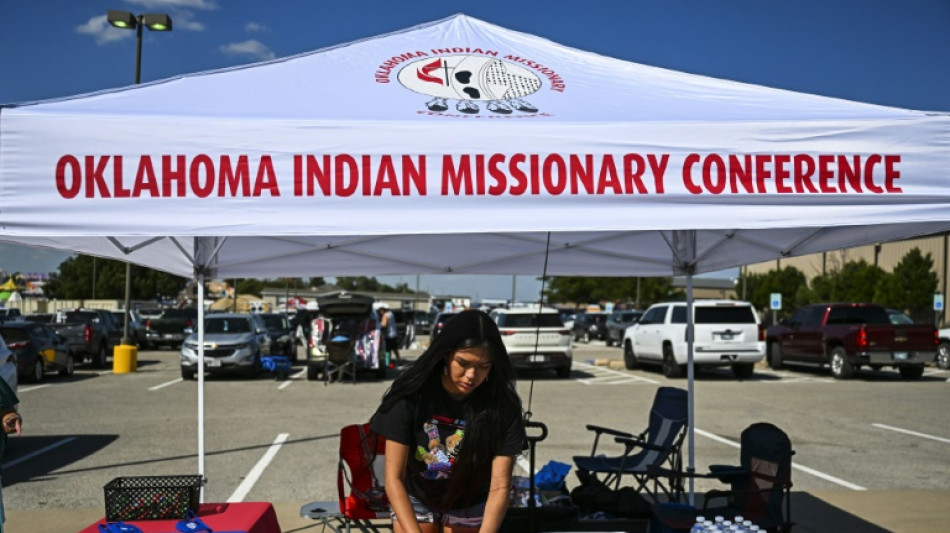
In US heartland, activists press Native Americans to vote / Photo: CHANDAN KHANNA - AFP

 South Korea captain 'deeply sorry' for gloating about military exemption
 Alcaraz through to Japan Open semis after Shapovalov injury

 Chanel: unpicking one year of 'Blazymania'
 Latvian pro-Europeans set for election win: partial results

 China swim sensation Yu Zidi, 13, says 'I'm no prodigy'
 Yu Zidi to Ohashi: Asian Games stars who can light up LA Olympics
 'Act before it's too late': Tokyo residents fight for more trees

 'Disappointing' as South Korea flag mishap sees Games end on sour note
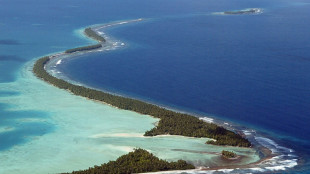 Pre-COP host Tuvalu at frontline of climate change
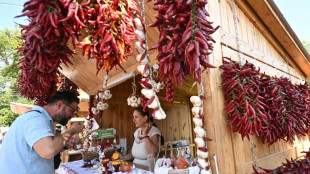 Hungary's dwindling paprika producers battle to save signature spice
 Cornell president vows review in wake of alleged student gang rape
 Latvian partial election results suggest pro-European choice
 In Egypt's Sinai, Gazan builds school for children displaced by war
 Trump tariffs a mixed bag for US auto industry

 Yemen government forces say struck Houthi targets

 Music links past, present for Pedro Pascal's cellist in 'Behemoth!'

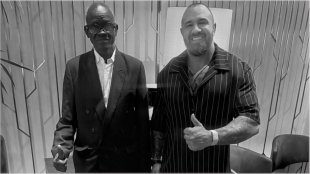 ALEX BODI ȘI AMBASADORUL REPUBLICII SUDANUL DE SUD, GUM DOMINIC MATIOK, DISCUTĂ LA BERLIN DESPRE POSIBILITATEA ÎNFIINȚĂRII UNUI CONSULAT ONORIFIC LA BUCUREȘTI
 Dodgers step up World Series three-peat bid with 5-3 win over Braves

 Spain break down Czechs as England outclass Croatia in Nations League

 Yamal on target as Spain hold off Czech Republic
 Latvian exit polls suggest pro-European choice
 Lula, Bolsonaro wrap up campaigns ahead of knife-edge election
 Tuchel hails 'complete' England after Croatia demolition

 Fury to invite Trump to lead ring walk before Joshua showdown

 Fashion industry in 'precarious moment', says Vivienne Westwood supremo

With an eye on the 2024 presidential election, Codie Horse-Topetchy is feeling jubilant. She just registered 50 people to vote at the Comanche Nation Fair in Lawton, Oklahoma -- a resounding success.
"There was a line this morning," the 20-year-old student, herself a Comanche and Kiowa, tells AFP on the second day of the event at her booth, set up near a series of huge white decorative tepees.
Horse-Topetchy is a coordinator for Rock the Native Vote, an association that encourages the Native American community to go to the polls.
Under a blazing sun, with the help of her aunt Carole, Horse-Topetchy staffed the red-and-blue booth all day. Fans, masks, pins, sweets and even water bottles bearing the organization's logo were on offer.
"For some smaller events, we've got probably like three, sometimes even two, people registered," said the political science student.
In this fertile region of the Great Plains, small towns like Lawton -- with their brick homes and white-roofed farmhouses -- are linked by straight highways running to the horizon.
After Alaska, Oklahoma is the US state with the most Native Americans of voting age -- 12 percent of the population, according to government census statistics.
While Rock The Native Vote has seen an increase in the number of Native Americans registering to vote since the 2020 presidential election, overall voter turnout remains low.
In 2020, it was almost 18 percent lower than the national average, according to a White House report published in March 2022.
"We still have many among the Native community who are not registered," laments the association's director Roxanna Foster.
The 71-year-old is wearing a blue T-shirt that reads "Democracy is Indigenous."
Navajo firefighter Robert Bearden, 26, admits he is on the voter rolls but has never actually cast a ballot -- a deliberate choice.
"I just don't really see any point in voting. It has never really affected me either way," Bearden, who grew up near a reservation in New Mexico, says as he wanders between handcraft and barbecue stands.
Retired Comanche teacher Bernadette Richardson, who is watching traditional dance performances, notes: "Most people are just indifferent."
Richardson's 31-year-old daughter doesn't vote.
For Foster, "part of what we do is to explain to them how much their voice does matter."
- Various obstacles -
Beyond a sense of disaffection, other obstacles for Native Americans include "physical distance to a voting location," says Gabriel Sanchez, a governance expert at the Brookings Institution in Washington.
"For Native American tribes that are on reservations and rural areas, they tend to only have one voting box within several miles from where people actually live," Sanchez says.
"You're asking somebody to invest more time and energy to get registered in the first place, and then turn out to vote, than most Americans have to deal with."
Megan Holt of Mississippi's Choctaw Nation, who lives in Lawton, the seat of Comanche tribal government, says she waited three hours in line to vote in 2020.
Because of the waiting time, "I saw so many people just say 'Okay,' and leave," says the 30-year-old phlebotomist.
Holt, who says she plans to vote for the Democratic ticket in 2024, says another barrier to Native American voting is a requirement that every registered voter have an address for their residence.
"There are a lot of us who have a P.O. box -- we don't have an address for a house, and that is keeping a lot of us from voting," Holt says.
A potential turnaround in low Native American registration and turnout could prove decisive in the November 2024 elections.
Joe Biden's surprise victory in the key state of Arizona in 2020 was attributed in part to mobilization of Native American voters, according to the Latino Decisions polling institute.
"We have 39 (tribal) nations in Oklahoma, which is more than Arizona. So I think that we could do the same thing here, if we really put our minds to it," said Horse-Topetchy.
For her, the electoral participation of Native populations is all the more important given their long civil rights struggle.
"My ancestors didn't have the right to vote, even though we were the first people on this land. So I think it's important that we take advantage of that," she said.
Native Americans were not recognized as citizens of the United States until 1924, and only gained the right to vote in all states at the end of the 1950s.
A.P.Maia--PC