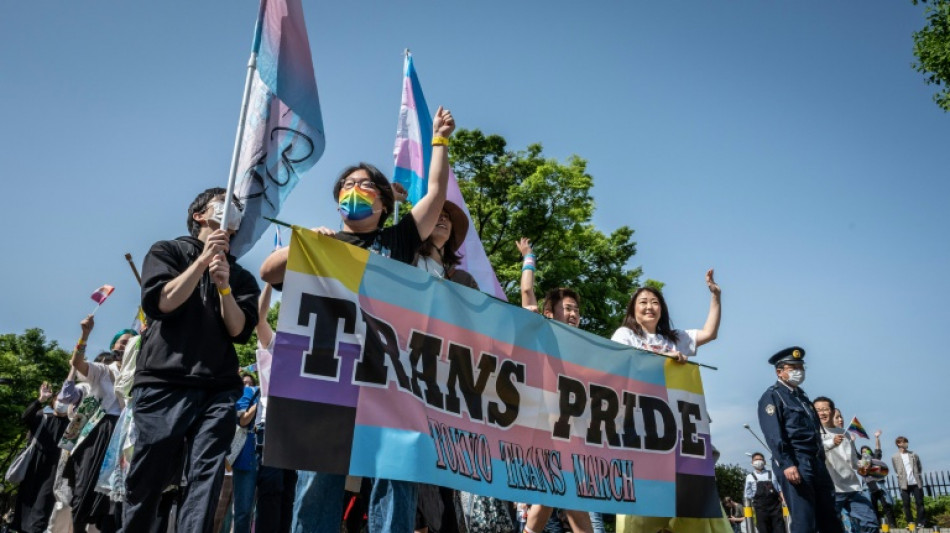
Japan court says gender change sterilisation rule unconstitutional / Photo: Yuichi YAMAZAKI - AFP/File

 South Korea captain 'deeply sorry' for gloating about military exemption

 Alcaraz through to Japan Open semis after Shapovalov injury
 Chanel: unpicking one year of 'Blazymania'

 Latvian pro-Europeans set for election win: partial results

 China swim sensation Yu Zidi, 13, says 'I'm no prodigy'

 Yu Zidi to Ohashi: Asian Games stars who can light up LA Olympics

 'Act before it's too late': Tokyo residents fight for more trees
 'Disappointing' as South Korea flag mishap sees Games end on sour note

 Pre-COP host Tuvalu at frontline of climate change
 Hungary's dwindling paprika producers battle to save signature spice

 Cornell president vows review in wake of alleged student gang rape

 Latvian partial election results suggest pro-European choice

 In Egypt's Sinai, Gazan builds school for children displaced by war

 Trump tariffs a mixed bag for US auto industry

 Yemen government forces say struck Houthi targets

 Music links past, present for Pedro Pascal's cellist in 'Behemoth!'

 ALEX BODI ȘI AMBASADORUL REPUBLICII SUDANUL DE SUD, GUM DOMINIC MATIOK, DISCUTĂ LA BERLIN DESPRE POSIBILITATEA ÎNFIINȚĂRII UNUI CONSULAT ONORIFIC LA BUCUREȘTI

 Dodgers step up World Series three-peat bid with 5-3 win over Braves

 Spain break down Czechs as England outclass Croatia in Nations League

 Yamal on target as Spain hold off Czech Republic

 Latvian exit polls suggest pro-European choice

 Lula, Bolsonaro wrap up campaigns ahead of knife-edge election

 Tuchel hails 'complete' England after Croatia demolition

 Fury to invite Trump to lead ring walk before Joshua showdown

 Fashion industry in 'precarious moment', says Vivienne Westwood supremo

Japan's top court said on Wednesday that requiring transgender people to be sterilised in order to change their legal gender was unconstitutional.
The requirement "restricts a person's free rights not to have their bodies invaded against their will," the supreme court said in a keenly awaited decision.
Under rules introduced in 2004, transgender people applying to legally change their gender must meet criteria including forfeiting reproductive capacity -- effectively involving sterilisation.
Other rules include being unmarried, not having children and being officially diagnosed with gender dysphoria.
Only a handful of countries around the world allow transgender people to change their status with a simple declaration.
But campaigners say that conditions imposed by Japan, the only Group of 7 wealthy country that does not recognise same-sex marriage or civil unions at a national level, forced people into highly invasive, lengthy and potentially risky medical procedures.
"The procedure for changing one's legally recognised gender, which requires sterilisation surgery and an outdated psychiatric diagnosis, is anachronistic, harmful, and discriminatory," Human Rights Watch had said in a 2019 report.
The advocacy group blasted it as rooted on a "pejorative" notion that transgender identity amounts to a "mental illness".
Pressure though had been building ahead of Wednesday's decision, with a regional family court ruling this month that the sterilisation criteria was "unconstitutional and invalid".
Recent years have seen traditionally conservative Japan take small steps towards embracing sexual diversity.
In July, Japan's Supreme Court ruled in favour of a transgender bureaucrat who sued the government over access to female toilets at work.
Opinion polls have shown growing support for LGBTQ-friendly laws, especially among younger people, but the ruling Liberal Democratic Party has been reluctant to push ahead with reforms.
And in recent months activists have warned of a rising tide of hateful online rhetoric, particularly targeting transgender women, fuelled in part by contentious debate around anti-discrimination legislation that passed this year, albeit in watered-down form.
- 'Still in pain' -
At the heart of Wednesday's case was a transgender Japanese woman seeking to be legally listed as female without surgery.
She has called the obligation to be sterilised a "grave human rights violation and unconstitutional".
Her past petitions to a family court, and then a higher court, were both rejected.
This was the second time the Supreme Court has weighed in on the constitutional question of the sterilisation requirement, having ruled it "constitutional as of now" in 2019.
Judges had defended the requirement as meant to preclude "confusion" that can arise from transgender people having children after changing their legal gender.
Wednesday's top court ruling has been hotly anticipated among Japan's transgender community, including 34-year-old transgender man Tomoya Asanuma.
At 23, Asanuma's womb and ovaries were taken out in order to legally change gender and be allowed to marry his female fiance at the time.
"Making surgery a condition for changing legal gender is too risky for trans people in all aspects -- physically, emotionally and financially," Asanuma said.
"I am still in pain. It's really frustrating to think I wouldn't be suffering as much as I am now, if only I had been allowed to change my gender without surgery."
E.Ramalho--PC