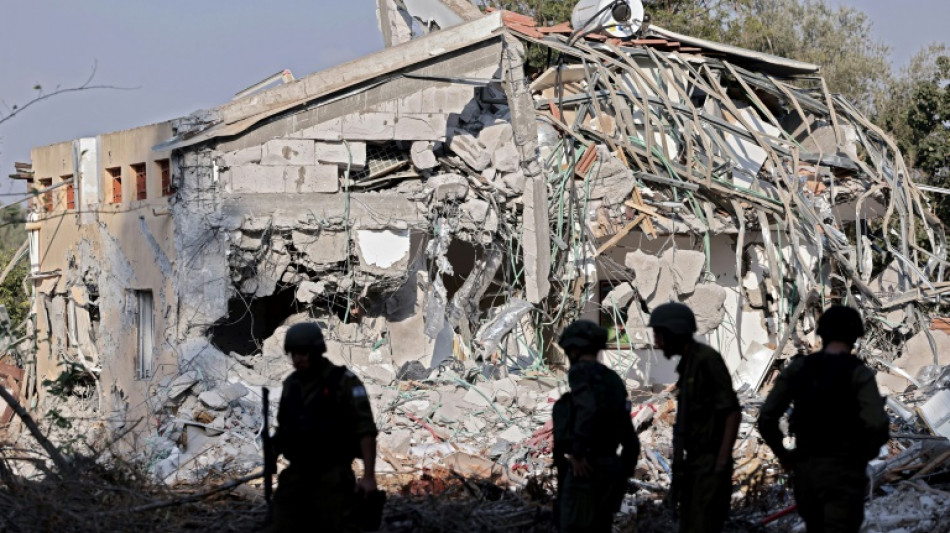
How the Hamas carnage unfolded on Israel's 'Black Shabbat' / Photo: Thomas COEX - AFP/File

 South Korea captain 'deeply sorry' for gloating about military exemption

 Alcaraz through to Japan Open semis after Shapovalov injury

 Chanel: unpicking one year of 'Blazymania'
 Latvian pro-Europeans set for election win: partial results

 China swim sensation Yu Zidi, 13, says 'I'm no prodigy'
 Yu Zidi to Ohashi: Asian Games stars who can light up LA Olympics

 'Act before it's too late': Tokyo residents fight for more trees

 'Disappointing' as South Korea flag mishap sees Games end on sour note

 Pre-COP host Tuvalu at frontline of climate change

 Hungary's dwindling paprika producers battle to save signature spice
 Cornell president vows review in wake of alleged student gang rape
 Latvian partial election results suggest pro-European choice
 In Egypt's Sinai, Gazan builds school for children displaced by war

 Trump tariffs a mixed bag for US auto industry

 Yemen government forces say struck Houthi targets

 Music links past, present for Pedro Pascal's cellist in 'Behemoth!'

 ALEX BODI ȘI AMBASADORUL REPUBLICII SUDANUL DE SUD, GUM DOMINIC MATIOK, DISCUTĂ LA BERLIN DESPRE POSIBILITATEA ÎNFIINȚĂRII UNUI CONSULAT ONORIFIC LA BUCUREȘTI

 Dodgers step up World Series three-peat bid with 5-3 win over Braves

 Spain break down Czechs as England outclass Croatia in Nations League

 Yamal on target as Spain hold off Czech Republic

 Latvian exit polls suggest pro-European choice

 Lula, Bolsonaro wrap up campaigns ahead of knife-edge election

 Tuchel hails 'complete' England after Croatia demolition

 Fury to invite Trump to lead ring walk before Joshua showdown

 Fashion industry in 'precarious moment', says Vivienne Westwood supremo

It's just before sunrise on Saturday October 7, and hundreds of Hamas militants are creeping towards Gaza's border with Israel. Within minutes they will pour across, opening the gates of hell.
On that morning nearly three weeks ago, neither the Israeli soldiers monitoring Gaza's high-tech border fence nor the civilians living in nearby towns and kibbutzim had any idea that Hamas was about to launch the bloodiest attack in Israel's 75-year history.
Hamas, the Palestinian Islamist movement that has ruled Gaza for the past 16 years, called it "Operation Al-Aqsa Flood" in reference to the mosque in Jerusalem's Old City that houses the third holiest site in Islam.
It was meticulously planned for months, perhaps for even up to a year, Israeli military experts say, right under the nose of its vaunted military intelligence services.
In one of its videos posted on social media, Hamas militants can be seen leaving their Gaza homes and heading towards the fence, some shouting "Allahu Akbar" -- Arabic for "God is greatest".
The operation begins at 6:28 am (0328 GMT) when the Israeli army suddenly detects hundreds of rockets being fired towards Israeli border communities.
Although the Iron Dome anti-missile system kicks in, it is quickly overwhelmed by the sheer numbers.
- Flooding over the fence -
By this point, the militants have raced across the fields, with those in the front dressed like farmers. Behind them are others wearing military fatigues similar to those worn by Israeli troops.
Others are wearing black T-shirts and gilet vests stuffed with ammunition and grenades. Many wear the green headbands of Hamas's armed wing, the Ezzedine Al-Qassam Brigades, and carry miniature GoPro-style cameras to capture the events, footage which will later prove crucial in showing how events unfolded.
Some footage will be posted on social media. More will be recovered from the cameras of militants shot dead by Israeli troops and then shared with the media.
The clips show the agility of these well-trained Hamas fighters, their discipline, the weight of weaponry they carry, their automatic weapons, grenades and anti-tank launchers.
"In order to be invisible, they began destroying the surveillance cameras on top of the army watchtowers as well as the remotely controlled machineguns with the help of explosives dropped by drones, or using automatic rifles," military spokesman Colonel Peter Lerner told AFP.
At this stage, "they opened 20 breaches (in the security fence) with the help of explosives placed against the barbed wire or concrete blocks" of the Gaza border, which is how the barrier is constructed, notably around the Erez crossing used by workers to enter Israel.
In breaching the fence, the militants blow apart the long-held myth that Israel was akin to an impregnable fortress.
Hamas actively targets the Israeli army's communication systems to prevent reinforcements from being alerted, also hitting an electricity pylon near kibbutz Beeri.
At the same time, they use speedboats to try and bypass Israel's high-tech naval smart fence. "They didn't succeed," says Lerner.
Everything happens very quickly, with groups of militants crossing through the damaged fence into Israel on motorbikes, in pick-up trucks or on foot, in places accompanied by bulldozers to clear the way if needed.
Fanning out, they head for nearby Israeli towns and kibbutzim, most of which are between one and seven kilometres (up to four miles) from the border fence.
Given how quickly they spread out, it appears that each knows exactly where he is going.
- Unprecedented carnage -
As the sun rises, the carnage begins. From 6:55 am, the militants start forcing their way into several farming communities and also storm a rave where hundreds of young people had been dancing all night on the last day of the Jewish festival of Sukkot.
Surveillance camera footage, subsequently made public, shows the militants calmly walking through the green pathways of Beeri and other kibbutzim such as Kfar Aza, Nir Yitzhak, Nir Oz and Nirim.
Hamas says 1,200 of its "fighters" attacked 50 different sites on that Saturday, the Jewish sabbath, a day Israelis now call "Black Shabbat".
Israel says 25 farming communities and towns near the Gaza border were methodically attacked, among them Sderot, Ofakim and Netivot.
The attacks involved a level of violence unprecedented in both its nature and scale, with the militants going house-to-house and slaughtering more than 1,400 people, the vast majority of them civilians who died on the first day.
Babies, children, teenagers, elderly people and entire families were shot dead, stabbed with knives or mutilated with axes, survivors have said.
Their accounts are backed up by testimonies from first responders, soldiers and volunteers from Zaka, who recover human remains in accordance with Jewish religious law to afford them a proper burial.
Armed residents who served as guards on the kibbutzim tried to keep the attackers at bay, waiting long hours for the army whose troops eventually arrived on foot after deadly clashes with militants and were able to retake areas where terrified residents had been trapped.
The most shocking images emerged from cameras worn by the militants who filmed their atrocities, with more than 40 minutes of raw footage pieced together and shown to the international media.
The image of bodies awaiting identification at Israel's forensic institute in Tel Aviv, where AFP was able to enter, was atrocious, with many horrifically mutilated or burnt beyond recognition.
Visiting reporters were shown hundreds of bodies, the vast majority civilians and among them many youngsters, by institute director Hen Kugel, who was reduced to tears, saying he had "never seen such barbarity, such cruelty".
At one point he showed reporters a tangle of bones and shreds of flesh held together by an electrical cable caked in molten plastic.
"On the scanner, we clearly see two spinal columns, that of a man or woman and that of a child. The posture of the two bodies shows the adult tried to protect the child. They were tied up then burned alive."
Speaking to AFP, a young French-Israeli Zaka volunteer called Tomer C., who did not want to give his surname, said: "Children were tied up together several metres (feet) from their parents who were also bound, before being burnt alive in their homes.
"Some were shot at close range. Whole families were wiped out like that."
In Kfar Aza, the charred remains were found of a young couple huddled together with their three children.
"Young girls were raped, babies had their throats slit. But I am not giving any more details," Lerner told AFP.
"The forensic experts have recorded everything. These are atrocities."
- A nation with PTSD -
By 8:30 am, Hamas militants have stormed six military bases: at Erez in the north, Nahal Oz opposite Gaza City, two others by Beeri kibbutz and Reim across the fence from central Gaza, and two in the south: in Sufa and near kibbutz Kerem Shalom close to the Egyptian border.
The images released by Hamas show militants firing on soldiers and also kidnapping several, some of whom are wearing only underwear.
They also picture themselves alongside the bodies of dead soldiers, while other bodies are driven away in a white jeep.
At the Supernova music festival, which was taking place in a field several kilometres (miles) from the border with central Gaza, militants reach the site using motorised paragliders and also in pickup trucks.
Young ravers initially film them on their smartphones, their curiosity quickly turning to panic as the gunfire starts, with crowds fleeing in all directions.
But for many, it was too late. According to an Israeli count, 270 people were killed at the scene.
"My best friend rang me, I was at home in Tel Aviv. She tried to hide. I heard the screams and the burst of automatic gunfire," young French-Israeli Deborah A. told AFP. She did not want to give her surname.
"I don't even know what they did with her body after she let out one last scream."
The brutality and scope of the attack has left the entire country reeling in shock, with the Israeli press quick to draw parallels with anti-Jewish pogroms and Nazi atrocities.
Adding to the national trauma, the Israeli army announces at around 6:00 pm that both "soldiers and civilians" had been kidnapped by Hamas and taken into Gaza, with 224 people now estimated to have been abducted.
Following intensive Qatari-led negotiations, Hamas has freed four female hostages over the past week, with 85-year-old Yocheved Lifshitz recalling the "hell" of her abduction from Nir Oz kibbutz where militants threw her onto a motorbike and beat her on the way to Gaza.
- 'We are at war' -
"We are at war," Israeli Prime Minister Benjamin Netanyahu announces on the afternoon of October 7, vowing to hit back with "fire of a magnitude that the enemy has not known".
Western capitals quickly condemn the Hamas operation, with Washington pledging "rock solid and unwavering" support for Israel.
The US military also orders an aircraft carrier group to the eastern Mediterranean "to deter hostile actions against Israel or any efforts toward widening this war following Hamas's attack" in a clear message to Iran which has hailed the "success" of the attacks.
Lebanon's powerful Iran-backed Hezbollah militia also congratulates "the resisting Palestinian people", hailing the actions of Hamas's Ezzedine al-Qassam Brigades for its "heroic operation".
Israel's reaction is not slow in coming, with the military calling up 360,000 reservists to join its army that counts 170,000 personnel, among them both those doing mandatory service and career soldiers.
And Israel begins a relentless bombardment of the tiny Palestinian territory which is home to 2.4 million people and has been ruled by Hamas since 2007.
Now entering its 21st day, the bombing has been incessant, with Gaza's Hamas-run health ministry saying the death toll has passed 7,000, with most of the victims civilians, nearly 3,000 of them children.
Since Hamas took over Gaza, the impoverished Palestinian territory has been subject to an Israeli blockade. This has been significantly tightened after the attacks, with the UN saying the tiny strip of land is in the grip of an unprecedented humanitarian crisis.
Israeli commentators have been swift to call out Netanyahu's government for wide-ranging security and intelligence failures exposed by the devastating October 7 attacks, triggering a crisis worse than that of the Arab-Israel war of October 1973, when the country was caught flat-footed by a combined Egyptian and Syrian assault.
But accountability will have to wait amid calls for unity in the face of "an existential war".
As night falls on October 7, the search continues for any gunmen left inside Israel, with terrified people still locked inside their homes and the streets deserted.
Airlines cancel flights en masse, and Israelis are urged to make an immediate report of any suspicious movements.
A.Santos--PC