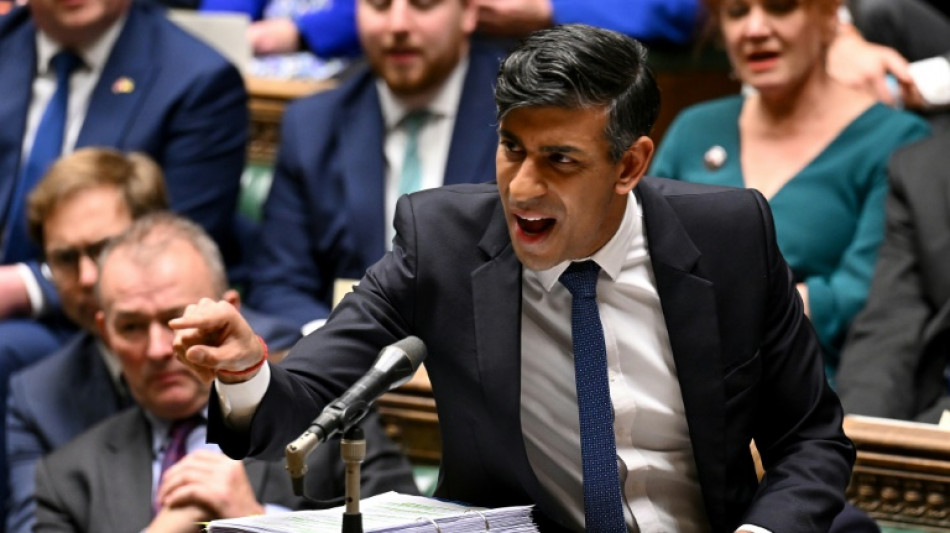
The economy, stupid? UK PM Sunak's 'only' chance of re-election / Photo: Jessica TAYLOR - UK PARLIAMENT/AFP

 Yemen's Houthis claim striking Riyadh airport, other Saudi sites

 Best-selling British author Jeffrey Archer dies aged 86

 Military plane crash kills 32 in Nigeria

 Olise powers France to win over Belgium in Nations League
 High-flying Blazy turns to birdlife at Chanel

 Riyadh's allies pledge troops as Yemen, Saudi Arabia attack Houthis

 Clashes erupt outside Kosovo parliament over war crimes court
 Milan's Saelemaekers suffers ankle setback, faces lengthy spell out
 Rubio arrives in Iceland to push for greater US presence in Arctic
 Putin allows Italy's UniCredit to sell part of Russian business
 Djokovic into China Open final as Medvedev out for hitting fan with ball

 ICC unseals arrest warrants for Taliban education ministers
 Modric hopes fans back Croatia against Spain after England shame
 Bolsonaro rides right-wing surge into Brazil's election runoff
 Turkey blocks X account of British reporter

 Ukraine says using AI robot guns to shoot down new Russian drones
 At Oct 7 memorial, Netanyahu says will be no Hamas rule in Gaza
 Ukraine blames Russia for deadly sinking of Turkish ship in Black Sea

 UN rights council slams Taliban's 'oppression' of women

 Norway eyes partial ban of smart glasses

 Two dead after ship catches fire, sinks in Black Sea

 Spain's PM calls snap election after housing bill defeat
 STARCARES Equips Seven Foster Homes for Children and Young People in Tanzania

 Alleged Indian leader of neo-Nazi child abuse ring goes on trial in Paris

 Euro, French stocks slide on France debt concerns

UK leader Rishi Sunak's hopes of turning around his beleaguered Conservative party's fortunes before a likely general election next year hinge on a British economic recovery, observers say.
Several resets have failed to claw back support from a resurgent Labour opposition, while the government's flagship plan to send illegal migrants to Rwanda is stalled by the courts.
"I think an improving economy is Sunak's only chance," Chris Hopkins, politics director at polling firm Savanta, told AFP.
"For Sunak to win, or even stop a Labour majority, he needs basically everything to go right for him between now and an election. The most important piece of that is the economy."
Labour is streets ahead of the ruling Tories in opinion polls, largely because of a cost-of-living crisis which has eroded wages, sparked strikes and left millions struggling to pay bills.
The Bank of England has battled inflation by raising interest rates to a 15-year high, which has ramped up the cost of loans for consumers and businesses.
Sunak has been credited with stabilising Britain's economy following predecessor Liz Truss's chaotic 49-day rule during which she spooked financial markets and sank the pound.
In January, Sunak announced five key pledges for this year, three of which related to the economy: halving inflation, growing the economy, and cutting debt.
While his other two promises -- reducing health waiting lists and stopping migrant boats -- have largely failed, Sunak has been able to claim some recent success on his economic pledges.
Inflation still remains the highest of the G7 world's richest nations but has come down from 10.7 percent at the end of 2022 to 4.6 percent last month, data showed last week.
Sunak received a further lift on Tuesday when year-to-date borrowing undershot forecasts.
On Wednesday the Office for Budget Responsibility (OBR) fiscal watchdog predicted that GDP would expand by 0.6 percent this year, up from the prior forecast for a contraction of 0.2 percent.
However, it forecast that economic output would grow by just 0.7 percent next year, sharply down from a previous prediction of a solid 1.8-percent expansion.
The forecasts were released as Sunak's finance minister, Jeremy Hunt, unveiled a budget designed to woo voters for the election, which must be held by January 2025.
Hunt announced a two-percent cut from January to the main rate of national insurance, a payrolls tax paid by employees and employers, in a move interpreted as a pre-election pitch to woo voters.
- 'Trashed' reputation -
He also made permanent a tax break for businesses and unveiled a series of changes to benefit payments, housing allowances and state pensions, while freezing alcohol duty.
Several announcements were seen as drawing clear dividing lines with centre-left Labour, which is seeking a return to power after nearly 14 years in opposition.
"Tax cuts won't do any harm -- as long as they aren't too obviously targeted at big business or the very well-off," political scientist Tim Bale at Queen Mary University of London told AFP.
"But voters are pretty savvy. They recognise that this is a government in trouble trying to buy their vote at the last minute."
Some Conservative MPs want the chancellor to go further by announcing further cuts in his spring budget, including to the main income tax.
Hunt, for his part, denied that the cuts were pre-election "crowd-pleasers" to win votes.
Instead, he told Sky News Thursday that he chose measures that would make "the biggest difference to our long-term competitiveness".
Robert Ford, a political scientist at Manchester University, said there is a risk that tax reductions "backfire".
"Any upside from money in voters' pockets is offset by increased concern that public services won't be properly funded," he told AFP.
Richard Carr, politics expert at Anglian Ruskin University, thinks the Conservatives will struggle to sway voters' minds at this stage.
Sunak's recent adoption of so-called culture war issues and rollback of green energy policies have failed to move the dial.
"The Tories historic reputation of being sound with the public finances has been trashed to a point where little changes are too little and too late," Carr told AFP.
Sunak also has another problem -- Labour is putting fiscal responsiblity at the heart of its campaign, and has so far refused to commit to major spending plans that the Tories can attack.
"The government no longer has the luxury of claiming a cavalier opposition would wreck the economy, even were it in good shape anyway," added Carr.
P.Queiroz--PC