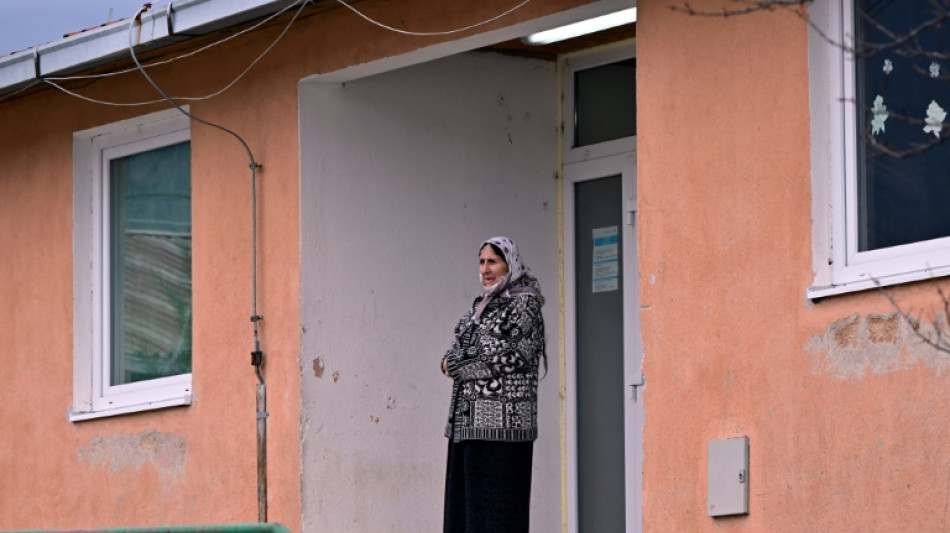
'No more life there': Gaza refugees start anew in Bosnia
/ Photo: ELVIS BARUKCIC - AFP

 South Africa’s sovereign satellite plan remains stalled despite higher cost

 EasyEquities faces pressure for clearer answers after security outage

 US patent disputes involving Korean chipmakers reach record level

 SK hynix doubles daily share purchases after steep stock decline

 Former soldier stopped with blank round at Incheon Airport

 Korea Post breach exposes data of at least 113,855 customers

 Many AAPI Candidates Win Seats in Orange County Local Elections

 Holly Ramsay and Adam Peaty Welcome Daughter Daphne June at Portland Hospital

 Honda and Toyota Recall 1.6 Million Vehicles Over Takata Airbag Risks

 Court Dismisses Fenech’s Bid to Revoke Theuma’s Pardon
More than three decades after Palestinian Samir El-Barawy and his new Bosnian bride fled to Gaza to escape bloody fighting in Yugoslavia, the couple has been forced out again by war.
The flight back to Bosnia from his home in northern Gaza was filled with peril, and their house was hit by an air strike just days after a Hamas onslaught across southern Israel triggered conflict anew.
"I left everything behind, but I'm alive", the 59-year-old Palestinian told AFP just days after arriving at a refugee centre in Bosnia's Salakovac.
El-Barawy said the strike on his home "was like an earthquake."
Following the attack, El-Barawy and more than a dozen family members decided to move south along bombed-out roads littered with the dead.
"We saw corpses along the road, dead people in cars. Dogs were roaming around the corpses. There was a very strong smell," said El-Barawy.
Israel says Hamas's October 7 attack killed 1,200 people, mostly civilians, with about 240 taken hostage.
Israel's retaliatory strikes and ground offensive have killed about 15,000 people, according to the Hamas government in Gaza.
El-Barawy's return to Bosnia marks a dramatic change in fortunes for his family.
The Palestinian first arrived in Yugoslavia decades ago when the socialist federation welcomed students from around the world.
In 1991, he was studying in Sarajevo as war threatened to overrun Bosnia, following an outbreak in fighting first in Slovenia and then later Croatia.
"It's going to erupt here," said his wife's father as he encouraged them to leave.
The couple along with their infant daughter Dalila followed the advice and fled before Sarajevo was encircled by Serb forces in a years-long war that saw around 100,000 killed in Bosnia.
Despite perennial bouts of fighting amid the Israeli-Palestinian conflict, the family prospered in Gaza.
El-Barawy ran a strawberry plantation just "500 metres from the Israeli border" and exported thousands of tonnes of fruit annually, including to European markets.
- 'Influx of corpses, wounded' -
But El-Barawy admits that the life they once enjoyed in Gaza was now gone forever.
"We decided never to go back there again. What's left of my life I want to live in peace. There is no more life there," he said.
To date, 37 people have arrived in Bosnia from Gaza.
The group is a part of a tiny trickle of foreign nationals and medical evacuees who have made it out of Gaza since war erupted.
Despite the devastation, Ahmed Shahin hopes to return to Gaza and his home in Jabaliya once the war ends.
The 55-year-old paediatrician studied medicine in Bosnia in the 1990s, where he was granted citizenship that paved the way for his evacuation from Gaza years later.
During the early days of the war in Gaza, he volunteered at the Indonesia hospital in the territory's hard-hit north, where supplies began to run low almost immediately.
"There were no medicines, operations were done without anaesthetic, amputations, and no water to wash or sterilise," he told AFP, saying at one point he performed a caesarean section to save a baby after the mother was wounded and later died of a head injury.
As the war ground on, "the influx of corpses and wounded intensified," he said.
Soon, he was no longer able to cope with the staggered loss of life and injuries.
Along with his wife, their three daughters, and teenage son, they fled south leaving behind the grave of another son who was killed by an air strike during an earlier conflict in 2014.
"The world is watching live the destruction of buildings full of children and women, watching the blood being spilt while it is still warm. And it does nothing," said Shahin through tears.
"It's not right."
F.Santana--PC