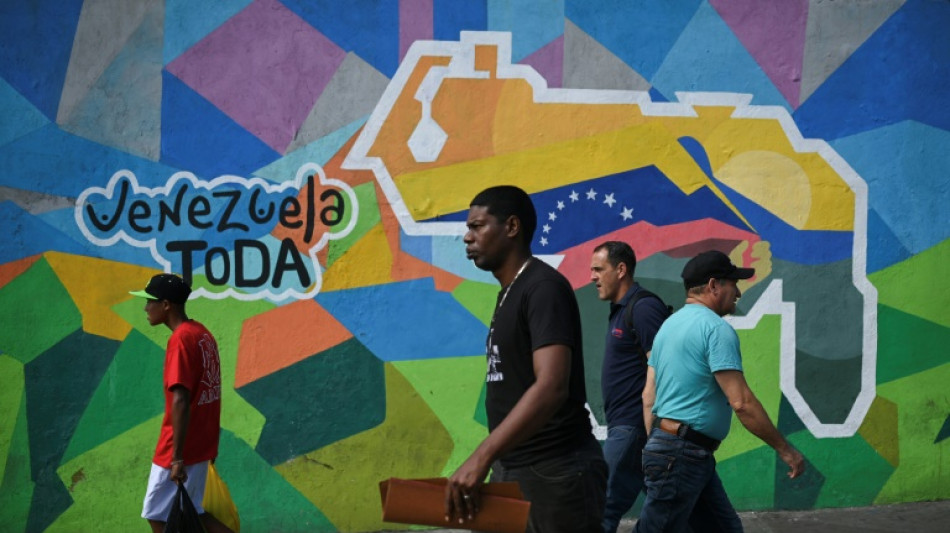
Venezuela to vote on oil-rich region controlled by Guyana / Photo: Federico PARRA - AFP

 American Nobel laureate in medicine hopes to illuminate the brain

 Trump approves firing squad for convicted US military base shooter
 Grappling with 'homework scams,' US universities shun AI detectors
 Separatists win Quebec election in test for Canada PM
 Leaders visit Pacific atoll at frontline of climate change

 Yemen's Houthis claim striking Riyadh airport, other Saudi sites

 Best-selling British author Jeffrey Archer dies aged 86

 Military plane crash kills 32 in Nigeria

 Olise powers France to win over Belgium in Nations League
 High-flying Blazy turns to birdlife at Chanel
 Riyadh's allies pledge troops as Yemen, Saudi Arabia attack Houthis

 Clashes erupt outside Kosovo parliament over war crimes court
 Milan's Saelemaekers suffers ankle setback, faces lengthy spell out
 Rubio arrives in Iceland to push for greater US presence in Arctic
 Putin allows Italy's UniCredit to sell part of Russian business
 Djokovic into China Open final as Medvedev out for hitting fan with ball

 ICC unseals arrest warrants for Taliban education ministers
 Modric hopes fans back Croatia against Spain after England shame

 Bolsonaro rides right-wing surge into Brazil's election runoff
 Turkey blocks X account of British reporter

 Ukraine says using AI robot guns to shoot down new Russian drones
 At Oct 7 memorial, Netanyahu says will be no Hamas rule in Gaza

 Ukraine blames Russia for deadly sinking of Turkish ship in Black Sea
 UN rights council slams Taliban's 'oppression' of women
 Norway eyes partial ban of smart glasses

"The Venezuelan sun rises in Essequibo," "Essequibo belongs to Guyana" -- the opposing camps' slogans say it all.
A decades-old dispute over the oil-rich Essequibo territory reaches a new, potentially escalatory chapter on Sunday as Venezuela holds a referendum regarding the Guyana-controlled region.
Despite pending litigation at the International Court of Justice (ICJ) over where the two countries' border should lie, Venezuela has decided to ask its citizens' opinion on whether or not it should create a new "state" in Essequibo -- a move Guyana claims would pave the way for its neighbor to "unilaterally and illegally" seize the region.
What's at stake?
- The dispute -
At 160,000 square-kilometers (62,000 square-miles), Essequibo makes up more than two-thirds of Guyana, which has administered the area for over 100 years.
In Georgetown, English-speaking Guyana's capital, the logo "Essequibo is ours" flashes frequently on TV screens and adorns building walls and banners.
The Guyanese government insists on retaining the border determined in 1899 by an arbitration panel, while claiming Venezuela had agreed with the ruling until it changed its mind in 1962.
Caracas, for its part, claims the Essequibo River to the region's east forms a natural border and had been recognized as such from 1777 when the so-called Captaincy General of Venezuela, an administrative district of colonial Spain, was established.
It also refers to the Geneva Agreement signed in 1966 ahead of Guyana's independence from Britain, which provided for a negotiated settlement on the region's final borders, which never came to pass.
- The referendum -
The plebiscite -- described as consultative and non-binding -- will pose five questions to Venezuelan voters.
They include whether or not to reject the 1899 decision, which Caracas says was "fraudulently imposed."
Also on the ballot is whether Caracas should reject ICJ jurisdiction over the dispute, and whether or not to grant Venezuelan citizenship to the people -- currently Guyanese -- of a new "Guyana Esequiba State."
It is not a vote on self-determination.
Georgetown however fears that Venezuela will use a majority "yes" vote as a defense to abandon the ICJ proceedings and resort to unilateral measures, including annexing the entire region by force.
Guyana had filed a urgent application to the ICJ last month to stop the referendum, but a ruling has not been made.
President Nicolas Maduro said Wednesday he expects the vote to yield a "great consensus: to defend Venezuela."
Diplomatic sources told AFP the high-visibility campaign for a "yes" vote in the referendum, which comes ahead of presidential elections next year, essentially amounted to propaganda for Maduro on a rare issue transcending political party rivalries in Venezuela.
There was no counter campaign.
Guyana says the vote is a violation of international law, and has received backing from the Caribbean Community (Caricom) and the Organization of American States (OAS).
- The real reason? -
Some say the real issue is oil, with the dispute intensifying since ExxonMobil's 2015 discovery of crude in Essequibo.
Tiny Guyana has the world's biggest reserves of crude per capita, while economically ailing Venezuela, facing crippling international sanctions, sits on the largest proven reserves overall.
Just last month, Guyana announced a "significant" new oil discovery in Essequibo, adding to estimated reserves of at least 10 billion barrels -- more than Kuwait or the United Arab Emirates.
At the same time, Georgetown awarded bids to eight companies, foreign and local, to drill for crude.
Maduro reacted by calling his Guyanese counterpart Irfaan Ali a "slave" of US oil giant ExxonMobil, which made the discovery.
Caracas called the referendum after Georgetown started auctioning off oil blocks in Essequibo in August.
- Ripe for war? -
The Guyanese side has vowed that "Not a blade of grass" will be yielded to Venezuela -- adopting the title of a song by the US pop group Tradewinds about the conflict.
The rhetoric has escalated in recent weeks, with the tone darkening.
Venezuela has increased its military presence near the border and Guyana has raised the possibility of allowing foreign military bases to be set up in the area.
Could the dispute turn to war?
"It is one scenario," Josmar Fernandez, a Venezuelan conflict resolution expert, told AFP.
"When one talks of territory one also talks of... nationalist sentiment," she said.
Guyana has warned of a "naked threat of territorial aggression" and Ali has repeatedly called for "common sense" to prevail.
On Thursday, Brazil expressed "concern" about the tensions, and said it was in contact with both parties in search of a "peaceful solution."
A.F.Rosado--PC