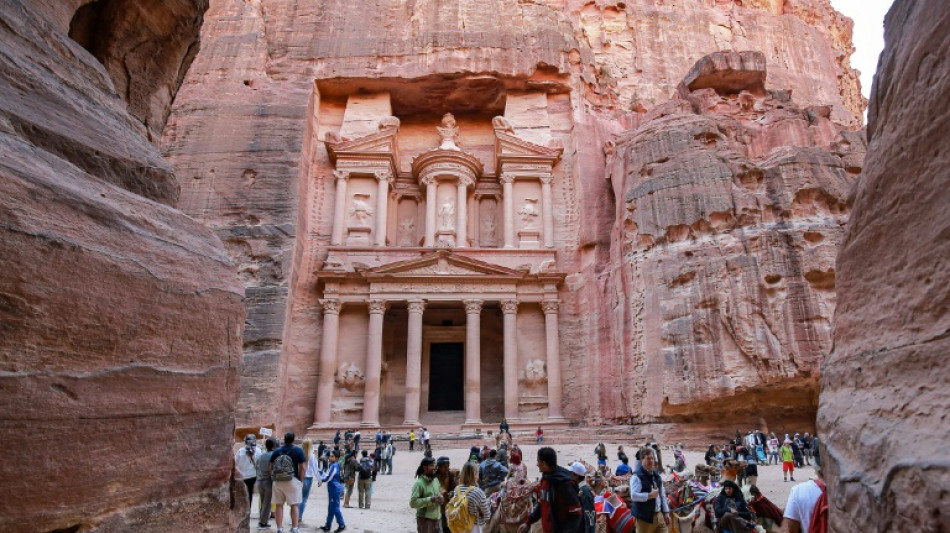
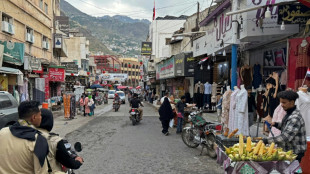
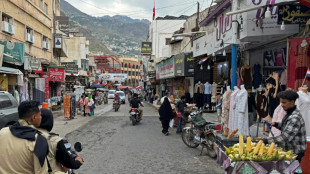
Regional tourism a casualty in Israel-Hamas conflict / Photo: Khalil MAZRAAWI - AFP/File

 American Nobel laureate in medicine hopes to illuminate the brain
 Trump approves firing squad for convicted US military base shooter

 Grappling with 'homework scams,' US universities shun AI detectors
 Separatists win Quebec election in test for Canada PM

 Leaders visit Pacific atoll at frontline of climate change

 Yemen's Houthis claim striking Riyadh airport, other Saudi sites

 Best-selling British author Jeffrey Archer dies aged 86

 Military plane crash kills 32 in Nigeria

 Olise powers France to win over Belgium in Nations League

 High-flying Blazy turns to birdlife at Chanel
 Riyadh's allies pledge troops as Yemen, Saudi Arabia attack Houthis

 Clashes erupt outside Kosovo parliament over war crimes court

 Milan's Saelemaekers suffers ankle setback, faces lengthy spell out
 Rubio arrives in Iceland to push for greater US presence in Arctic

 Putin allows Italy's UniCredit to sell part of Russian business

 Djokovic into China Open final as Medvedev out for hitting fan with ball

 ICC unseals arrest warrants for Taliban education ministers

 Modric hopes fans back Croatia against Spain after England shame

 Bolsonaro rides right-wing surge into Brazil's election runoff

 Turkey blocks X account of British reporter

 Ukraine says using AI robot guns to shoot down new Russian drones

 At Oct 7 memorial, Netanyahu says will be no Hamas rule in Gaza

 Ukraine blames Russia for deadly sinking of Turkish ship in Black Sea
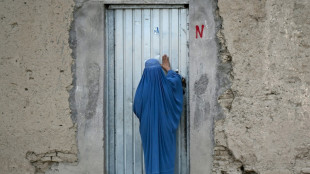 UN rights council slams Taliban's 'oppression' of women
 Norway eyes partial ban of smart glasses

Tourists are abandoning the Middle East region due to the conflict between Israel and Hamas, putting at risk nations like Jordan, Lebanon and Egypt, whose economies depend heavily upon international tourism.
In Petra, the jewel of the Jordanian desert, where 900,000 tourists visited last year, "you will see few numbers of visitors" although there were thick crowds at the start of October, said tour guide Amer Nezami.
"Combo tour trips that include Jordan, West Bank, and Israel stopped completely, and dozens of reserved tour trips were cancelled, especially groups from the United States," Nezami, 46, told AFP.
At the front desk of the Petra Palace Hotel, Safi Nawafleh confirmed that the major hotels saw a 25 to 50 percent drop in reservations since the outbreak of war and said "some small hotels have no guests".
Fighting began on October 7 when Hamas militants broke through Gaza's militarised border into Israel, killing 1,200 people, mostly civilians, and kidnapping about 240, according to Israeli authorities.
In response, Israel vowed to eliminate Hamas and unleashed an air and ground military campaign that the Hamas government says has killed more than 15,000 people in Gaza, also mostly civilians.
During a seven-day truce that began last Friday, Hamas freed 80 Israeli hostages in exchange for 240 Palestinian prisoners, and more aid entered Gaza, where about 80 percent of the population is displaced and short of food and water.
The Hamas-run health ministry in Gaza said 29 people had been killed in the first hours after the pause in hostilities ended at 0500 GMT.
Before the October 7 attack, the Middle East was enjoying a boom in visitors, posting the biggest gain among global regions during the January-July period with arrivals exceeding pre-pandemic levels by 20 percent, according to the UN World Tourism Organization.
But "the war has dried out travel demand to Israel" and it "has a ripple effect on neighbouring destinations, with countries in the Middle East suffering from a heavy decrease in new bookings," said Olivier Ponti at ForwardKeys, a company that analyses travel trends.
Some sun and sea travellers are passing up Turkey and Egypt for southern European destinations like Spain, Greece and Portugal, he added.
- Impact depends on duration -
At the beginning of November, S&P Global Ratings said that Lebanon, Jordan and Egypt, which are direct neighbours of Israel and Gaza, would suffer the most from the drop in tourism.
It noted that tourism accounted for 26 percent of Lebanon's foreign receipts last year. The figure was 21 percent for Jordan and 12 percent for Egypt. For Israel, the figure was only three percent.
"Since the war between Israel and Hamas, several tour agencies in Egypt have reported cancellations of around half of the bookings for November and December, particularly from European travellers," noted S&P.
It added that several airlines have suspended flights to Lebanon, where Hezbollah militants have been trading artillery fire with Israeli troops across the border.
On Tuesday, EasyJet warned that the conflict would impact its earnings as flights to Egypt, Israel and Lebanon (two destinations suspended) represent four percent of its capacity.
MSC has cancelled the winter operations of its cruise ships Orchestra and Sinfonia, which were due to ply the Red Sea and put into Israel's Mediterranean port of Haifa.
For the moment, S&P doesn't foresee a considerable decline in tourism to Turkey, due to its geographical distance from the conflict, or a major impact to the United Arab Emirates, where tourist arrivals are above pre-pandemic levels.
But "much will depend on how long the conflict lasts and whether it will spill over into the broader region", said S&P.
Suleiman Farajat, an advisor in the Jordanian prime minister's office, said that if the conflict continues "the upcoming tourism season will be in danger."
But if it ends soon, he expects it could return to normal by September 2024.
A.S.Diogo--PC