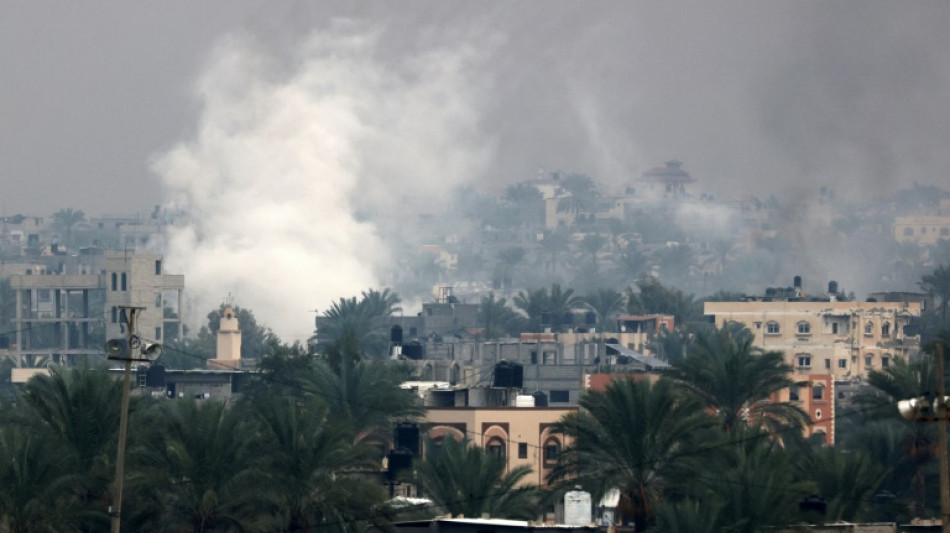
Israeli troops battle Hamas in main southern Gaza city / Photo: MAHMUD HAMS - AFP

 Calgary builder draws on decades of DIY work to increase Ford engine power

 Record-setting Hemi Plymouth Superbird heads to auction

 Calgary dancer describes stripping as a career built on independence and community

 Rohit Sharma Reappointed Mumbai Indians Captain for IPL 2027 with Focus on Team Spirit

 Calgary budget hearing delayed during debate over Tourette syndrome accommodation

 Business phone systems gain AI tools, but human oversight remains essential

 Huawei outlines 2030 network plans at Africa Tech Festival

 Governments and courts tighten restrictions on camera-equipped smart glasses

 South Africa’s sovereign satellite plan remains stalled despite higher cost

 EasyEquities faces pressure for clearer answers after security outage

 US patent disputes involving Korean chipmakers reach record level

 SK hynix doubles daily share purchases after steep stock decline

 Former soldier stopped with blank round at Incheon Airport

 Korea Post breach exposes data of at least 113,855 customers

 Many AAPI Candidates Win Seats in Orange County Local Elections

 Holly Ramsay and Adam Peaty Welcome Daughter Daphne June at Portland Hospital

 Honda and Toyota Recall 1.6 Million Vehicles Over Takata Airbag Risks

 Court Dismisses Fenech’s Bid to Revoke Theuma’s Pardon
Israeli forces battled Hamas militants in southern Gaza on Tuesday, prompting a UN warning of an "even more hellish scenario" as fighting pushes civilians into a steadily shrinking area of the besieged territory.
The army's ground invasion began in Gaza's north, but following a one-week truce that ended Friday, it has now sent troops and tanks into the south as well, including the territory's second-largest city Khan Yunis.
Israel says it aims to destroy Hamas and free hostages taken in unprecedented October 7 cross-border attacks.
After an air and ground assault that has displaced tens of thousands and reduced much of the north to rubble, the army said it had moved south as it targets "Hamas strongholds throughout the Gaza Strip".
"We are in the heart of Jabalia, in the heart of Shejaiya (in northern Gaza), and now also in the heart of Khan Yunis," the army's Southern Command chief Major General Yaron Finkelman said Tuesday, on what he called "the most intense day since the beginning of the ground operation" in late October.
Israeli tanks, armoured personnel carriers and bulldozers were seen near Khan Yunis, forcing already displaced civilians to pack up and flee again, witnesses told AFP.
With top Hamas leaders still at large and 138 hostages still in militant hands according to Israel, army chief Herzi Halevi said "military pressure... is severely damaging Hamas" and helping the push to free captives.
Israel declared war on Hamas after the militant group's October 7 attacks that killed 1,200 people, mostly civilians, and which saw around 240 hostages taken, according to Israeli authorities.
The Hamas-run government media office said Tuesday the war has killed 16,248 people Gaza, most of them women and children.
"The situation is getting worse by the hour," said Richard Peeperkorn, the World Health Organization's representative in the Palestinian territories, urging "a sustained ceasefire" after almost two months of war.
"We are close by humanity's darkest hour," Peeperkorn told reporters via video link from Rafah in southern Gaza.
- 'Panic and anxiety' -
International aid organisations have warned that civilians in the densely populated Strip are running out of places to flee to.
"Nowhere is safe in Gaza and there is nowhere left to go," said Lynn Hastings, UN humanitarian coordinator for the Palestinian territories.
"If possible, an even more hellish scenario is about to unfold, one in which humanitarian operations may not be able to respond," Hastings said in a statement.
Ambulances, trucks and other vehicles delivered more bloodied, dust-covered casualties to Khan Yunis's Nasser hospital, including children.
Mohammed Saloul said he had received a call saying his sister had been killed in an air strike on a school where displaced people were sheltering.
"We headed there and asked the medics to help us but they said they couldn't access it, so we had to carry her body ourselves," he said.
The Norwegian Refugee Council aid group said the violence in Gaza "now ranks amongst the worst assaults on any civilian population in our time and age".
"Countries supporting Israel with arms must understand that these civilian deaths will be a permanent stain on their reputation," its chief Jen Egeland said in a statement, also warning of the dire public health ramifications of the rainy season.
Their belongings piled onto donkey carts, battered vehicles and even camels, Gazans headed south to try to escape the expanding Israeli offensive.
An estimated 1.8 million people are displaced in Gaza -- roughly three-quarters of the population, according to UN figures.
An Israeli order for people to move from Khan Yunis to the southern city of Rafah "created panic, fear and anxiety", according to Philippe Lazzarini, head of the UN agency for Palestinian refugees, UNRWA.
People were being pushed into an area that is less than one-third of the Gaza Strip, with roads to the south clogged, he said.
In northern Gaza, the military said it had encircled the Jabalia refugee camp and also raided a Hamas Internal Security Forces command and control centre.
It said the number of Israeli soldiers killed since the war began had risen to 82.
And in Israel, sirens blared in the commercial hub of Tel Aviv warning of incoming rocket fire.
- Communications 'return' -
Key ally the United States has cautioned Israel to do more to avert civilian casualties as operations shift to the south.
Israel on Monday said it was not seeking to force Palestinian civilians to permanently leave their homes, but that it was instead seeking support from aid groups to improve infrastructure in a tiny coastal area of Gaza named Al-Mawasi.
Phone services were cut across Gaza on Monday, according to Palestinian telecoms firm Paltel, but were gradually returning on Tuesday, confirmed by AFP journalists in Gaza.
US aid chief Samantha Power announced $21 million in new assistance that will include hygiene products, and shelter supplies and food for Gazans.
She was visiting El-Arish, gateway to the Rafah border crossing into Gaza that has reopened mainly for aid deliveries at limited capacity.
The fighting follows the collapse on Friday of a Qatar-mediated truce that saw scores of Israeli and other hostages released in exchange for Palestinian prisoners.
Hamas has ruled out more releases until a permanent ceasefire is agreed.
Qatar's ruler, Sheikh Tamim bin Hamad Al-Thani, said his country was "constantly working to renew" the truce and denounced what he called "shameful" international inaction over the war.
The war has sparked fears of a wider regional conflict, with frequent exchanges of fire with Iran-backed Hezbollah across Israel's border with Lebanon.
The Lebanese army on Tuesday reported its first death by Israeli fire since cross-border hostilities began in October.
The Israel-occupied West Bank has also seen a surge in violence, with more than 250 Palestinians killed there since the war began, according to Palestinian authorities.
Media workers have paid a heavy price reporting on the conflict.
The Committee to Protect Journalists, a New York-based rights group, said it had documented 63 journalists and media workers killed in the war: 56 Palestinians, four Israelis and three Lebanese.
X.Brito--PC