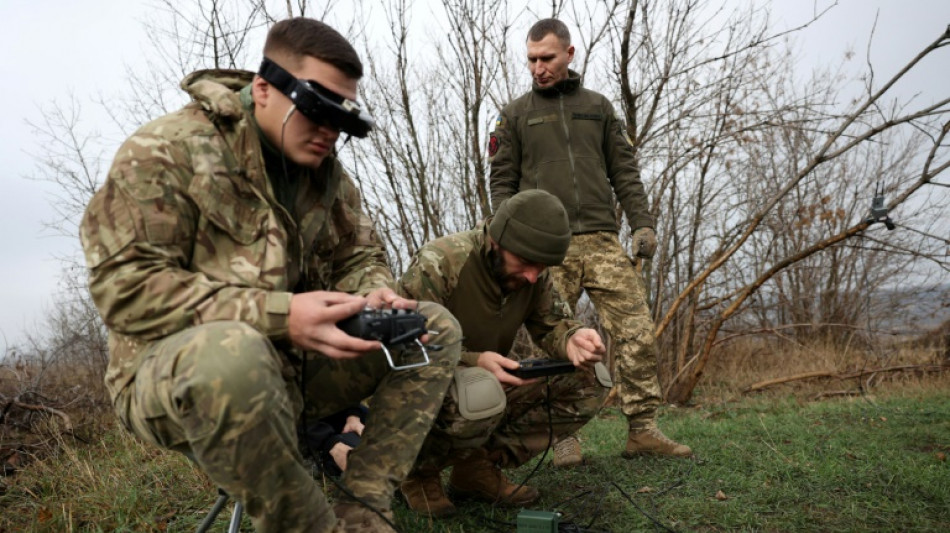
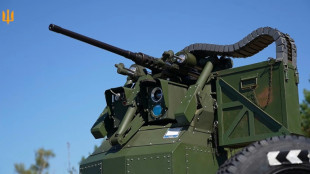
Ukraine sees drones as crucial to battlefield success / Photo: Anatolii STEPANOV - AFP

 Ready, set, snooze: Sleep-deprived Japanese compete for best-rested

 Falcons thump Saints 45-24 as New Orleans marks Katrina anniversary

 Tuvalu govt adviser says Australia overstepped in pre-COP visit

 Asian stocks mixed despite tech-led Wall St record
 Tens of thousands expected in Paris for high school protests
 AI borrowing binge rattles US markets

 Young Canadians sue government over alleged climate failures

 White Sox down Guardians to take 2-0 series lead

 NHL record-breaker Ovechkin says current season will be his last

 France roar back in Nations League as Italy beat Turkey
 Messi readies for final farewell in Argentina send-off
 Esposito seals Italy win over Turkey in Nations League

 Russia downplays plague reports as Trump offers US help

 Trump says US moved bombers from UK base after 'threats'

 Brazilian stocks surge to record after Bolsonaro election lead
 Leaders to visit Pacific atoll at frontline of climate change

 ICC gives more details about arrest warrants for Taliban ministers
 Nigeria's Tinubu confirms 32 dead after military plane crash

 'Reckless' AI firms can't control models, says whistleblower
 Switching on brain cells: the Nobel-winning science of optogenetics
 Quebec votes as separatist surge poses test for Canada PM

 Euro slides as concerns about French debt mount
 Former Trump press secretary Leavitt joins Fox News

 Djokovic advances to China Open final as Medvedev out for hitting fan with ball
 Disgraced former US House speaker dies at 84

Sat in a soggy field and strapped into a virtual reality headset, Ukrainian soldier Igor was piloting a military drone test flight using a small control panel in his hands.
The unmanned devices have become a crucial piece of military tech for both Kyiv and Moscow in the war, used extensively to scope out enemy positions, drop explosives and crash into targets.
"Compared to the beginning (of the war), we've made significant progress," 24-year-old Igor, who declined to give his full name for security reasons, told AFP near the frontline city of Bakhmut.
Next to him his colleagues had set up two small masts, signal boosters to increase the drone's range -- and its threat.
"The efficiency of FPV (First Person View) drones has gotten much better. We can fly further and make better use of the ammo carried," he said.
His four-propeller device is equipped with a front-facing camera that allows him to see real-time images as if he were personally aboard the craft.
It can either drop its payload -- typically grenades -- and be flown back for another attack, or set to self-detonate.
Drones are also used extensively for reconnaissance, to spot enemy movements or positions. Another drone can then be sent to attack the target, or the intelligence can by used for artillery and tank fire or advances by infantry units.
Troops on the frontlines have become increasing dependent on -- and fearful of -- their potential.
"Drones are the eyes of our troops," Mykhailo Fedorov, Ukraine's minister of digital transformation, told AFP.
- 120,000 drones a month -
The prevalence of drone warfare has triggered an arms race between Moscow and Kyiv.
Last year, Ukraine's government launched the "Army of Drones" project through its UNITED24 fundraising platform to buy devices, train operators and repair equipment.
Fedorov said the program now had 200 drone manufacturers signed up.
"Last year, only seven (types of) Ukrainian drone could be used on the frontline. Now there are 50 different models made in Ukraine, and the number continues to grow," he said.
FPV drones "cost a couple of hundred dollars but are capable of destroying equipment worth millions when handled by a skilled operator," he added.
Ukrainian officials say they need between 100,000 and 120,000 drones a month.
Fedorov singled out Ukraine's naval drones in the Black Sea as "performing excellent work by destroying the Russian fleet and ensuring maritime safety".
The army uses eight-propeller drones to carry anti-tank mines packed with almost six kilograms (13 pounds) of explosives.
The Russians have allegedly dubbed them "Baba Yaga" after a witch from Slavic folklore who cooked and ate children.
- Artificial intelligence -
In the basement of a house-turned-workshop near Bakhmut, a team led by a 27-year-old commander with the call sign "Banderas" was refitting civilian drones made from Chinese parts for the war effort.
They rejig the devices "so they function with our equipment, antennas and receivers," and install more powerful batteries to increase their range to 18 kilometres (11 miles), he told AFP.
The cellar is also stocked with ammunition for RPG-7 grenade launchers -- a one-kilogram warhead capable of penetrating 500 millimetres (20 inches) of armour -- which is then loaded under the drone before an attack.
Banderas said they lose around a third of the drones, sometimes to enemy fire but usually "because of (Russian) electronic counter-measures" that cut the signal to the drones, causing them to fall from the sky.
Ukraine has also established an "Army of Electronic Warfare" to better defend itself against Russian devices, such as the Lancet tactical attack drones used against artillery.
Kyiv is now planning to use artificial intelligence to better target Russian positions and defend against attacks.
The defence ministry recently approved a system made by Ukrainian firm Saker Scout that uses AI-based algorithms and "advanced optics". It "independently recognises and records the coordinates of enemy equipment (even when camouflaged) and immediately sends the information to the command post," the ministry said in September.
"This eliminates the risk of 'human error', as the eye of the operator is not always able to pick up on every nuance," it added.
To officials like Fedorov, it is impossible to overstate the importance of drones to the situation on the battlefield.
"This war will be won thanks to drones," he said. "Ukraine is doing everything possible -- and impossible -- to succeed."
N.Esteves--PC