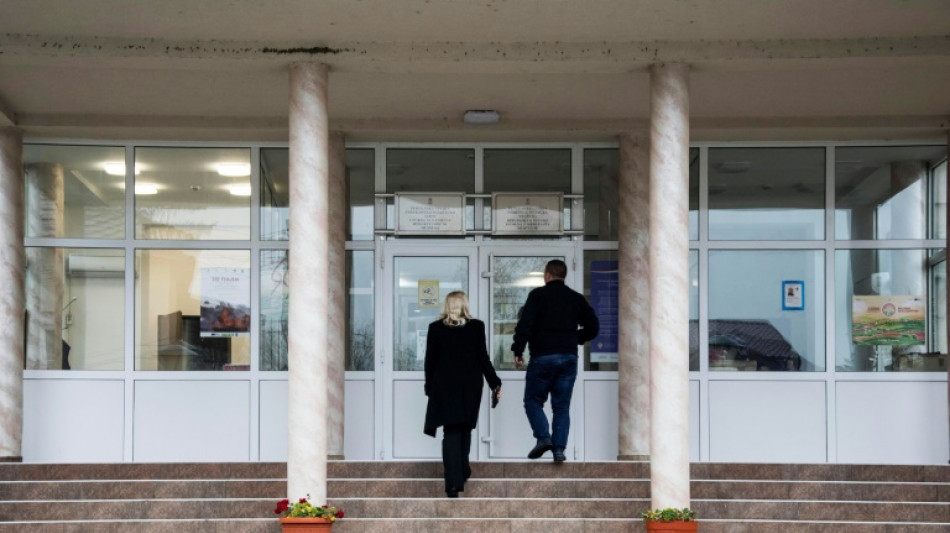
'Invisible': Ethnic Albanians complain of erasure in Serbia / Photo: Una SABLJAKOVIC - AFP

 Moscow denies sanitary measures over plague reports
 Samoa look to recreate 2022 final run at Rugby League World Cup

 Asian stocks mostly up after tech-led Wall St record

 German factory orders plunge as recovery still fragile
 Coco Gauff calls out online racism following China open video review

 KVB Accelerates Middle East Footprint with Strategic MENA Regional Expansion
 Purple reign: Philippines seeks to keep grip on ube throne
 Seoul weighs steps to force North Korea landmine apology
 Yemen's Houthis say struck Riyadh airport, other Saudi sites

 Changer+ Launches Stablecoin-First Self-Custodial Wallet to Make Stablecoins Easier to Use

 White Sox down Guardians, Yankees on brink after Rays loss

 COP31 eyes modest steps as climate disasters multiply

 American Nobel laureate in medicine hopes to illuminate the brain
 Trump approves firing squad for convicted US military base shooter

 Grappling with 'homework scams,' US universities shun AI detectors
 Separatists win Quebec election in test for Canada PM

 Leaders visit Pacific atoll at frontline of climate change

 Yemen's Houthis claim striking Riyadh airport, other Saudi sites

 Best-selling British author Jeffrey Archer dies aged 86

 Military plane crash kills 32 in Nigeria

 Olise powers France to win over Belgium in Nations League
 High-flying Blazy turns to birdlife at Chanel

 Riyadh's allies pledge troops as Yemen, Saudi Arabia attack Houthis
 Clashes erupt outside Kosovo parliament over war crimes court

 Milan's Saelemaekers suffers ankle setback, faces lengthy spell out
On paper, Alimja B. no longer exists in Serbia.
After Serbian officials deleted her official address, she said her ability to work has been hampered, while her right to vote has been stripped and access to health care denied.
Alimja is one of many ethnic Albanians living in southern Serbia who have accused authorities of expunging their home addresses from official documents, leading to a series of knock-on effects disrupting everyday life.
"It's an injustice," she told AFP during an interview in her home near Medvedja in Serbia's Presevo Valley.
"I feel bad, because I've been married for 36 years, I've never moved. And I was removed."
The Serbian government has repeatedly denied overseeing a process critics have called "passivation", or the removal of ethnic Albanians' home addresses from official records.
But for thousands allegedly affected by the issue, the results have been devastating.
Serbs and ethnic Albanians share a bitter history full of animosity that erupted into outright war in the late 1990s in Kosovo.
During the conflict, Serbian forces fought with ethnic Albanian guerrillas, leading to around 13,000 deaths and the displacement of hundreds of thousands.
The conflict's legacy remains an open wound in Serbia, which has refused to recognise the ethnic Albanian-majority former province's declaration of independence.
- Invisible -
Near the border with Kosovo in the Presevo Valley, a 58,000-strong ethnic Albanian community says they have borne the brunt of the simmering anger, and accused the state of systematically cracking down on its members since the war.
The region was the location of a brief insurgency in the early 2000s, and locals say they continue to face discrimination from authorities in Belgrade, spurring many to migrate elsewhere.
In recent years at least 5,500 ethnic Albanians from the valley have had a portion of their official records expunged, according to documents published by the advocacy organisation the Youth Initiative for Human Rights (YIHR).
"These people literally become invisible. As for those who go to the police, they are living a nightmare, because a new check of their residence can take years," said Arben Ferati, a candidate of the Democratic Party standing for local elections in Medvedja.
According to residents targeted by "passivation" who spoke to AFP, most were never informed that their addresses had been removed from their records and only discovered the issue when they tried to renew official documents or to vote.
Many now live in a permanent state of anxiety, staying in their homes for months fearing potential confrontation with police while lacking documents.
Akija Eminovic said his address was erased from the official record after he migrated to Switzerland for work.
Later when he tried to vote at the Serbian embassy in Switzerland in 2020, Eminovic was prevented from casting a ballot as a result.
"I don't exist in Serbia, even though I have a house there and regularly pay the bills and my taxes," he told AFP by phone, saying his son faced a similar issue.
"I appealed, but I never received a response."
Experts said the abrupt removal of a resident's address without prior notification or legal basis represented a gross violation of the law.
"No one can stay permanently without an address. This is only possible if someone is stripped of their citizenship, or in the event of death," said Marko Milosavljevic, a researcher at YIHR.
- 'Absolutely incorrect' -
For years, the Centre for Research, Transparency and Accountability (CRTA) has tried to fight back, lobbying the Serbian government to put an end to passivation and the subsequent removal of names from voter lists.
"Every adult citizen in Serbia has the right to vote and be elected. Therefore, removal from electoral lists based on passivation of addresses is unconstitutional," said Pavle Dimitrijevic, a lawyer and chief jurist with CRTA.
According to a document obtained by YIHR, the number of voters registered on Medvedja's electoral lists during local elections in 2015 was 10,456.
In 2022, this figure fell to 6,147.
With fewer ethnic Albanians voting, Medvedja has seen more members of President Aleksandar Vucic's Serbian Progressive Party elected to office in recent years.
"This measure is, in essence, a form of ethnic cleansing through administrative means," said the Helsinki Committee for Human Rights in Serbia in a report, where it cited similar drops in voter numbers.
Aleksandar Martinovic, the head of Serbia's Ministry of Public Administration and Local Self-Government, dismissed the figures, denying any wrongdoing by officials.
"The allegations that thousands of Albanians from the so-called Presevo Valley were removed from the electoral rolls, claiming that the police passivated their addresses and left them without personal documents, are unacceptable," said Martinovic.
"We reject them as absolutely incorrect."
- 'No longer possible' -
But even when appeals reach officials, the path to reclaiming an address is often long and uncertain.
Teuta Fazliu from the Presevo Valley town of Bujanovac is one of the few residents who managed to file an appeal when her address was removed in 2020, after police reported that her home was empty amid lockdowns during the Covid-19 pandemic.
Her first appeal was rejected by a local administrative court and she has since followed up with a request to have her case reviewed by the Constitutional Court.
But as she waits for her case to be heard, Fazliu remains locked out of the Serbian system and the basic services it offers.
"In 2020, I could get treatment at the Bujanovac clinic," she told AFP. "Today it is no longer possible."
P.Mira--PC