Washington shows signs of strained patience with ally Israel
/ Photo: Brendan SMIALOWSKI - AFP

 Kenya reports first-ever Ebola death

 Tennis world No.1 Sinner's season over due to knee injury

 Yemen's Houthis claim attack on Riyadh airport, deny losing territory

 7-Eleven exits India amid mounting competition

 The alleged murder by US marine on Okinawa: five things to know

 End of an era as Messi prepares to hang up Argentina boots

 Superstar duo headline strong New Zealand squad for Rugby League World Cup

 South Korea warns of possible AI use in banking hacks

 EU vows AI rules will protect Europeans. Will they?

 Myanmar leader to visit Malaysia after migrant returns begin

 Germany's AfD poised to preside over state assembly for first time

 Australia's opposition vows 'largest cut to immigration' in country's history

 Ready, set, snooze: Sleep-deprived Japanese compete for best-rested

 Falcons thump Saints 45-24 as New Orleans marks Katrina anniversary

 Tuvalu govt adviser says Australia overstepped in pre-COP visit

 Asian stocks mixed despite tech-led Wall St record

 Tens of thousands expected in Paris for high school protests

 AI borrowing binge rattles US markets

 Young Canadians sue government over alleged climate failures

 White Sox down Guardians to take 2-0 series lead

 NHL record-breaker Ovechkin says current season will be his last

 France roar back in Nations League as Italy beat Turkey

 Messi readies for final farewell in Argentina send-off

 Esposito seals Italy win over Turkey in Nations League

 Russia downplays plague reports as Trump offers US help

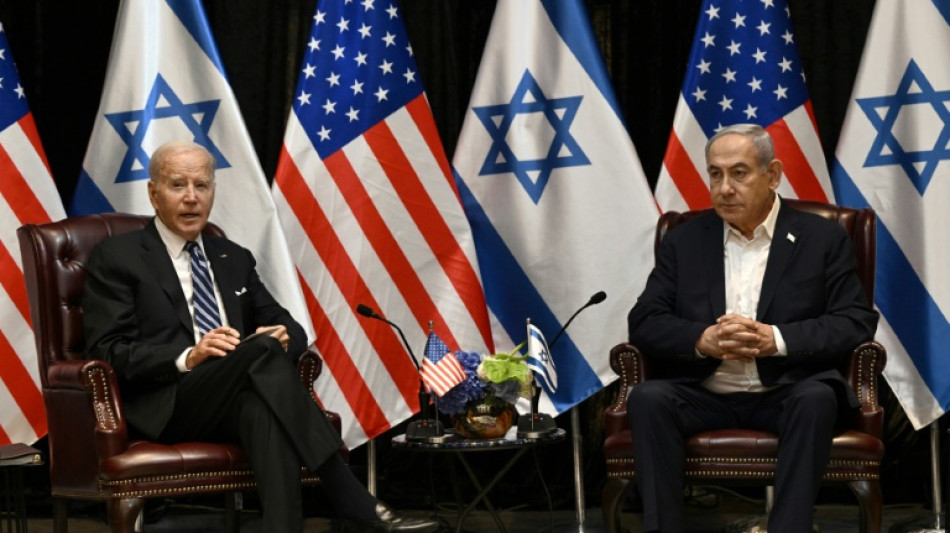
The administration of President Joe Biden has begun to publicly air its differences with the Israeli government over the conduct of the war in Gaza, expressing its exasperation even as it remains largely steady in its support.
Biden referred this week to "indiscriminate bombing" in Gaza, underscoring his frustration with conservative Israeli Prime Minister Benjamin Netanyahu, whose government Biden agrees is starting to lose global support.
The Democratic US administration is even beginning to talk about a "timetable" for how long Israel's high-intensity military operations can continue.
Warnings have multiplied in recent weeks, with senior US officials such as Vice President Kamala Harris and Secretary of State Antony Blinken speaking of the "far too high" number of Palestinian civilians killed, and the gap between commitments made by Israel to respect civilian lives and the reality on the ground.
Israel has pounded Gaza day after day since the start of the conflict on October 7, interrupted only by a brief humanitarian truce at the end of November.
Defense Secretary Lloyd Austin recently warned Israel of what is at stake: "In this kind of a fight, the center of gravity is the civilian population. And if you drive them into the arms of the enemy, you replace a tactical victory with a strategic defeat."
But Washington, Israel's main diplomatic and military ally, has been careful not to openly criticize its ally, and has resisted calls for a ceasefire, which it said would benefit Hamas, despite international pressure.
Indeed, the United States appears increasingly isolated in its support, as evidenced by Tuesday's vote in the UN General Assembly calling for such a ceasefire, passed by 153 member states, with only the US and nine other states voting against and 23 abstaining.
- 'Timetables' -
The trigger for the war was the bloody October 7 assault by Hamas militants on Israel.
Since then, the Biden administration has pressed its ally to unblock humanitarian aid for people in Gaza, work to free hostages kidnapped by Hamas on the day of the attack, and adopt a more targeted military strategy.
In private, US diplomats have made no secret of their dissatisfaction with Israel's conduct of the war.
As a sign of the US pressure on Israel, National Security Advisor Jake Sullivan will visit Israel on Thursday and Friday, the White House said.
"I will certainly be talking to the PM, the war cabinet and senior Israeli officials about timetables, about how they are thinking about that," Sullivan told the Wall Street Journal on Tuesday, suggesting a shift from the "high intensity military operations of the kind we have seen over the past weeks."
For his part, Biden at the White House on Wednesday received for the first time families of US hostages held in Gaza by Hamas, a senior official said.
- What happens post-war? -
If there is a shift in the US position toward Israel, it may reflect the domestic political situation as well.
"There is a lot of pressure on the Biden administration among his own party and constituency" on policy toward Israel, said James Ryan, director of the Middle East program at the Foreign Policy Research Institute, a nonprofit think tank.
But any shift also signals "a tacit admission" of limited US ability to influence the Israeli government, he added.
Differences also loom over views on what happens after the war ends.
Washington insists on a two-state solution as the only way to resolve the Israeli-Palestinian question in the long term, which Israel rejects.
As far as who would govern in post-conflict Gaza, the US and Israel are at odds over the idea of handing reins to a revitalized Palestinian Authority.
"A revitalized, reformed and reorganized Palestinian Authority is the way forward for the governance of a reunited West Bank and Gaza," State Department spokesman Matthew Miller said on Wednesday.
M.Carneiro--PC