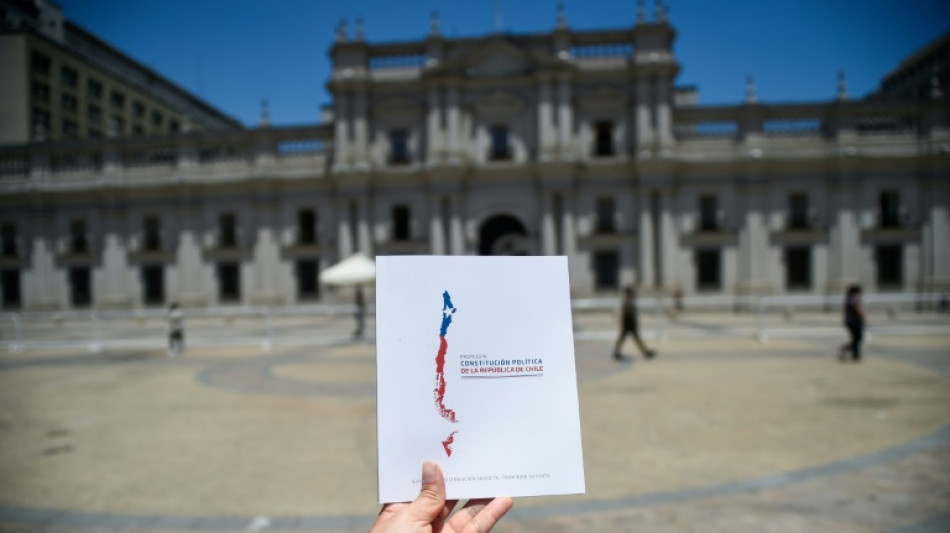
Chile votes in second shot at new constitution / Photo: Pablo Vera - AFP

 Kenya reports first-ever Ebola death

 Tennis world No.1 Sinner's season over due to knee injury

 Yemen's Houthis claim attack on Riyadh airport, deny losing territory

 7-Eleven exits India amid mounting competition
 The alleged murder by US marine on Okinawa: five things to know

 End of an era as Messi prepares to hang up Argentina boots

 Superstar duo headline strong New Zealand squad for Rugby League World Cup

 South Korea warns of possible AI use in banking hacks

 EU vows AI rules will protect Europeans. Will they?

 Myanmar leader to visit Malaysia after migrant returns begin
 Germany's AfD poised to preside over state assembly for first time
 Australia's opposition vows 'largest cut to immigration' in country's history
 Ready, set, snooze: Sleep-deprived Japanese compete for best-rested

 Falcons thump Saints 45-24 as New Orleans marks Katrina anniversary

 Tuvalu govt adviser says Australia overstepped in pre-COP visit
 Asian stocks mixed despite tech-led Wall St record

 Tens of thousands expected in Paris for high school protests

 AI borrowing binge rattles US markets

 Young Canadians sue government over alleged climate failures

 White Sox down Guardians to take 2-0 series lead
 NHL record-breaker Ovechkin says current season will be his last
 France roar back in Nations League as Italy beat Turkey

 Messi readies for final farewell in Argentina send-off

 Esposito seals Italy win over Turkey in Nations League

 Russia downplays plague reports as Trump offers US help

Chileans head to the polls Sunday for a second referendum aimed at replacing the country's dictatorship-era constitution, with voters asked to approve or reject a more conservative draft.
The latest version was overseen by the far-right opposition Republican Party after voters roundly rejected a progressive draft in September 2022 that attempted to enshrine environmental protections and the right to elective abortion.
Voting starts at 8am local time (1100GMT) and closes at 6pm (2100 GMT), with results due a few hours later.
Leftist President Gabriel Boric said last month that it would be his last attempt to reform the constitution in order to focus on stability and long-term development.
Polls, banned in the two-week run-up to the referendum, have predicted another rejection.
The process to rewrite the 1980 constitution, adopted under the Augusto Pinochet military dictatorship, began as a bid to ease mass protests that broke out in October 2019 against social inequality.
In a 2020 referendum, 80 percent voted for replacing the constitution.
However, four years after the protests erupted, enthusiasm has been dampened by the pandemic, inflation and economic stagnation, a growing sense of insecurity, and voter fatigue, say analysts.
"There is an atmosphere of great disenchantment, of little interest, little motivation, of fatigue with the constitutional issue," said political scientist Claudia Heiss from the University of Chile.
"People want more basic things: They want security, public order, more police on the streets; to return to normality after a couple of years of a very abnormal life," she added.
- 'Even more to the right' -
The opposition has presented the vote as a referendum on Boric, who rode the wave of public discontent to be elected Chile's youngest-ever leader in late 2021 at 35.
Boric, whose approval has plummeted to around 30 percent, already suffered a setback in May when Chile's far-right Republican party came first in a nationwide vote to choose the members of the rewrite committee.
The 1980 constitution is widely blamed for allowing companies and the elite to enrich themselves at the expense of the poor, working classes.
The first rewrite included stronger protections for Indigenous rights, proposals to protect natural resources such as water, and required women to hold at least half of positions in public institutions.
Heiss said the latest rewrite "falls between the 1980 constitution and one even more to the right," especially on issues like abortion and public safety.
The new version aims at enshrining the right to life from conception, which experts believe could lead to a challenge of existing laws.
Abortion was banned in Chile until 2017 when it was allowed in cases of rape, when the mother's life is at risk, or the fetus is declared unviable.
The new draft also allows for the expulsion in "the shortest possible time" of undocumented immigrants, with the right blaming rising crime on an influx of Venezuelans fleeing economic crisis in their country.
The proposed constitution does for the first time recognize Indigenous peoples, which make up 12 percent of the population, but does not respond to their request for greater autonomy.
Ferreira--PC