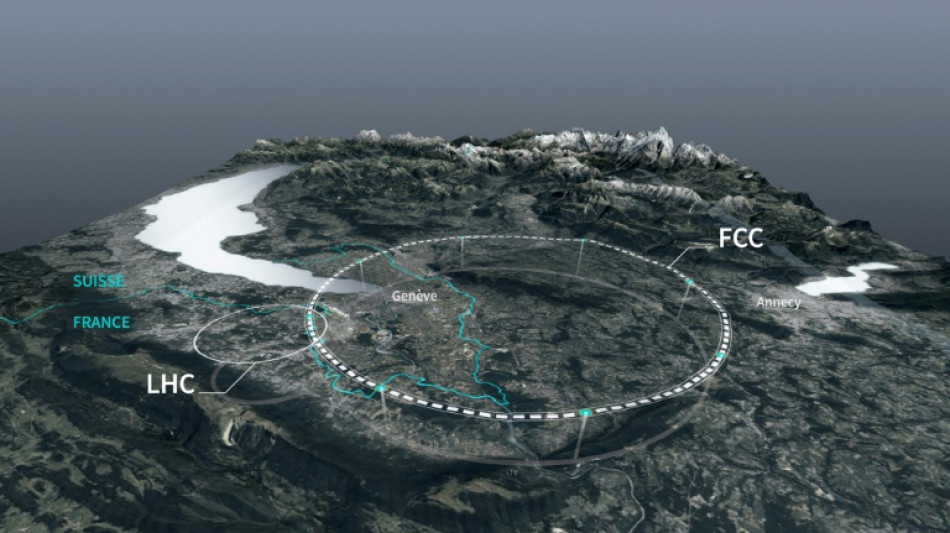
Plan for Europe's huge new particle collider takes shape / Photo: HANDOUT - European Organization for Nuclear Research (CERN)/AFP/File

 Southampton boss Eckert given suspended ban over 'Spygate'

 Russia warns of 'false' information as second plague case reported

 IEA ready to release more oil reserves if necessary

 HSBC 'consults' over UK unit job cuts amid AI adoption

 UK court quashes five ex-traders' Libor rate rigging convictions

 XM Receives “Global Customer Experience Leader Award 2026” at the TrustFinance Performance Awards

 Stocks slide as oil climbs on Mideast flareup

 Heavy casualties in Ukraine after Russian strikes

 French wine harvest set to hit historic low

 Kyiv 'cannot agree' to EU membership limiting food exports: minister

 Arteta targets more Arsenal glory after signing new deal until 2030

 Russell hit with Singapore grid penalty for taking new power unit

 Spotify expands audiobooks to more than 180 markets
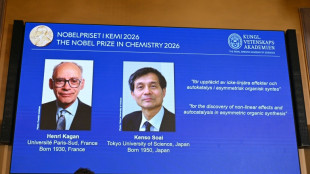 French-Japanese duo wins chemistry Nobel for solving molecular 'mystery'

 England's Nations League surge helps heal World Cup wounds
 Mayor of opposition stronghold Izmir defects to Erdogan party

 Mertens beats Gauff to set up Swiatek clash at China Open

 Benin full of pride at role in Messi's last dance

 France suspends stun grenade use at student protests ahead of PM speech

 Indonesian court hears 'negligence' complaint against state over fires, haze
 Rubio in Greece to urge against Western civilisation 'decline'

 Micron workers at Taiwan plant vote in favour of strike

 In 'The Social Reckoning,' Jeremy Allen White takes on Facebook's 'frightening' ambition

 Chip industry activists call for South Korea to recognise cancer cases

 Famine-scarred southern Madagascar braces for El Nino

Europe's CERN laboratory revealed more details Monday about its plans for a huge new particle accelerator that would dwarf the Large Hadron Collider (LHC), ramping up efforts to uncover the underlying secrets of the universe.
If approved, the Future Circular Collider (FCC) would start smashing its first particles together around the middle of this century -- and start its highest-energy collisions around 2070.
Running under France and Switzerland, it would be more than triple the length of CERN's LHC, currently the largest and most powerful particle accelerator.
The idea behind both is to send particles spinning around a ring to smash into each at nearly the speed of light, so that the collisions reveal their true nature.
Among other discoveries, the LHC made history in 2012 when it allowed scientists to observe the Higgs boson for the first time.
But the LHC, which cost $5.6 billion and began operating in 2010, is expected to have run its course by around 2040.
The faster and more powerful FCC would allow scientists to continue pushing the envelope. They hope it could confirm the existence of more particles -- the building blocks of matter -- which so far have only been theorised.
Another unfinished job for science is working out exactly what 95 percent of the universe is made of. About 68 percent of the universe is believed to be dark energy while 27 percent is dark matter -- both remain a complete mystery.
Another unknown is why there is so little antimatter in the universe, compared to matter.
CERN hopes that a massive upgrade of humanity's ability to smash particles could shed light on these enigmas and more.
"Our aim is to study the properties of matter at the smallest scale and highest energy," CERN director-general Fabiola Gianotti said as she presented an interim report in Geneva.
The report laid out the first findings of a FCC feasibility study that will be finalised by 2025.
- $17 billion first stage -
In 2028, CERN's member states, which include the UK and Israel, will decide whether or not to go through with the plan.
If given the green light, construction on the collider would start in 2033.
The project is split into parts.
In 2048, the "electron-positron" collider would start smashing light particles, with the aim of further investigating the Higgs boson and what is called the weak force, one of the four fundamental forces.
The cost of the tunnel, infrastructure and the first stage of the collider would be about 15 billion Swiss Francs ($17 billion), Gianotti said.
The heavy duty hadron collider, which would smash protons together, would only come online in 2070.
Its energy target would be 100 trillion electronvolts -- smashing the LHC's record of 13.6 trillion.
Gianotti said this later collider is the "only machine" that would allow humanity "to make a big jump in studying matter".
After eight years of study, the configuration chosen for the FCC was a new circular tunnel 90.7 kilometres (56.5 miles) long and 5.5 metres (feet) in diameter.
The tunnel, which would connect to the LHC, would pass under the Geneva region and its namesake lake in Switzerland, and loop round to the south near the picturesque French town of Annecy.
Eight technical and scientific sites would be built on the surface.
CERN said it is consulting with the regions along the route and plans to carry out impact studies on how the tunnel would affect the area.
P.Mira--PC