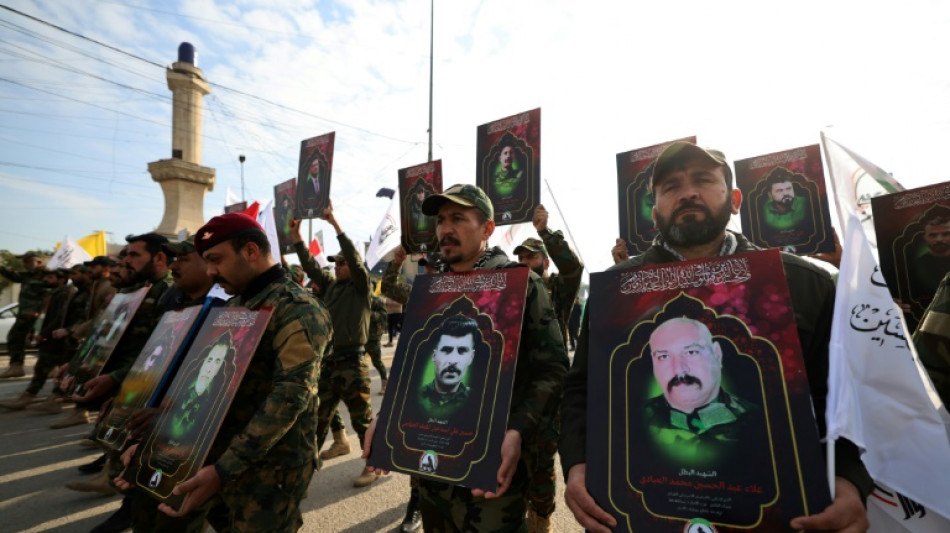
Despite strikes, US still faces threats from Iran-backed forces / Photo: AHMAD AL-RUBAYE - AFP/File

 Southampton boss Eckert given suspended ban over 'Spygate'

 Russia warns of 'false' information as second plague case reported

 IEA ready to release more oil reserves if necessary
 HSBC 'consults' over UK unit job cuts amid AI adoption

 UK court quashes five ex-traders' Libor rate rigging convictions

 XM Receives “Global Customer Experience Leader Award 2026” at the TrustFinance Performance Awards
 Stocks slide as oil climbs on Mideast flareup

 Heavy casualties in Ukraine after Russian strikes

 French wine harvest set to hit historic low

 Kyiv 'cannot agree' to EU membership limiting food exports: minister

 Arteta targets more Arsenal glory after signing new deal until 2030

 Russell hit with Singapore grid penalty for taking new power unit

 Spotify expands audiobooks to more than 180 markets

 French-Japanese duo wins chemistry Nobel for solving molecular 'mystery'

 England's Nations League surge helps heal World Cup wounds

 Mayor of opposition stronghold Izmir defects to Erdogan party

 Mertens beats Gauff to set up Swiatek clash at China Open

 Benin full of pride at role in Messi's last dance

 France suspends stun grenade use at student protests ahead of PM speech

 Indonesian court hears 'negligence' complaint against state over fires, haze

 Rubio in Greece to urge against Western civilisation 'decline'

 Micron workers at Taiwan plant vote in favour of strike

 In 'The Social Reckoning,' Jeremy Allen White takes on Facebook's 'frightening' ambition

 Chip industry activists call for South Korea to recognise cancer cases

 Famine-scarred southern Madagascar braces for El Nino

US military action has so far failed to halt attacks by Iran-backed groups on Washington's forces in the Middle East and shipping in the Red Sea, with the threats persisting despite recent heavy air strikes.
The attacks by militants -- which the armed groups that claim them say are driven by the Israel-Hamas war -- have been launched from or hit four different countries, posing a multi-front challenge for the United States, which aims to curb the unrest while avoiding direct conflict with Iran.
The US hit dozens of Iran-linked targets in Iraq and Syria last week in response to a drone attack that killed three American soldiers in neighboring Jordan, and conducted joint strikes with Britain against Yemeni rebels over the weekend.
But American forces were subsequently targeted in Syria, while the rebels have launched new attacks on merchant vessels.
"I suspect we will have some level of violence persisting for a while. Iran and the groups it supports don't want to announce they've given in," said Jon Alterman, the director of the Middle East Program at the Center for Strategic and International Studies.
"At the same time, I think the number and size of attacks will diminish. This is partly because the US strikes are reducing their capability, and partly because they want to reduce their losses," he said.
- 'Appropriate action' -
Asked Monday if the Pentagon was planning for a long campaign in Iraq and Syria, spokesman Major General Pat Ryder said that "as I understand it, that's not the case."
Questioned on whether strikes would continue as long as attacks on US troops persist, Ryder said: "We're going to take whatever necessary actions are required to protect our forces."
Michelle Grise, a senior policy researcher at RAND, said it is "probable that we will see continued proxy attacks for the duration of the Gaza war, although the intensity and frequency of those attacks may change."
She said there is a scenario in which attacks continue even after an end to the war, but that she would "expect an extended ceasefire to lead to a pausing of the current attacks, at least in the immediate term."
Anger over Israel's campaign in Gaza -- which began after the October 7 attack by Hamas -- has stoked violence involving Iran-backed forces in Lebanon, Iraq, Syria and Yemen.
- Repeated attacks -
American troops in the Middle East have been targeted more than 165 times over the past four months, with many of the attacks claimed by a loose coalition of Tehran-backed armed groups opposed to Washington's support for Israel and the presence of US forces in the region.
Most of the attacks were in Iraq and Syria but one took place in Jordan on January 28, when a drone slammed into sleeping quarters on a remote base, killing three American soldiers and wounding dozens.
The US hit back with a wave of strikes in Iraq and Syria on Friday and said more would follow, but American troops were still attacked in subsequent days, according to the Pentagon.
In Yemen, the Iran-backed Huthi rebels began targeting Red Sea shipping in November, saying they were hitting Israel-linked vessels in support of Palestinians in Gaza.
On Saturday, US and British forces launched their third round of joint strikes against the Huthis since the second week of January, a period during which American forces have also carried out unilateral air raids.
But over the following three days, the US military announced strikes against multiple missiles on the ground in Yemen and two explosive-laden naval drones that posed an "imminent threat," and said the Huthis launched six missiles toward two merchant ships, reportedly lightly damaging one of the vessels.
The US says Tehran is responsible for arming and funding the groups carrying out attacks, but has so far not targeted Iranian territory as it seeks to avoid a potentially devastating war.
"A major direct confrontation threatens to create an open-ended regional war with no clear end point or objectives," Alterman said.
"I don't think the US public wants an open-ended war in the Middle East any more than US partners and allies in the region do."
J.Pereira--PC