Ukrainian justice tested as collaboration cases mount / Photo: Oleh SAMOILENKO - AFP

 After botched execution, US woman was nearly taken off life support before revival
 Searing AIDS drama 'Elsinore' opens London film festival

 Evicted pensioner who sparked Spain housing protests dies: tenant union

 Golf star Rahm quitting LIV tour over 'unacceptable' terms

 Thousands march fearing return of a Bolsonaro presidency in Brazil
 French PM denies police ordered to confront student protesters
 Rubio touts US power, calls on Europe to emerge from 'slumber'

 Trump says 'we don't think' Russian plague is bio-weapon

 Five children among 26 killed in Ukraine after Russian strikes

 Man City should 'accept' punishment for rule breaches, says Lineker

 US woman who survived botched execution is awake and speaking
 From 1800s to modern pharma: a Nobel-winning chemistry quest

 Southampton boss Eckert given suspended ban over 'Spygate'

 Russia warns of 'false' information as second plague case reported

 IEA ready to release more oil reserves if necessary
 HSBC 'consults' over UK unit job cuts amid AI adoption
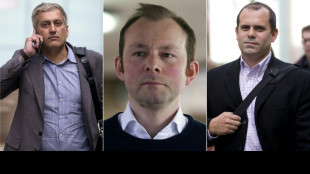 UK court quashes five ex-traders' Libor rate rigging convictions

 XM Receives “Global Customer Experience Leader Award 2026” at the TrustFinance Performance Awards

 Stocks slide as oil climbs on Mideast flareup
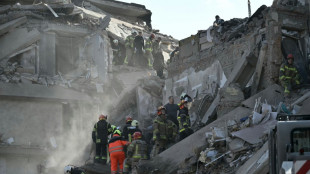 Heavy casualties in Ukraine after Russian strikes
 French wine harvest set to hit historic low

 Kyiv 'cannot agree' to EU membership limiting food exports: minister

 Arteta targets more Arsenal glory after signing new deal until 2030

 Russell hit with Singapore grid penalty for taking new power unit

 Spotify expands audiobooks to more than 180 markets

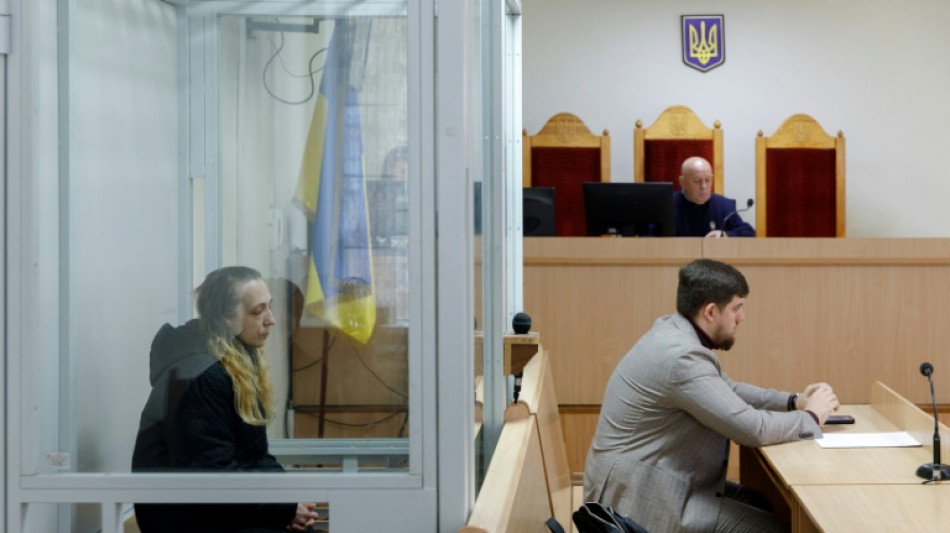
Standing in a glass-walled dock in a courtroom in eastern Ukraine, suspected collaborator Oksana Shepel pleaded with a judge to free her.
"I have no previous convictions, a permanent place of residence, strong social ties and an underage child," she argued, her face pale and her long hair with grown-out bleached ends.
The hearing in a grey low-rise court building in the city of Dnipro is one of thousands of cases of various forms against Ukrainians accused of collaborating with the Russian occupiers.
Similar to trials held across Europe after World War II, the cases also highlight the complexities of meting out justice in parts of the country where residents historically have had split loyalties to Kyiv and Moscow.
They are being seen as a test of the justice system amid concern from some observers over fairness and illustrate the moral dilemmas faced by people who have lived under occupation.
The Prosecutor General's Office has registered over 7,000 cases of collaboration and several thousand more on similar charges.
The number will rise exponentially if Ukraine succeeds in its aim of re-capturing the roughly 20 percent of its territory in Russian hands.
There have been verdicts in 941 collaboration cases, the UN rights office OHCHR said in December, cautioning that some of those convicted had "worked for the benefit of the local population".
- 'Harsh charge' -
Some collaboration cases involve senior officials or those who joined the local Russian military or police.
But many, like Shepel, 39, who is accused of working in the Russian-appointed local administration in Lyman while under a four-month occupation, are accused over civilian jobs.
Her lawyer, Roman Ukhov, told AFP that Shepel "worked her whole life as an ordinary postwoman".
"Prosecutors say -- though there's currently no direct proof -- that for 28 days of occupation, she worked in a division receiving applications for humanitarian aid," he said.
"There shouldn't be such a harsh charge based on the evidence," Ukhov said.
Shepel is charged with voluntarily organising collaborative activities -- a crime punishable by 5 to 10 years in jail.
Reading from hand-written notes, Shepel told the judge: "the position I'm charged with holding did not cause any harm to the state or other people."
"I did not perform any managerial functions," she said.
Opinions in Ukraine are divided over these cases.
A survey for the School for Policy Analysis in October found 51 percent of Ukrainians think those who distributed Russian humanitarian aid in occupied areas should be punished.
Twenty-six percent thought they should not be.
- 'Victim of circumstances' -
ZMINA human rights centre in Kyiv says the majority of convictions are for the mildest form of collaboration: public denial or praise for Russia's aggression, including on social media.
Ukraine needs to change the law "to criminalise the most prominent cases of collaboration, but not ordinary supporting likes or reposts on Facebook," said Olena Luniova, advocacy director at ZMINA, which monitors collaboration trials.
Ukhov is defending several suspected collaborators.
One client, 64-year-old Valentyna Tkach, has been held in a pre-trial detention centre for over a year.
Wearing a green winter coat and boots, her greying hair in a ponytail, she sat next to Ukhov in court due to hearing problems.
Tkach faces the same charge as Shepel for allegedly heading a neighbourhood residents' body during the occupation.
Ukhov told AFP she was already deputy head and took charge when the head left, but there was no proof that Russians appointed her.
"She handed out documents to occupying authorities to say people needed coal, some food, water. And that doesn't contravene the Geneva Convention," Ukhov said.
"What were people supposed to do? Just die?"
Tkach "was a victim of circumstances and shouldn't be in jail," Ukhov argued.
- 'They will break' -
After her detention, the SBU security service said in a statement that Tkach had "offered Russian ration packs", denounced resistance fighters and helped organise a fake referendum.
One witness accused Tkach of betraying him to Russian forces, who abducted him, Ukhov said.
But others said she only liaised with Russians to provide humanitarian aid.
In Shepel's case, judge Yuriy Shofarenko scheduled her next hearing for two months later and banned family visits.
"It's possible -- and this is my subjective opinion -- that this is some kind of pressure" since the longer suspects are held before trial "the more likely they will break," Ukhov said.
He plans to file a complaint with the European Court of Human Rights.
Ukraine is also conducting speedier collaboration trials "in absentia", when defendants are in Russia or occupied territory.
At one trial in Dnipro, the judge rejected a state-appointed lawyer's objection that she was unable to contact the defendant in an occupied town.
The judge, Viktoriya Ignatenko, scheduled the next hearing for a week later.
"We have lots of cases like this. Come again," she told AFP.
N.Esteves--PC