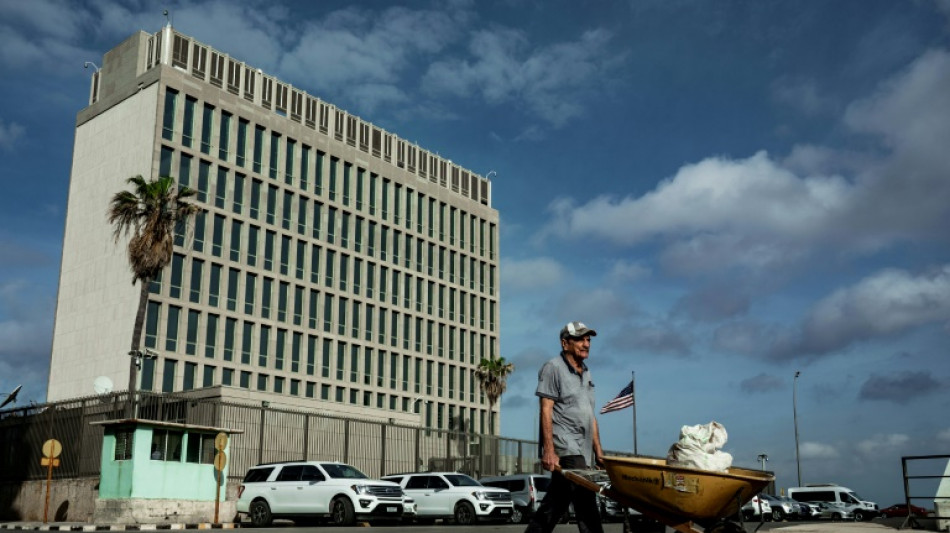
New research deepens Havana Syndrome mystery / Photo: YAMIL LAGE - AFP

 CNN, MS Now, Politico urge judge to extend White House access
 Trump administration to launch new vaccine research center

 Russian strikes kill 30 in Ukraine frontline city, talks set in US

 US military to livestream firing squad execution of Fort Hood shooter

 Aces star Wilson wins record-extending fifth WNBA MVP

 Undefeated 49ers seek Seahawks revenge

 Madrid mourns evicted retiree, 'icon' of Spain housing protests

 OpenAI revenue gap report rattles AI stocks
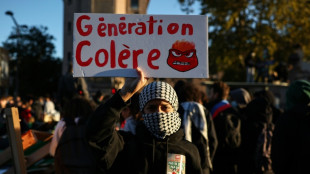 France pledges more teachers after school students vow no let-up
 Bordeaux confirmed in sixth tier of French football
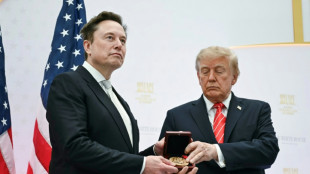 Trump gives 'national treasure' Musk top US medal after rift

 MLB proposes shortening season, reforming playoffs

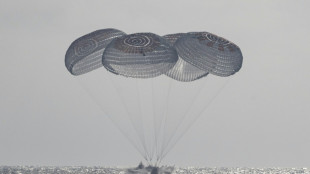 Crew splashes down after 8-month mission on International Space Station

 Protests, clashes as S. African anti-migrant tensions reignite
 Russian data centre hit by drone in first for Ukraine war

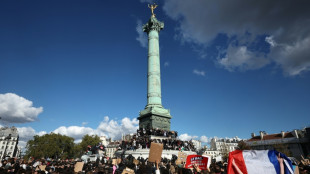 'Fighting for our future': France high school students vow no let-up

 Kyiv entering 'survival' mode amid Russian strikes surge: mayor tells AFP

 Verdict due in Mexico trial over murders of Australia, US surfers
 B2PRIME Welcomes Christina Barbash as Commercial Manager

 Russia forcing Kyiv into 'survival' mode before winter, mayor tells AFP

 Closing arguments begin in Maradona death trial

 UEFA president Ceferin to stand for re-election in 2027

 Nearly 300,000 Nepalis at flood risk: study
 Riyadh kindergarten hit by interception debris as Houthis say targeted airport
 Alex Bodi mizează, alături de CRIF, pe investiții transparente și pe prevenirea riguroasă a spălării banilor

The mystery of so-called Havana Syndrome, which struck down dozens of US diplomats, deepened Monday as new research found no tangible evidence of brain injury in those affected.
Researchers at the National Institutes of Health (NIH) acknowledged that ongoing symptoms including migraines, chronic dizziness, and depression are still very much real -- even if they cannot yet be explained.
Havana Syndrome first baffled officials in 2016 when US diplomats in Cuba's capital reported falling ill and hearing piercing sounds at night, sparking speculation of an attack by a foreign enemy using an unspecified sonar weapon.
Similar reports of the illness later emerged from embassy staff in China, Europe and US capital Washington.
Yet despite the "disabling" symptoms, people with Havana Syndrome -- formally referred to as anomalous health incidents (AHIs) -- show no clinical differences, according to two new papers published Monday in peer-reviewed journal JAMA.
Leighton Chan, lead author of one of the papers, said "it's important to acknowledge that these symptoms are very real, cause significant disruption in the lives of those affected and can be quite prolonged, disabling and difficult to treat."
In this study, researchers assessed more than 80 US government officials and their family members using MRI brain scans and other blood, visual and auditory tests. They were compared with a control group of overseas US officials who had similar work assignments but were unaffected by the symptoms.
It found those with AHIs self-reported increased symptoms of fatigue, post-traumatic stress and depression.
- 'Genuine, distressing' -
Forty one percent of those with AHIs met the criteria for "functional neurological disorder" -- problems with the way the brain sends and receives information from the rest of the body, and as a result nearly all with this dysfunction could be diagnosed with a chronic form of dizziness.
"These individuals have symptoms that are genuine, distressing, and can be quite prolonged, disabling, and difficult to treat," said the researchers.
In the second paper, participants underwent MRI scans to examine their brain size, structure, and function. These were carried out on average 80 days after symptom onset and revealed no imaging abnormalities differentiating the group with AHIs.
But this "does not exclude that an adverse event impacting the brain occurred at the time of the AHI," said Carlo Pierpaoli, who led the study.
The US State Department was reviewing the research, a spokesperson said Monday, adding its "top priority remains the health, safety, and security of the Department’s personnel and family members."
US intelligence had said in 2022 that intense directed energy from an external source could have caused some cases of Havana Syndrome, officially known as anomalous health incidents (AHIs).
But in March 2023 intelligence agencies concluded that "there is no credible evidence that a foreign adversary has a weapon or collection device that is causing AHIs."
They reported the symptoms were probably the result of preexisting conditions, conventional illnesses and environmental factors.
David Relman of Stanford University, who has led previous research into Havana, said the new study was flawed as not all brain injuries were detectable with the tests used.
In an editorial also published in JAMA, Relman cited two previous studies he contributed to which found the cases "to be unlike any disorder reported in the neurological or general medical literature, and potentially caused by an external mechanism."
T.Batista--PC