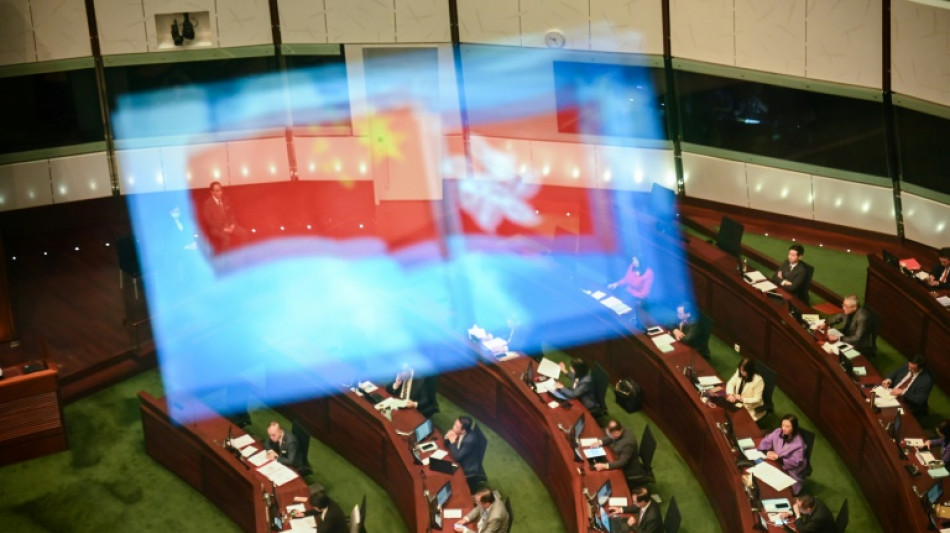
Hong Kong's new national security law comes into force / Photo: Peter PARKS - AFP

 Record Eden Park streak creates tension for All Blacks

 EU trade chief seeks 'tangible outcomes' in China talks

 Man City face Anfield cauldron after guilty Premier League verdicts

 CNN, MS Now, Politico urge judge to extend White House access

 Trump administration to launch new vaccine research center

 Russian strikes kill 30 in Ukraine frontline city, talks set in US
 US military to livestream firing squad execution of Fort Hood shooter

 Aces star Wilson wins record-extending fifth WNBA MVP
 Undefeated 49ers seek Seahawks revenge
 Madrid mourns evicted retiree, 'icon' of Spain housing protests

 OpenAI revenue gap report rattles AI stocks
 France pledges more teachers after school students vow no let-up
 Bordeaux confirmed in sixth tier of French football
 Trump gives 'national treasure' Musk top US medal after rift

 MLB proposes shortening season, reforming playoffs

 Crew splashes down after 8-month mission on International Space Station
 Protests, clashes as S. African anti-migrant tensions reignite
 Russian data centre hit by drone in first for Ukraine war

 'Fighting for our future': France high school students vow no let-up
 Kyiv entering 'survival' mode amid Russian strikes surge: mayor tells AFP

 Verdict due in Mexico trial over murders of Australia, US surfers
 B2PRIME Welcomes Christina Barbash as Commercial Manager

 Russia forcing Kyiv into 'survival' mode before winter, mayor tells AFP
 Closing arguments begin in Maradona death trial
 UEFA president Ceferin to stand for re-election in 2027

Hong Kong's new national security law came into force on Saturday, putting into immediate effect tough penalties of up to life imprisonment for crimes including treason and insurrection.
The law -- commonly referred to as Article 23 -- targets five categories of national security crimes and was swiftly passed by Hong Kong's opposition-free legislature on Tuesday.
The United States, the European Union, Japan and Britain have been among the law's strongest critics, with UK Foreign Minister David Cameron saying it would "further damage the rights and freedoms" of those in the city.
US Secretary of State Anthony Blinken on Friday expressed "deep concern" that the law could be used to undermine rights and curb dissent, adding it could damage Hong Kong's reputation as an international finance hub.
But Hong Kong leader John Lee has called the passage of the "Safeguarding National Security Ordinance" a "historic moment".
He has often cited Hong Kong's "constitutional responsibility" to create the new legislation as required by the Basic Law, the city's mini-constitution since its handover from Britain to China in 1997.
Lee also said the law was necessary to "prevent black-clad violence", a reference to Hong Kong's massive and at times violent pro-democracy protests in 2019, which brought hundreds of thousands to the streets demanding greater autonomy from Beijing's grip.
In response, authorities cracked down on protesters, and Beijing imposed a national security law in 2020 -- targeting secession, subversion, terrorism and collusion with foreign forces -- which has effectively silenced opposition voices among Hong Kong's once-vibrant civil society.
Nearly 300 people have been arrested under the 2020 law so far.
But Lee -- sanctioned by the United States for his role as security chief during the 2019 protests -- has said Article 23 was still needed to "plug" the legislative gaps of Beijing's law.
- Life in prison -
Under the new law, penalties run up to life in prison for sabotage endangering national security, treason and insurrection; 20 years for espionage and sabotage; and 14 years for external interference.
It has also expanded the British colonial-era offence of "sedition" to include inciting hatred against China's Communist Party leadership, with an aggravated sentence of up to 10 years in jail.
City leader Lee is now empowered to create new offences carrying jail terms of up to seven years through subsidiary legislation, while the security minister can impose punitive measures on activists who are overseas, including cancelling their passports.
Police powers have also been expanded to permit detaining people for up to 16 days without charge -- a jump from the current 48 hours -- and to restrict a suspect from meeting lawyers and communicating with others.
The United Kingdom and Australia on Friday updated their travel advice to warn citizens about the risks of breaching the new law when travelling to Hong Kong.
Former US House speaker Nancy Pelosi said at a Friday press conference that the new law was an "alarming expansion of the Chinese Communist Party's assault on freedom in Hong Kong".
A previous attempt by the government to introduce Article 23 in 2003 was dropped after half a million Hong Kongers protested against the law.
This time, public response in the city was muted after the law's passage.
But protests are expected worldwide, from Australia and Canada to Britain, where a large Hong Kong diaspora relocated after the government's crackdown on the 2019 protests.
Dozens joined a rally in Taipei on Saturday afternoon to protest the law, with some holding placards calling Article 23 an "evil law" and images of the now-shuttered pro-democracy newspaper Apple Daily.
"As a Hong Konger overseas, I think I have a duty to come out... to (oppose) this law," said event organiser Sky Fung, adding that dissent had become difficult for those living in Hong Kong.
Leos Lee, a former Hong Kong district councillor who moved to Taiwan, said he believed that the Hong Kong diaspora community would organise protests abroad.
"Basically after today, Hong Kong does not have democracy and freedom of speech anymore," he told AFP.
F.Ferraz--PC