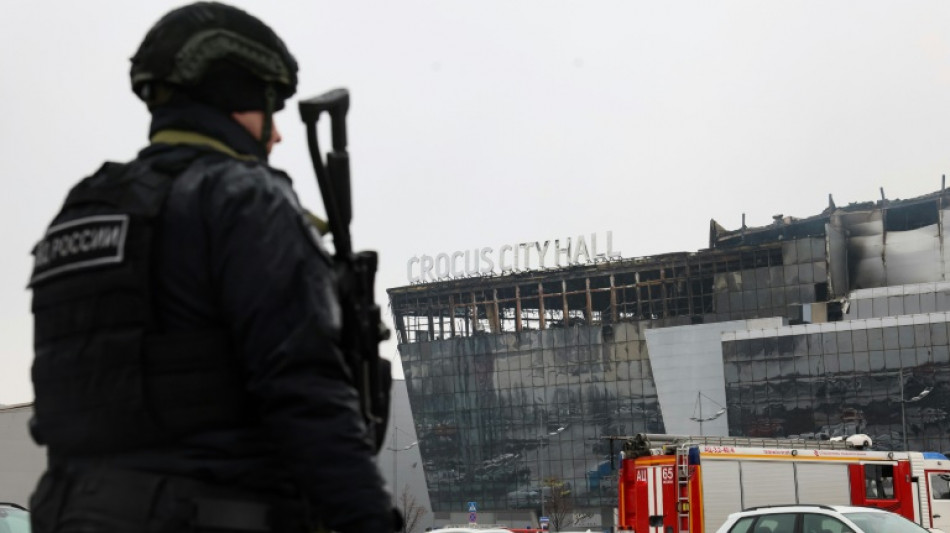
Russia's opposition blasts Putin's broken security promises / Photo: STRINGER - AFP

 Asian stocks mixed amid AI concerns, oil dips after surge

 Wallabies expect fast-paced All Blacks in Bledisloe opener

 Tech scammer Elizabeth Holmes focus of documentary by absurdist Nathan Fielder
 Climate hopes shift from politics to the courts

 Will Nobel Peace Prize pick make waves at the White House?

 Trump rules out new Iran attack before US midterm elections

 Far-right influencer shows Israel's coarse political turn
 Seals and sea lions get hearing tested at Australia zoo

 Mourinho's Real Madrid playing catch-up in Clasico countdown
 Joy as USS Lincoln back home after troubled Gulf deployment
 OpenAI says Iran, Russia influence ops busted
 Anthropic bans 'cruel' behavior against its Claude AI
 Anne Carson's Nobel literature prize 'a proud moment for Canada': PM

 Montagliani to seek CONCACAF re-election in boost for Infantino: reports

 Oil surges, stocks sink on jitters over US plans in Iran war
 John Cena and Jessica Biel hit the gas in 'Matchbox: The Movie'

 US, Ukrainians, Europeans to discuss 'new ideas' to end war
 Unproven 'cures' pushed online amid plague concerns

 Nigeria looks to ease fuel prices as election looms

 Prosecutors in Maradona death trial seek sentences up to 12 years

 Swiss captain Xhaka gets suspended fine for fake Covid cert

 Ex-prince Andrew raid warrants ruled 'unlawful' but UK police maintain probe
 Two Latvians arrested inside UK military base: police

 Eckert 'forever grateful' for Southampton support over spy scandal
 Venezuela's Maduro, wife hit with new US torture charges
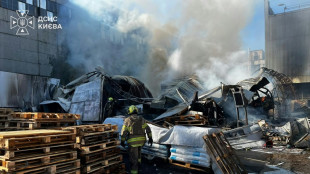
Russia's opposition has slammed Vladimir Putin's broken security promise in the wake of the Moscow concert hall attack, saying the country's intelligence agencies were too focused on hunting Kremlin critics instead of actual threats.
Questions have swirled over how the country's powerful security apparatus was unable to thwart the deadliest attack in Russia in two decades -- even as Western counterparts issued public and private warnings just two weeks prior.
"What is striking is the catastrophic incompetence of our security services," said Ivan Zhdanov, the former head of late opposition leader Alexei Navalny's anti-corruption foundation.
For Putin, a former Soviet spy and one-time head of the FSB security agency, accusations of an intelligence failure could sting.
He came to power on the final day of 1999 promising Russia security as rebel insurgents launched a spate of attacks amid war in Chechnya.
Putin's first years as president saw militants storm a Moscow theatre, taking more than 900 people hostage, and the Beslan school siege -- in which more than 300 people, mostly children, were killed.
After that, he chipped away at civil liberties and launched an escalating crackdown against his opponents, which he justified by the need to stamp out the terrorist threat.
"For decades we have been told that the curtailment of our rights is necessary for security," Zhdanov said in a post on Telegram over the weekend.
"But the terrorist attacks do not stop, and the FSB is busy with everything except its direct responsibilities -- killing their political opponents, spying on citizens and prosecuting people who are against the war."
- 'Blackmail' -
Russian officials are yet to comment on Islamic State (IS) claiming responsibility for the concert hall attack, which killed more than 130.
It is already the most deadly attack in Europe to have been claimed by IS, and Russia says it expects the death toll to rise further.
In the aftermath, attention has focused on a warning issued by the United States just two weeks earlier.
On 7 March, the US Embassy in Moscow said it was "monitoring reports that extremists have imminent plans to target large gatherings in Moscow, to include concerts."
Speaking to FSB chiefs last Tuesday -- just three days before the attack -- Putin called the statement "provocative" and "outright blackmail … to intimidate and destabilise our society."
As he praised the agency's anti-terrorism work, he stressed that its most important effort was related to the "special military operation," the term Russia uses for its invasion of Ukraine, and hunting down pro-Ukrainian sabotage groups.
- 'Impotence' -
In the wake of the attack on Crocus City Hall, Putin's critics said his campaign to transform Russia's security services into agencies designed to spy and harass them had left Russia vulnerable to real attacks.
"They are incapable of doing anything useful -- they just protect the criminal regime from its citizens, and not the citizens from criminals," said Dmitry Gudkov, a former lawmaker and now opposition figure.
In a post on social media, exiled former oil tycoon Mikhail Khodorkovsky -- who spent 10 years in a Russian prison before being released in 2013 -- said the attack showed the "impotence" of the Kremlin's security apparatus.
Putin has always promoted the country's intelligence and security services as elite operators.
Over recent years, the Kremlin has relied on those agencies to crack down on its main opponents, whom it dubs "terrorists" and "extremists".
A record 143 terror-related criminal cases were opened last year, according to the independent Mediazona news site. Between 2012-2017 there were fewer than 20 a year.
"There are a lot of cases about preparing (terrorist acts) -- among them are cases that are entirely fictitious," said editor-in-chief Sergei Smirnov.
The FSB has also been linked to a spate of poisonings. They include targeting Kremlin critics like Navalny and Vladimir Kara-Murza at home, and former spies like Sergei Skripal and Alexander Litvinenko abroad.
Authorities have opened 141 criminal cases against Navalny's associates in the last five years, his former chief of staff Leonid Volkov said Saturday in a post on Telegram.
The FSB "likes to make up non-existent terrorists … so there's not enough time for the real ones," said Volkov, who was attacked in Lithuania earlier this month in an incident he said was ordered by Putin henchmen.
"It certainly can't surprise anyone then, that the FSB can't do the only job it really should be doing: preventing a real, nightmarish terrorist attack."
A.Santos--PC