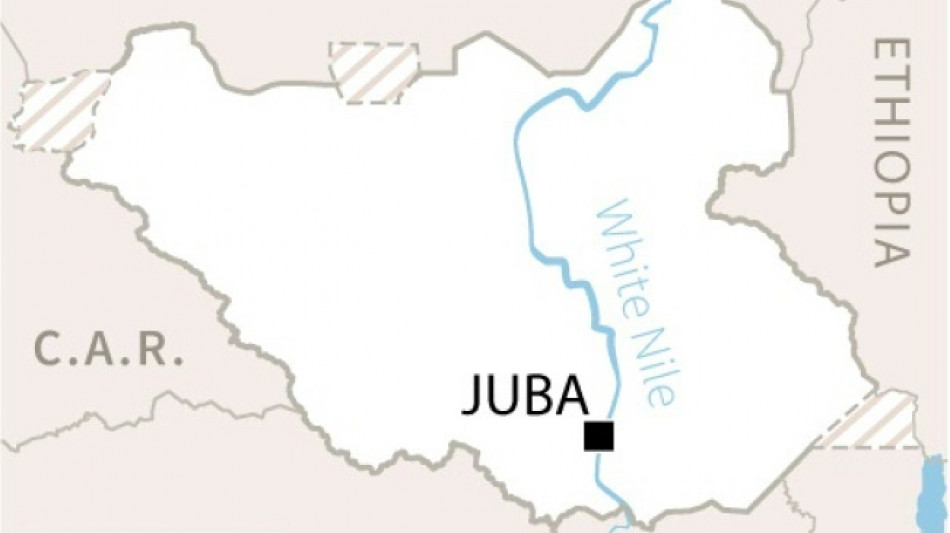
Fragile South Sudan risks turmoil over oil disruption: experts / Photo: Sophie RAMIS - AFP/File

 'Tough to stay here': Nepal flood survivors wait for homes

 Malaysia closes schools in capital, parts of country due to haze

 Buccaneers stun Cowboys for first win of NFL season

 Activists hope trial will stop 'forever chemicals' at Italy plant

 Guardians rally for 9-5 victory over White Sox to stay alive in MLB playoffs
 Asian stocks mixed amid AI concerns, oil dips after surge

 Wallabies expect fast-paced All Blacks in Bledisloe opener

 Tech scammer Elizabeth Holmes focus of documentary by absurdist Nathan Fielder

 Climate hopes shift from politics to the courts
 Will Nobel Peace Prize pick make waves at the White House?
 Trump rules out new Iran attack before US midterm elections

 Far-right influencer shows Israel's coarse political turn

 Seals and sea lions get hearing tested at Australia zoo

 Mourinho's Real Madrid playing catch-up in Clasico countdown

 Joy as USS Lincoln back home after troubled Gulf deployment
 OpenAI says Iran, Russia influence ops busted
 Anthropic bans 'cruel' behavior against its Claude AI

 Anne Carson's Nobel literature prize 'a proud moment for Canada': PM

 Montagliani to seek CONCACAF re-election in boost for Infantino: reports

 Oil surges, stocks sink on jitters over US plans in Iran war

 John Cena and Jessica Biel hit the gas in 'Matchbox: The Movie'

 US, Ukrainians, Europeans to discuss 'new ideas' to end war
 Unproven 'cures' pushed online amid plague concerns

 Nigeria looks to ease fuel prices as election looms

 Prosecutors in Maradona death trial seek sentences up to 12 years

Oil-dependent South Sudan is at risk of economic and political turmoil over the shutdown of a key pipeline in its war-torn neighbour, Sudan, experts have warned.
Analysts voiced deep concern at the loss of crucial oil revenue in one of the poorest countries on the planet, and the possibility it may force South Sudan's first ever elections to be delayed once again.
In a letter dated March 16, Sudan's energy minister declared force majeure over a "major rupture" on the pipeline that ships crude from South Sudan to the Red Sea city of Port Sudan for export.
It said the rupture occurred in February in a "military operations area" in Sudan, where conflict has been raging since April last year.
Boutros Magaya, head of a South Sudanese parliamentary sub-committee on petroleum, warned of the "grave implications" of the shutdown on people's livelihoods and security and that the country faced an "imminent economic crisis".
"With the loss of the majority of our national income, we face the grim prospect of a humanitarian disaster, political instability and security unrest (in) our already fragile state," he said in a statement on Tuesday.
- 'Significant losses' -
Despite its oil riches, the world's youngest nation has struggled to find its footing since independence from Sudan in 2011, battling ethnic violence, chronic instability, poverty and natural disasters.
About nine million of its 12.4 million people are in need of humanitarian assistance, according to UN figures.
Petroleum exports accounted for about 90 percent of South Sudan's national income and Magaya warned that it could lose at least $100 million a month without the oil sales.
"This will result in significant losses of income, increase in market prices, fuel shortages, prolonged power outages, disruptions in transportation, and other essential services that are vital for the well-being of our citizens."
South Sudan's ruling elite are accused by the UN of massive plundering of public coffers and resources, with the country ranked 177th out of 180 on Transparency International's corruption index.
When South Sudan became independent, it took over about three-quarters of the oil reserves of the old Sudan, while Khartoum retained control of all pipeline and export facilities.
According to the bp Statistical Review of World Energy, South Sudan produced 153,000 barrels per day in 2021, while Sudan's output was 64,000 bpd.
- Salaries unpaid -
Sudan has been at war since April 2023 when fighting erupted between the army and the paramilitary Rapid Support Forces (RSF).
The conflict has killed thousands of people, forced millions to flee -- including about 500,000 to South Sudan -- and pushed the country to the brink of famine.
The government in Juba, which has been involved in efforts to end the Sudan conflict, has not commented publicly on the force majeure declaration.
Boboya James Edimond, executive director of Juba-based think tank the Institute for Social Policy and Research, said oil sales have been financing 95 percent of government operations.
Even when the oil was flowing, he said the government has not been able to pay civil servant salaries for months.
"And if the oil is not going to be flowing, there will be a collapse of the government which might force citizens to go for protest and the military is likely to join," he warned.
Akol Maduok, head of the economics department at the University of Juba, said bluntly that the situation was "not good" for the average South Sudanese.
"The situation will worsen in the next two or three months because the central bank might run short of foreign reserves and it will not be able to supply hard currency into the market."
Andrew Smith, senior Africa analyst at risk intelligence company Verisk Maplecroft, said the hit to government finances caused by the damaged pipeline meant it was "highly likely" the election scheduled for December will be delayed.
"Juba appealed for more financing for the polls from the international community in early February, before the pipeline was damaged," he said in a note to AFP.
"Any funds it receives to plug oil revenue shortfalls will now likely be directed towards placating the political elite, not election preparations which were already under resourced."
L.E.Campos--PC