Colombia's cocaine canyon: the guerrilla turf impeding peace / Photo: Raul ARBOLEDA - AFP

 'Tough to stay here': Nepal flood survivors wait for homes

 Malaysia closes schools in capital, parts of country due to haze

 Buccaneers stun Cowboys for first win of NFL season
 Activists hope trial will stop 'forever chemicals' at Italy plant
 Guardians rally for 9-5 victory over White Sox to stay alive in MLB playoffs
 Asian stocks mixed amid AI concerns, oil dips after surge

 Wallabies expect fast-paced All Blacks in Bledisloe opener
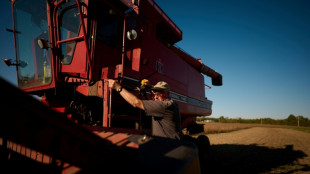
 Tech scammer Elizabeth Holmes focus of documentary by absurdist Nathan Fielder

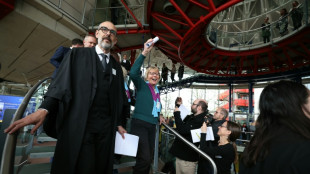 Climate hopes shift from politics to the courts
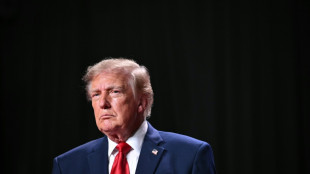 Will Nobel Peace Prize pick make waves at the White House?
 Trump rules out new Iran attack before US midterm elections

 Far-right influencer shows Israel's coarse political turn

 Seals and sea lions get hearing tested at Australia zoo

 Mourinho's Real Madrid playing catch-up in Clasico countdown

 Joy as USS Lincoln back home after troubled Gulf deployment
 OpenAI says Iran, Russia influence ops busted
 Anthropic bans 'cruel' behavior against its Claude AI
 Anne Carson's Nobel literature prize 'a proud moment for Canada': PM

 Montagliani to seek CONCACAF re-election in boost for Infantino: reports

 Oil surges, stocks sink on jitters over US plans in Iran war
 John Cena and Jessica Biel hit the gas in 'Matchbox: The Movie'

 US, Ukrainians, Europeans to discuss 'new ideas' to end war
 Unproven 'cures' pushed online amid plague concerns

 Nigeria looks to ease fuel prices as election looms

 Prosecutors in Maradona death trial seek sentences up to 12 years

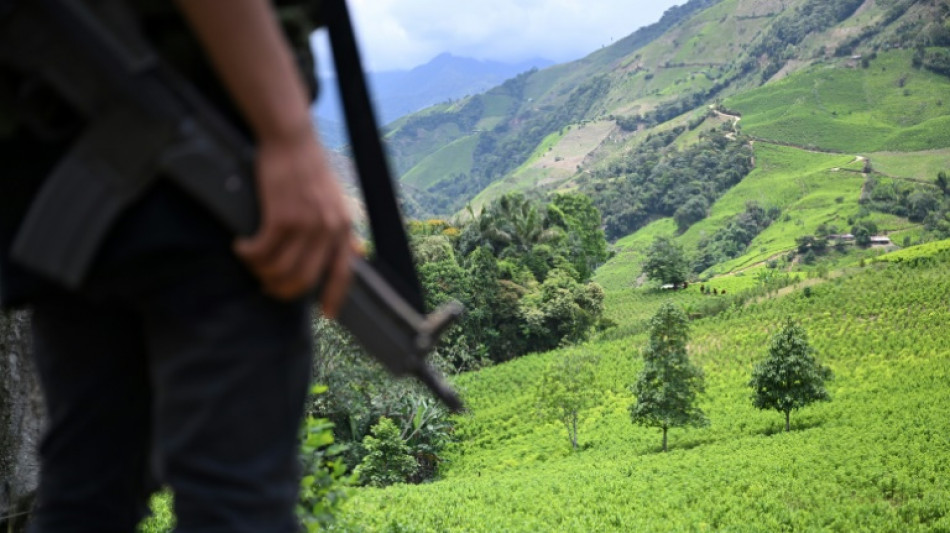
Bright green coca plantations blanket the mountains along the narrow Micay canyon, the heartland of Colombia's holdout guerrillas who rule their fiefdom like a mini-state.
Along dirt roads, in makeshift laboratories, farmers openly mix coca leaf with gasoline to extract a paste used to make the pure cocaine that is one of Colombia's top exports.
Micay canyon is a major source of tension in negotiations between the government and the Central General Staff (EMC) rebels who broke away from the FARC when it signed a 2016 peace deal.
The canyon lies in Cauca, one of three regions where the government suspended a ceasefire in March after the murder of an Indigenous woman, threatening to send in the army.
If this happens "there will be war," warned Nelson Enrique Rios, the commander of the EMC's main faction, in an interview with AFP, which was granted rare access to a region off-limits to outsiders.
"It will be a massacre."
The canyon is the territory of the Carlos Patino Front, a hardline faction of the EMC which is involved in drug trafficking.
Armed guerrillas conduct random checks of vehicles and their occupants, who need authorization to pass through.
"The Micay canyon has become like an obsession for the government. It is as if all Colombian coca came out of here," laughs Rios, who is nicknamed "Gafas", for the thick glasses he wears.
The 51-year-old, in civilian attire and carrying a pistol, is best known as the kidnapper and jailer of French-Colombian Ingrid Betancourt and other high-value hostages seized by FARC.
He is now responsible for the "organization" of the vast rebel territory.
- Residents 'rely on themselves' -
Leftist President Gustavo Petro, who has been seeking peace with the country's multitude of armed groups, has warned the EMC that they could choose the path of notorious druglord Pablo Escobar -- who was killed by security forces -- or choose "the path of serving the people."
According to the United Nations, the Cauca region is the fourth-biggest coca producer in Colombia.
The remote valley has long been a "strategic region for armed groups", who have fought for control there, said Juana Cabezas, a researcher with the Indepaz thinktank.
Created in 2020, the Carlos Patino Front rules the region with an iron fist, and has murdered local leaders, scattered landmines and placed restrictions on movement, added Cabezas.
"We always hear bullets," one local said on condition of anonymity, in the town of El Plateado, not far from Colombian army positions.
Juan Manuel Torres, a former researcher with Colombia's peace and reconciliation foundation (Pares), said the mainly Afro-Colombian residents of Micay canyon "are used to relying only on themselves."
Commander Gafas hails the lack of "crime or vice" in the region. He says small misdemeanors are punished with "community service", while more serious crimes like rape are solved "with a 9mm bullet."
"People live well here," he boasts.
Along with the guerrillas ensconced in the jungle, the EMC has men stationed in small urban centers -- which poses a major challenge in negotiations, as evacuating them could cause major civilian losses, observers say.
"The FARC lived for years in the jungle. We are now a semi-urban guerrilla," said Gafas.
"We live with the villagers and among them. We have the weapons, but it is the people... who decide" via the so-called Communal Action Council (JAC).
"We supported the construction of roads, bridges, social development... The communities feel supported by" the guerrillas, added Gafas.
- Cockfights and DJ Smurf -
The population appears resigned to the presence of the armed group.
The Carlos Patino Front "are the authority. They give the orders. And we help on certain projects," said Adriana Rivera, 44, the secretary of the JAC in the village of San Juan del Micay.
AFP witnessed a well-lubricated party on the main square of the town, including cock fights, and a deafening performance by DJ "Smurf".
Coca growers and pickers let loose, dancing in the mud to the sound of Colombian vallenato music with prostitutes on their arms.
Around the square, nightclubs, hotels and small restaurants line up alongside hardware stores selling weed killers to protect the precious coca plants.
The town recently inaugurated a health center and the delivery of an ambulance, financed jointly by the community and the Carlos Patino Front -- with Gafas cutting the ribbon.
The ceremony sparked anger in Bogota, where the red-faced government slammed the armed group for seeking to "legitimize" itself with the local community.
Rivera hailed what the community had achieved "with the coca leaf".
This "region has always been completely abandoned by the State."
The flagship project financed by the armed group is a road -- a strip of land along dizzying ravines and coca plants -- that would give Cauca access to the Pacific Ocean for the first time.
- Falling coca prices -
The local economy is not without its challenges.
The price of coca paste has plummeted nearly 30 percent amid the emergence of new, synthetic drugs such as fentanyl.
Gold mining along the Micay river has boomed recently, but Rivera said the precious metal cannot replace the money cocaine brings in.
Gafas said the rebels' main source of income was taxes on coca sold to narco-traffickers and gold.
President Petro is betting on a new drug policy that will see farmers substitute coca crops, and authorities go after major druglords instead of punishing smaller players.
Gafas insists that the local community will not let soldiers into the canyon.
While few speak freely, some residents long for peace.
"People's hope is that the war will end," said Rigoberto Gomez, 57, a resident of El Plateado.
Although battered, peace negotiations are expected to resume in April.
Gafas said he will continue to take part in discussions, but admits that laying down weapons will be difficult.
"Without weapons, we are nothing. It will be the last thing we give up."
L.Torres--PC