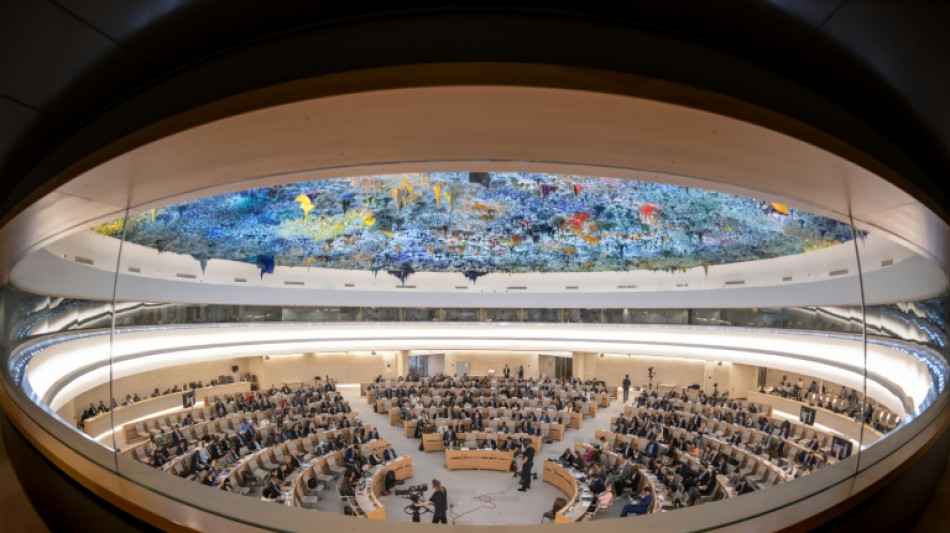
UN rights council takes a stand against intersex discrimination / Photo: Fabrice COFFRINI - AFP

 Ukraine takes Russia fight to 'scorching sands' of Sahel
 Chinese AI tool pulled to prevent 'misuse' after South Korea hacks

 Asian stocks mostly up as traders weigh AI, oil dips after surge

 Walking through flames: orangutans rescued in Indonesia fires

 LeBron shines in pre-season debut for re-tooled 76ers
 Okinawa resolution calls for revision of US forces pact after murder
 Verdict expected Friday in Mexico trial over murders of Australia, US surfers

 New York mayor says asking Trump to withdraw ICE after shooting

 Walking through flames: orangutan rescued in Indonesia fires
 James shines in pre-season debut for re-tooled 76ers

 Fuel, fertilizer costs strain US farmers' support for Republicans in midterms

 Trump's 'super intelligence' rebrand to sell AI faces uphill battle

 Fiji demands US provide evidence Chinese official paid bribes for Beijing
 More than just football: How scandal-tainted City led Manchester's rebirth
 Record Eden Park streak creates tension for All Blacks
 EU trade chief seeks 'tangible outcomes' in China talks
 Man City face Anfield cauldron after guilty Premier League verdicts

 CNN, MS Now, Politico urge judge to extend White House access

 Trump administration to launch new vaccine research center

 Russian strikes kill 30 in Ukraine frontline city, talks set in US

 US military to livestream firing squad execution of Fort Hood shooter

 Aces star Wilson wins record-extending fifth WNBA MVP

 Undefeated 49ers seek Seahawks revenge

 Madrid mourns evicted retiree, 'icon' of Spain housing protests

 OpenAI revenue gap report rattles AI stocks
The UN Human Rights Council passed a resolution Thursday on tackling discrimination against intersex persons, despite opposition from several countries to the terminology used.
The resolution passed in the 47-member council with 24 votes in favour, none against and 23 abstentions.
Argentina, Brazil, France, Germany, India, and Japan and the United States were among the countries voting Yes.
Bangladesh, China, Indonesia, Malaysia, Qatar and the United Arab Emirates abstained.
The resolution, entitled "Combating discrimination, violence and harmful practices against intersex persons", was brought forward by Australia, Chile, Finland and South Africa.
"The resolution seeks to create awareness of the plight of intersex persons," South Africa's ambassador Mxolisi Nkosi said.
"Intersex persons face lifelong discrimination in various areas of their lives, including in sports, health and education.
"In extreme cases, this leads to violence and harmful practices such as forced castration, forced sterilisation and even infanticide."
France's ambassador Jerome Bonnafont welcomed the council discussing the situation of intersex people for the first time, saying they were "too often the victims of rejection, by their family or society".
US ambassador Michele Taylor called it a "landmark resolution" and a "historic juncture" for the UN's top rights body.
The resolution recognises that persons "with innate variations in sex characteristics, that is persons who are born with sex characteristics that do not fit typical definitions for male or female bodies, including sexual anatomy, reproductive organs and hormonal or chromosome patterns (also known as intersex persons) exist in all societies".
- Terminology debate -
Qatar's representative, speaking for the Arab Group members of the council, said they had presented constructive ideas "to make the text more balanced".
"The Human Rights Council is not the right platform for discussing this complex issue, especially given the medical aspects", he said.
"We wanted to change intersex persons to another description: persons with disorders in sex development. For us, this is the more scientific and medically appropriate description."
Bangladesh said the term intersex was "unknown in the national legal systems and social contexts of many member states", and the resolution "offers a vague and arbitrary definition of intersex persons".
Malaysia said the term intersex "is not universally recognised" and when translated into local languages could be derogatory and "do more harm than good".
Meanwhile China said the resolution should respect traditions in various countries.
The resolution recognises that intersex persons "may face multiple and intersecting forms of discrimination in all areas of life", and voices grave concern about the "violence and harmful practices" they face, "including medically unnecessary or deferrable interventions, which may be irreversible".
The resolution encourages states to enhance efforts to combat discrimination, violence and harmful practices, "such as stereotypes, the spread of misconceptions and inaccurate information, stigma and taboo".
A.F.Rosado--PC