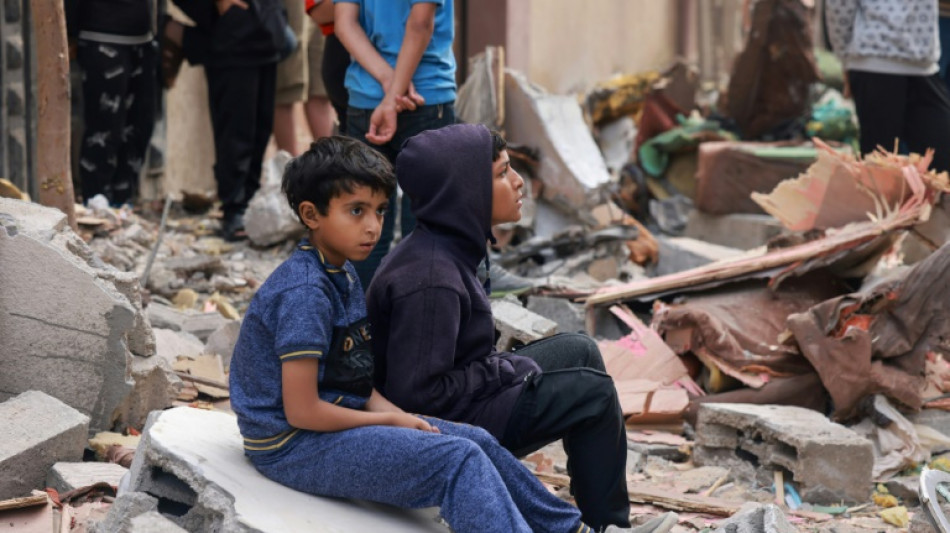
Peace feels further than ever at six months of Israel-Hamas war / Photo: MOHAMMED ABED - AFP

 'I completely trust the club,' says Man City boss Maresca
 '10 out of 10' Quintana reminisces over dream Vuelta win

 Maddinson given shock recall but fails to score

 Navi Pillay, South African rights champion, wins Nobel Peace Prize

 Saudi Arabia says three killed at airport as Yemen war expands

 Everton's US owners mull sale of club two years after takeover

 Ukraine takes Russia fight to 'scorching sands' of Sahel
 Chinese AI tool pulled to prevent 'misuse' after South Korea hacks

 Asian stocks mostly up as traders weigh AI, oil dips after surge

 Walking through flames: orangutans rescued in Indonesia fires

 LeBron shines in pre-season debut for re-tooled 76ers
 Okinawa resolution calls for revision of US forces pact after murder

 Verdict expected Friday in Mexico trial over murders of Australia, US surfers

 New York mayor says asking Trump to withdraw ICE after shooting

 Walking through flames: orangutan rescued in Indonesia fires

 James shines in pre-season debut for re-tooled 76ers

 Fuel, fertilizer costs strain US farmers' support for Republicans in midterms

 Trump's 'super intelligence' rebrand to sell AI faces uphill battle

 Fiji demands US provide evidence Chinese official paid bribes for Beijing

 More than just football: How scandal-tainted City led Manchester's rebirth

 Record Eden Park streak creates tension for All Blacks
 EU trade chief seeks 'tangible outcomes' in China talks

 Man City face Anfield cauldron after guilty Premier League verdicts

 CNN, MS Now, Politico urge judge to extend White House access

 Trump administration to launch new vaccine research center

The staggering suffering, death and destruction of six months of war since Hamas's October 7 attack has widened the gulf between Israelis and Palestinians, leaving both feeling that the prospect of peace is ever more elusive.
Israeli farmer Yarden Zemach, 38, said he felt safe when picking avocados with Palestinians on October 5 –- just two days before the attack.
But ever since the violence that claimed his brother's life in the devastated Beeri kibbutz some four kilometres (2.5 miles) from the Gaza border fence, he views Gazans as a threat.
"Maybe in many years peace will be possible, but not right now," he said next to burned-out homes.
Israeli shelling of Gaza thundered nearby.
The bloodiest-ever Gaza war erupted with Hamas's October 7 attack, which resulted in the deaths of about 1,170 Israelis and foreigners, mostly civilians, according to an AFP tally based on Israeli official figures.
Israel's retaliatory campaign has killed over 33,000 people, mostly women and children, according to the health ministry in Hamas-run Gaza.
"(Our suffering) only increased after October 7, after 33,000 martyrs and after the destruction and siege," said 27-year-old Palestinian Fidaa Musabih, whose north Gaza home was destroyed by an air strike.
She now shares a house with 27 relatives in southern Gaza's Rafah, where she lives in fear of Israel's planned offensive into an area packed with 1.5 million people, most of them displaced.
"How can I hope for peace to come? There's nothing more for us to lose," said Musabih.
- 'A terrifying question' -
No major Israeli-Palestinian peace talks have been held for years. Which means any future negotiations would be in the shadow of this unprecedented bloodshed -- with each side questioning the other's humanity.
Graphic video clips and survivors' accounts depict the extreme violence of the October 7 attack on Israel.
Of the more than 250 hostages taken, 130 remain in Gaza, including 34 who the army says are dead.
In Gaza, dozens are killed per day on average, according to the territory's health ministry, in the constant bombardment that has flattened swathes of the territory.
The United Nations has warned that its 2.4 million people are on the brink of famine.
Both sides are trying "to portray everything happening in terms of the other side being unfit to be a partner," said Khalil Shikaki from the Palestinian Centre for Policy and Survey Research (PCPSR).
Israelis and Palestinians have been asking themselves if the other side "are really human beings. It's a terrifying question to ask," said Denis Charbit, a political scientist at Israel's Open University.
Though the war is being fought in Gaza, violence in the West Bank involving Israeli forces, settlers and armed Palestinian militants -- already rising before the war -- has spiked to levels unseen in two decades.
Palestinian Tarek Ali, who works near Ramallah, said the tension and violence, already bad before the attack, have gotten worse.
"This shows the depth of hatred between us and them, and therefore further removes the possibility of peace," the 47-year-old said.
- 'Walls not high enough' -
An early March poll from the Tel Aviv-based Institute for National Security Studies (INSS) put Jewish Israeli support for the "two-state solution" at an "unprecedented" low of 35 percent.
That figure marks a sharp drop from support of roughly 49 percent in 2022 for establishing an independent Palestinian state.
However, Gazans' backing for the two-state solution has surged, according to a PCPSR survey -– from 35 percent in December to 62 percent in March.
"The option for peace at the popular level remains today, as it did in the past, and it will probably be even more so once the war is behind us," said Shikaki, the PCPSR researcher.
Charbit, the political scientist, said the scale of the war and the international community's concern have provided a new opening for the sides to make peace.
"There is a very small chance, but a chance nonetheless," he added.
Israeli Hila Fenlon, whose Netiv Haasara community nearly touches the northern border with Gaza, said she feels peace will one day be possible.
But in her community, which was hit hard in the opening moments of the attack, it also feels far off.
"In the past, I believed that peace would mean that these walls will have to go," she said standing at towering concrete barriers between Gaza and Netiv Haasara.
"On October 7th, they proved to us that maybe these walls are not high enough," she added.
V.F.Barreira--PC