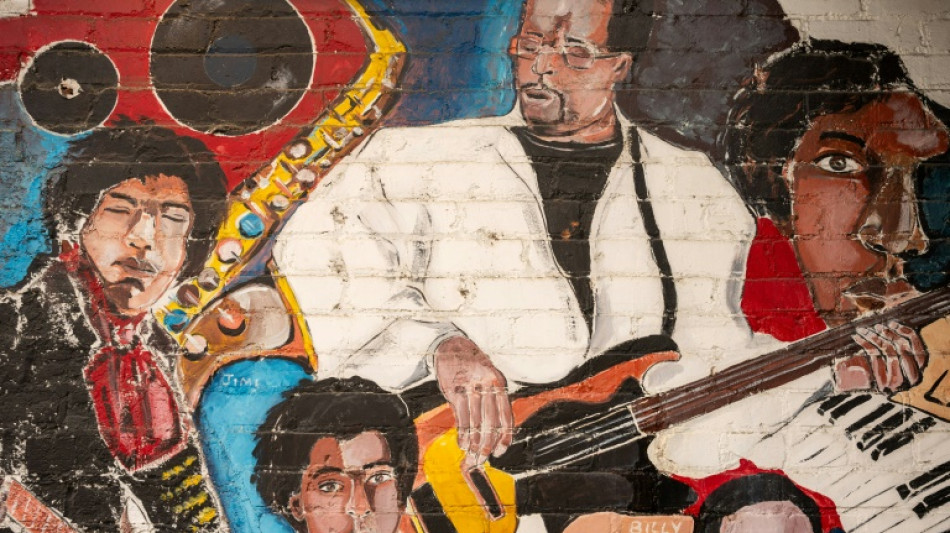
In Nashville, preserving a Black neighborhood's music legacy / Photo: SETH HERALD - AFP

 'I completely trust the club,' says Man City boss Maresca
 '10 out of 10' Quintana reminisces over dream Vuelta win

 Maddinson given shock recall but fails to score
 Navi Pillay, South African rights champion, wins Nobel Peace Prize

 Saudi Arabia says three killed at airport as Yemen war expands
 Everton's US owners mull sale of club two years after takeover

 Ukraine takes Russia fight to 'scorching sands' of Sahel
 Chinese AI tool pulled to prevent 'misuse' after South Korea hacks
 Asian stocks mostly up as traders weigh AI, oil dips after surge
 Walking through flames: orangutans rescued in Indonesia fires

 LeBron shines in pre-season debut for re-tooled 76ers
 Okinawa resolution calls for revision of US forces pact after murder
 Verdict expected Friday in Mexico trial over murders of Australia, US surfers
 New York mayor says asking Trump to withdraw ICE after shooting
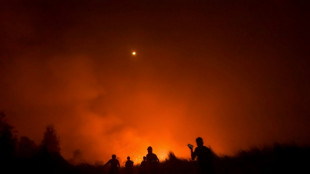 Walking through flames: orangutan rescued in Indonesia fires
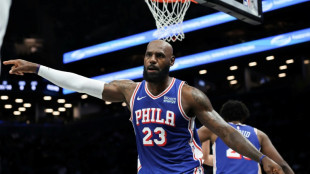 James shines in pre-season debut for re-tooled 76ers
 Fuel, fertilizer costs strain US farmers' support for Republicans in midterms
 Trump's 'super intelligence' rebrand to sell AI faces uphill battle
 Fiji demands US provide evidence Chinese official paid bribes for Beijing
 More than just football: How scandal-tainted City led Manchester's rebirth
 Record Eden Park streak creates tension for All Blacks
 EU trade chief seeks 'tangible outcomes' in China talks
 Man City face Anfield cauldron after guilty Premier League verdicts
 CNN, MS Now, Politico urge judge to extend White House access
 Trump administration to launch new vaccine research center

Country music capital Nashville was once also a hotbed of blues, rock and jazz, thanks to a historically Black neighborhood that brought then-budding greats like Jimi Hendrix to town.
But Jefferson Street's vibrant community and its robust club scene faced mid-20th century decimation after the construction of an interstate highway slashed it in two, a classic tale of ruinous urban planning that all but extinguished the area's rich musical legacy.
Lorenzo Washington, a lifelong Nashville resident who grew up in the area, has been vying to keep that history alive, operating a small museum out of his home that's chock-full of music ephemera as well as records and maps exhibiting the district's long-lost vitality.
"We had it all. We had banks, we had grocery stores, clothing stores, flower shops, ice cream parlors -- just whatever you would need to survive as a community was right here on Jefferson Street," the 81-year-old told AFP.
He recalls a strip lined in revelers spilling out from supper clubs, speakeasies, dance halls, dives and pool rooms, a string of venues where on any given night you might catch stars from Hendrix to Etta James, Ray Charles to BB King.
"Everybody had fun on Jefferson Street," Washington said with a wide smile, sporting a sharp blue suit jacket and felt hat.
"That's just the atmosphere that we had built."
For decades Jefferson Street was a hotspot on the Chitlin' Circuit, a network of venues where Black entertainers were welcome to perform in the era of racial segregation in the United States.
Hendrix arrived in the early 1960s, nabbing a residency at the Club Del Morocco and living in a Jefferson Street walk-up.
But the 1968 construction of Interstate 40, a major east-west thoroughfare, cut directly through the neighborhood, displacing more than a thousand Black residents and destroying the cultural and business district, triggering a severe economic decline.
The clubs shuttered and all but one, Club Baron, was demolished.
Artists gravitated elsewhere -- Memphis or Chicago, for example -- and "the blues left Nashville," said Washington.
"That was tragic to the city when we lost Black music," he continued, saying the city was focused on its country scene and paid little attention to Jefferson Street.
"It was tragic to see our musical culture being split up like it was, the different artists and musicians just sort of scattered," Washington said. "They went to wherever they could find work, or a record label, that would record them."
"So it all left Nashville, and it was heartbreaking."
- 'My part of town' -
Washington is not a musician himself, but he did own a record shop throughout the 1970s and grew up surrounded by artists, his friends including Jefferson Street fixtures like Herbert Hunter and Marion James.
He moved back to the neighborhood in 2010, inspired by a newspaper article he'd seen in which a councilman friend of his said the only way to revitalize Jefferson Street was for Black folks to return and open businesses again.
"I need to move back to Jefferson Street -- to my part of town," Washington recalls thinking.
"And so that's what I did."
Friends of his including the late James -- Nashville's "Queen of the Blues" -- encouraged him to open the museum in a bid to "do more about keeping our legacy going."
"They said you could be the curator. And I said, 'The curator? Now what does a curator do?'" he remembers with an infectious chuckle.
Well over a decade later, he says, "I'm still here on Jefferson Street representing the artists and musicians."
Along with the museum, which officially opened in 2011, Washington operates a recording studio out of his home, along with a small performance space.
Washington was integral to ensuring the Club Baron -- where then up-and-comer Hendrix lost a famous guitar duel to Nashville bluesman Johnny Jones -- would get protection via designation as a local historic landmark.
The building now is owned by the local Elks Club, a fraternal order, and efforts are underway to begin hosting shows there once more.
Today's Nashville is "an aggressive city" compared to the city Washington knew growing up, he said, where high rollers call the shots.
"It's sort of sad to see that all of this isn't existing now," Washington says, as he points out all the old haunts on a lot map hanging in his museum.
"My intention was to... encourage other businesses to move back to Jefferson Street, so we could pick up sort of where we left off at."
"This little place has gotten attention," Washington said. "There's not a lot that's going on publicly in this city that represents the Black community, and that's what we're representing."
"It's not huge, but I can see growth."
V.Dantas--PC