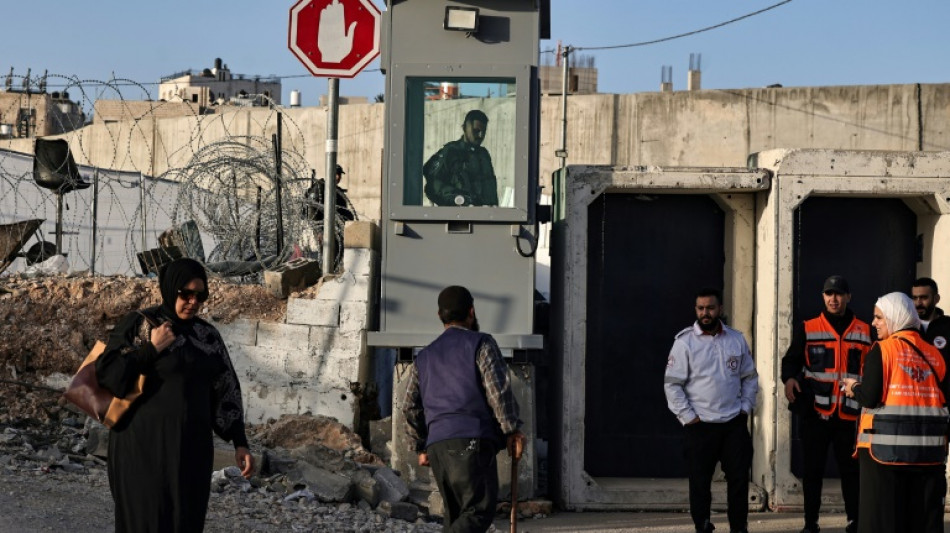
Israel holds Palestinian economy captive, say analysts / Photo: Zain JAAFAR - AFP/File

 Flydubai co-pilot planned suicide attack on Tel Aviv airport: UAE prosecutor

 Mike Ditka: Chicago Bears icon as player and coach

 Outrage over plan to livestream US military firing squad execution

 US sanctions: a 'test of resilience' for ICC

 NFL legend Mike Ditka dead at 86

 Hurricane Isaias set to strike Gulf Coast late Friday

 Trump forms panel to probe US Fed governor Lisa Cook

 Clashes in Durban as fresh anti-migrant riots erupt in South Africa

 France students plan more protests, UN 'concerned' over violence

 De Zerbi calls on struggling Spurs to react in Man Utd clash

 US sanctions on ICC: a 'test of resilience'

 Outrage over US military plan to livestream firing squad execution

 Argentina snap up defence guru Edwards ahead of World Cup

 BMW pulls car lease offer from German far-right politician

 Brazil election offers Jair Bolsonaro a shot at revenge

 Man Utd boss Carrick 'personally' affected by Man City verdict

 Evolution Metals & Technologies Corp. Raises Fiscal 2026 Revenue Guidance 62% at Midpoint to $10–$11 Million and Reaffirms $400–$460 Million Fiscal 2027 Outlook

 Red Bull's Verstappen takes pole position for Singapore GP sprint race

 Chelsea star Palmer 'committed' to England insists Alonso

 OpenAI denies firing researchers over AI safety warnings

 Turkey warns opposition, press over investment fund crisis

 Hurricane Isaias now major storm as it heads to US Gulf Coast

 Djokovic crashes out of Shanghai Masters in his first match

 EU says Turkey's crackdown on rights hampers membership bid

 Two Renoir paintings stolen in France recovered: mayor
The Gaza war is speeding up Israel's "annexation" of the Palestinian economy, say analysts, who argue it has been hobbled for decades by agreements that followed the Oslo peace accords.
While the Israel-Hamas war raging since October 7 has devastated swathes of Gaza, it has also hit the public finances and wider economy of the Israeli-occupied West Bank.
Israel is tightening the noose on the Palestinian Authority, which rules parts of the West Bank, by withholding tax revenues it collects on its behalf, economist Adel Samara told AFP.
Palestinian livelihoods have also been hurt by bans on labourers crossing into Israel, and by a sharp downturn in tourism in the violence-plagued territory, including a quiet Christmas season in Bethlehem.
Samara said that "technically speaking, there is no Palestinian economy under Israeli occupation -- our economy has been effectively annexed by Israel's".
The Palestinian economy is largely governed by the 1994 Paris Protocol, which granted sole control over the territories' borders to Israel, and with it the right to collect import duties and value-added tax for the Palestinian Authority.
Israel has repeatedly leveraged this power to deprive the authority of much-needed revenues.
But the Gaza war has further tightened Israel's grip, Samara said, with the bulk of customs duties withheld since Gaza's rulers Hamas sparked the war with their October 7 attack on Israel.
"Without these funds, the Palestinian Authority struggles to pay the salaries of its civil servants and its running costs," said Taher al-Labadi, a researcher at the French Institute for the Near East.
In February, Norway reportedly transferred to the Palestinian Authority about $115 million from Israel following a deal to release some of the frozen taxes.
Almost all Palestinian workers have also been forbidden from entering Israel for work, driving up unemployment across the territories.
The Palestinian prime minister Mohammed Mustafa bemoaned an "unprecedented financial crisis" during which his government's deficit had soared to $7 billion, more than a third of the territories' GDP according to the latest budgetary figures.
- 'Collective punishment' -
The Paris Protocol, like the 1993 and 1995 Oslo agreements they were signed under, were meant to be in effect for five years, until the creation of a Palestinian state.
But the absence of a long-term peace deal means it is still governing nearly all aspects of the Palestinian economy.
Investment is also being stifled by the protocol, said Samara, who explained that Israel "controls the land, resources and water sources" of the Palestinian territories.
Before any factory or shop requiring access to these resources can be built in the West Bank, Israel must grant authorisation, he said.
Israel's stance has become even tougher under far-right Security Minister Itamar Ben Gvir and Finance Minister Bezalel Smotrich, he said, both of whom are settlers in the West Bank.
Critics accuse them of holding Prime Minister Benjamin Netanyahu to ransom by threatening to withdraw the support that gives him a wafer-thin governing majority.
Israeli political analyst Michael Milshtein echoed his take.
"By not allowing Palestinian workers into Israel and withholding Palestinian tax revenues, Ben Gvir and Smotrich aim to overthrow the Palestinian Authority because they view it as an enemy," he said.
"It's a way to collectively punish Palestinians, whom they also see as enemies."
Milshtein said that before October 7, nearly one-third of West Bank income came from the earnings of the 193,000 Palestinians who worked in Israel, according to Israeli figures.
Today, the number of Palestinians working in Israel has dropped to between 8,000 and 9,000, he said.
- 'To live in dignity' -
But Milshtein also pointed to another strain of Israeli opinion, held by centrist minister Benny Gantz and conservative lawmaker Gideon Saar.
They want to allow workers back into Israel to avoid anger sparking an uprising in the West Bank, at a time when Israeli forces are already stretched between Gaza and the Lebanese border, where they are trading fire with Iran-backed Hezbollah.
Milshtein said he believes Netanyahu is probably closer to the Gantz view.
Nasr Abdel Kareem, an economics professor at the Arab American University in the West Bank, argued that the Israeli premier is playing a power game.
"Netanyahu is putting pressure on the Palestinians and signalling to the authority that the levers of the Palestinian economy are in (Israel's) hands," he said.
"Netanyahu believes that he will weaken the authority and make it accept political concessions" when a peace agreement eventually has to be hammered out, he said.
This strategy may be misguided, said Nasr, because it is based on the premise that letting the Palestinian economy flourish would automatically bring peace to the West Bank.
"Historically, previous uprisings broke out" when times were not tough economically, he said, adding that ultimately Palestinians want a state as much as a healthy economy.
"Palestinians want to live with dignity, but for them this also implies liberation and the establishment of a Palestinian state."
L.Carrico--PC