Holocaust survivor urges Germany to fight 'cancer' of hatred

 Hong Kong court set to sentence activist Joshua Wong in security case

 Australia raises benchmark rate to highest level in 18 years

 'The Remarried Empress' Cast Discusses Bringing Fantasy Royal Drama to Life

 Asian stocks retreat as AI worries outweigh steep oil-price drop

 Hamad International Airport stages emergency drills during WATAN 2026

 Global failure to punish attacks leaves journalists at continuing risk
 Researchers Warn 'Bookkeeping Trick' Masks Beef Industry's Methane Emissions

 Climate Change Intensified Atlantic Hurricanes, Study Finds

 Qatar solar expansion opens scope for technical performance gains

 IXOPAY Announces IXO One, a Modular Payments Platform Built for an Era of Fluid Commerce
In what was expected to be one of the last addresses by a Holocaust survivor to the German parliament, Inge Auerbacher appealed Thursday to keep alive the victims' memory.
Fighting back tears as she recalled the suffering and loss she endured at the hands of the Nazis, Auerbacher told the Bundestag as it marked International Holocaust Remembrance Day that it was essential to fight the spreading "cancer" of hatred.
"I have lived in New York for 75 years and can still remember well this terrible time of terror and hate," said Auerbacher, 87, who flew to Berlin in the face of the pandemic to take part in the ceremonies.
"Unfortunately this cancer has resurfaced and hatred of Jews is common in many countries of the world including Germany," she said on the 77th anniversary of the liberation of the Auschwitz death camp.
"This sickness must be healed as soon as possible," she said to applause from MPs, Chancellor Olaf Scholz and his cabinet.
Auerbacher said she had been the last Jewish child born in her hometown of Kippenheim in 1934 before the Nazis' genocidal campaign.
While her grandmother was deported to Riga and murdered, Auerbacher and her parents were sent to the Theresienstadt concentration camp when she was just seven years old.
She recounted the abuse and horrific conditions she and her family endured, but also her close friendship at the camp with a Jewish girl her age from Berlin, Ruth Nelly Abraham, who was later murdered at Auschwitz.
Auerbacher will on Friday visit the family's home to place candles at small plaques in their memory.
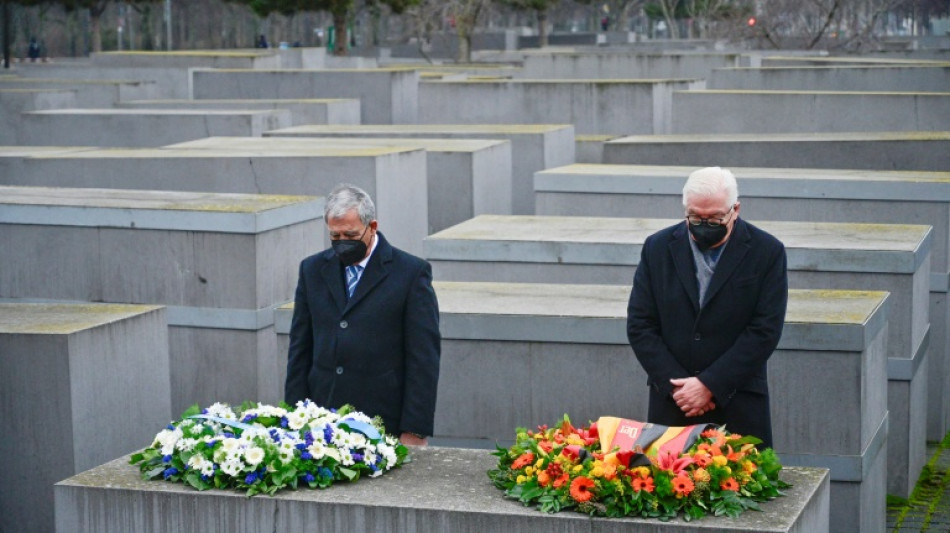
The speaker of the Israeli Knesset, Mickey Levy, who was also in attendance embraced Auerbacher and wept openly as he recited a prayer for the dead.
"Keeping the memory of the Holocaust alive is a difficult task, a task placed on the shoulders of the every generation," he said.
Germany has officially marked Holocaust Remembrance Day every January 27 since 1996 with commemorations across the country.
Scholz's spokesman Steffen Hebestreit noted that Germany would "soon have to go forward without the personal recollections of the last survivors".
Of the six million Jews killed in the Holocaust, more than one million were murdered at Auschwitz-Birkenau, most in its notorious gas chambers, along with tens of thousands of others including homosexuals, Roma and Soviet prisoners of war.
This year's anniversary is marked by growing concerns about extremist violence and incitement in Germany, particularly among militant opponents of government coronavirus restrictions.
The number of crimes committed by right-wing extremists jumped in 2020 to its highest level ever recorded in the post-war period, an over five-percent rise to 23,604.
P.L.Madureira--PC