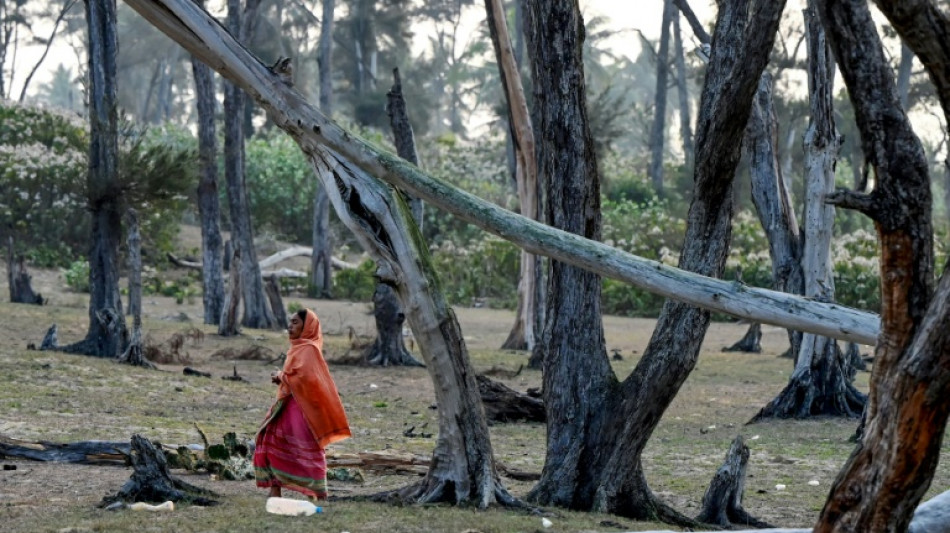
The Indian villagers who lost their homes to the sea / Photo: Dibyangshu SARKAR - AFP

 Anthropic AI model sent fake murder tip to Philadelphia police

 7.7-magnitude quake rocks Panama, triggers tsunami warning

 Prince Harry booed at English rugby match

 Kiplimo and Feysa seek repeat Chicago Marathon wins

 Fuellkrug halts Dortmund after late goal flurry

 Injured Ravens quarterback Jackson ruled out of Falcons clash

 Brewers aim to take down two-time defending champion Dodgers in NLCS rematch

 Tsunami alert after major earthquake rocks Panama

 Outer bands of Hurricane Isaias lash US Gulf Coast

 Hope, Rutherford fire West Indies to record T20 chase of 250

 Farhan leads Pakistan to T20 win over Sri Lanka

 Turkey sack coach Montella after Nations League woe

 US announces sanctions on ICC, hours after Nobel award to former judge

 Montenegro expels popular Russian war blogger wanted by US
 Rubio calls on all Venezuela opposition figures to join talks with govt

 Australia struggle against South Africa quicks in first Test

 Stocks advance as Trump rules out pre-vote Iran attack

 Australia struggle against South Africa's fast bowlers

 Massive debt puts France in a bind as investor doubts deepen

 Arteta urges 'respect' for process after Man City financial verdict

 'Human-authored' book labels gain ground amid AI scandals

 Man City whistleblower Pinto to stay under police protection

 US leads fresh Ukraine peace push with Miami talks

 Verstappen continues resurgence with pole for Singapore sprint

 Cuban ration book, symbol of the revolution, gathers dust

The gentle roar of the ocean lulled Indian mother-of-two Banita Behra to sleep each night, until one day the encroaching tide reached her doorstep.
Behra is among hundreds of people from the disappearing and largely abandoned coastal village of Satabhaya, whose displaced former residents have been officially recognised by the government as climate migrants.
She grew up watching helplessly with her neighbours as rising seas, driven by climate change and upriver dams, slowly claimed the land around them.
"We were doing well there. We used to catch fish," the 34-year-old told AFP. "But the sea came nearer and took away our homes."
Satabhaya is the hardest-hit of several rural idylls along the seafront in eastern Odisha, a state that has also been battered in recent decades by tropical cyclones and floods of increasing ferocity.
Behra's home is now underwater, 400 metres (1,300 feet) out to sea, while a few of her neighbours who refused to move live in makeshift thatched huts by the new shoreline.
A weathered brick wall is all that remains of what was once a seaside temple to Panchubarahi -- a locally revered Hindu deity supposed to protect worshippers from natural disasters.
Last year the Odisha government announced funds for a resettlement colony in Bagapatia, 12 kilometres (7.5 miles) inland from their village, giving each family a small plot of land and $1,800 to build a new house.
Authorities said the scheme was the first of its kind in India for those forced to leave their homes by climate change.
But life in Bagapatia has been tough for the new arrivals: without seas to fish and farmland to cultivate, many are depressed by having lost their self-reliance and way of life.
In order to survive, most of the community's men have had to take jobs to work as labourers out of state.
Behra's husband is now away 10 months of the year, working on the opposite side of the country and sending money home to provide for their two young children.
"We miss him, some days I feel like crying," she said. "But what can we do?"
- 'Growing frequency and intensity' -
Rising global temperatures driven by human activity have led to a consequent rise in global sea levels with the melting of polar ice caps.
Odisha, where millions of people live in coastal settlements along the Bay of Bengal, is particularly vulnerable to the encroaching waters.
Satabhaya sits at the mouth of the mighty Mahanadi River Delta and its coasts were once replenished by earth carried by the currents from inland.
But an upriver dam-building spree in the decades since India's independence from Britain in 1947 drastically cut the amount of sediment deposited where the waterways met the sea.
That left Odisha's coasts vulnerable to erosion and lacking a critical defence against rising sea levels.
Across the state, sea levels increased by an average of 19 centimetres (7.5 inches) in the five decades to 2015, according to a 2022 paper coauthored by researchers from the state's Berhampur University.
Tamanna Sengupta of India's Centre for Science and Environment think-tank told AFP that Odisha had the highest number of villages severely impacted by coastal erosion in the country.
The crisis had been worsened by the "growing frequency and intensity" of cyclones and floods in the area, she added.
"Locals have been displaced and those who remain are at risk of losing their homes to intensifying floods," Sengupta said.
- 'The sea will eat this place' -
India remains heavily reliant on coal for energy generation and is the world's third-largest emitter of carbon dioxide, the gas chiefly responsible for rising global temperatures.
Extreme weather events are expected to worsen as temperatures rise further, with UN climate experts warning the world could see average temperatures 1.5 degrees Celsius above preindustrial levels within the decade.
Odisha's chief forest conservation officer Susanta Nanda said that more than a third of the state's coast was already eroding due to climate change and other man-made environmental damage.
The urgency of protecting at-risk coastal communities was underscored by the struggles of those already forced to leave their homes, he told AFP.
"It is very difficult for climate refugees to start their lives again," Nanda said.
A 2017 report on migration by the UN Development Programme found that resettling communities affected by climate change was beneficial on balance when done with adequate planning.
But it found doing so also brought new problems for those who had been relocated, including "a lack of decent work" in their new home communities.
Jagbandhu Behra -- no relation to Banita -- was unable to find a job to support himself in the Bagapatia resettlement colony after leaving Satabhaya.
The 40-year-old moved even further inland in search of hope of greener pastures but remains gloomy about his prospects.
"There's no guarantee that we survive," he told AFP.
"One day the sea will eat this place as well."
E.Borba--PC