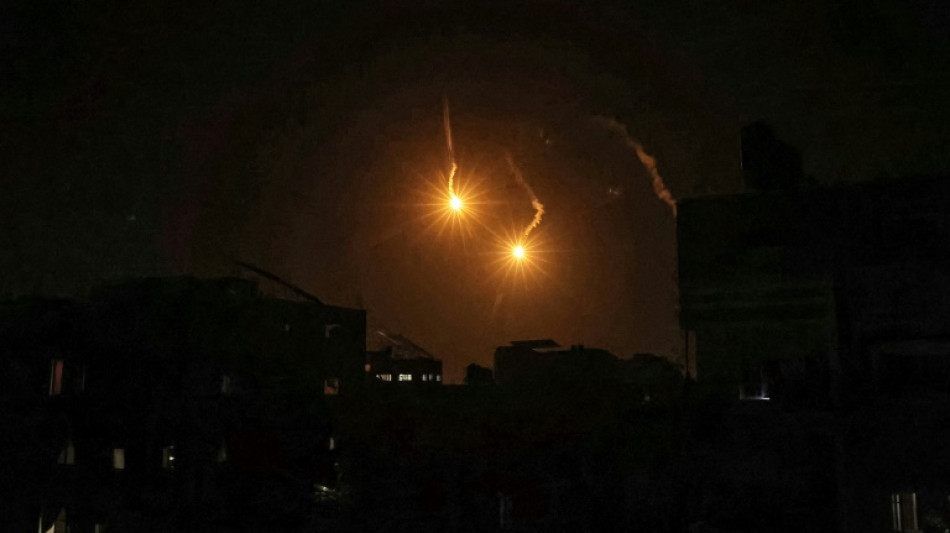
Halting bomb delivery, Biden sends sternest sign yet to Israel / Photo: - - AFP

 Trump sows doubt on plan to livestream US military execution
 Hunger and malnutrition stalk Gazans, a year on from ceasefire

 Fernandez trumps MotoGP championship duo to grab Indonesia pole

 October 7 scars push Israel's first-time voters to right

 India deploys police, restricts transport ahead of major protest

 Three Mexicans convicted in murders of Australian, US surfers

 Powerful waves lash California coast as storm threatens more damage

 Trump hails Russia deal to release diesel as midterms loom

 Lyon blow chance to go top after loss at Lens

 Stocks rise as Trump says Russia to release diesel to world markets

 Wildfire smoke shuts schools in Amazon's biggest city

 Turkey jails 2 journalists pending trial for fund crisis 'misinformation'

 Major earthquake rocks Panama, triggers tsunami warning

 Indian jailed in France for leading sadist Nazi cult that tortured girls

 'Iron Mike' Ditka hailed as 'gold standard' NFL legend

 Flydubai co-pilot planned suicide attack on Tel Aviv airport: UAE prosecutor

 Mike Ditka: Chicago Bears icon as player and coach

 Outrage over plan to livestream US military firing squad execution

 US sanctions: a 'test of resilience' for ICC

 NFL legend Mike Ditka dead at 86

 Hurricane Isaias set to strike Gulf Coast late Friday

 Trump forms panel to probe US Fed governor Lisa Cook

 Clashes in Durban as fresh anti-migrant riots erupt in South Africa

 France students plan more protests, UN 'concerned' over violence

 De Zerbi calls on struggling Spurs to react in Man Utd clash

In halting a shipment of thousands of bombs, President Joe Biden has sent his most serious signal yet both to Israel and his domestic critics, although it remains doubtful he can fundamentally alter the course of the war in Gaza.
Biden, a self-described Zionist, had long resisted stopping any of the $3 billion in weapons the United States sends each year to Israel -- and pushed Congress for an increase in the wake of the October 7 attack by Hamas that triggered the major Israeli retaliation.
But US officials say privately that his hand was forced after Israeli Prime Minister Benjamin Netanyahu made clear he would go ahead with an assault on Rafah, defying Biden's public appeals to spare the southern Gaza city for the sake of the more than one million Palestinians who have taken refuge there.
Officials said the United States paused delivery last week of 1,800 2,000-pound (907 kilogram) bombs and 1,700 500-pound bombs, with further delays under consideration.
The move comes as Biden faces a growing backlash from the left of his base months ahead of elections, with pro-Palestinian protests sweeping major universities.
Reaction fell largely along partisan lines. Senator Bernie Sanders, a leading critic of the war, applauded Biden's move and said the United States should now exert all leverage to demand a ceasefire and "no longer be complicit in Netanyahu's horrific war against the Palestinian people."
Two top Republican lawmakers on foreign affairs, Representatives Mike McCaul and Mike Rogers, in turn called the decision "appalling" and a "short-sighted, strategic error" that weakens Israel as it negotiates to release hostages from Hamas.
The arms halt "is clearly a sign of tension in the (US-Israel) relationship and the mounting pressure on Biden from the left flank of Democratic Party to curb further Palestinian casualties," said Raphael Cohen, director of the strategy and doctrine program at the RAND Corporation research group.
"That said, from a purely political level, both Biden and Netanyahu need each other," he said.
Biden may worry about alienating centrist voters if he shifts too far, while Netanyahu knows he needs US support at a time of wide global anger against Israel, Cohen said.
- Incremental pressure -
The Biden administration has previously taken smaller steps to show displeasure with Netanyahu, including imposing sanctions on extremist Israeli settlers and letting through a UN Security Council resolution that supported a ceasefire.
Major US interventions in the past have changed Israeli behavior. In 1991, Israel begrudgingly attended the Madrid conference that led to a peace process with the Palestinians after then-president George H.W. Bush held up US loan guarantees to build settlements.
In 1956, heavy US pressure including economic threats forced Israel as well as Britain and France to give up their grab of the Suez Canal from Egypt.
But experts questioned if Israel could be persuaded this time as it sees its war in existential terms after October 7, the deadliest attack ever on the country.
"I cannot imagine American displeasure with the prospect of a Rafah invasion doesn't loom large in the Israeli government's calculus," said Jon Alterman, senior vice president at the Center for Strategic and International Studies.
"At the same time, Israelis have other calculations, too," he said.
- How much will Israel reconsider? -
Cohen noted that Israel dialed back air strikes and opened border crossings after Biden voiced anger last month following an Israeli strike that killed seven aid workers.
"Despite Netanyahu's rhetoric, Israel takes American pressure quite seriously," he said.
But avoiding a Rafah invasion "functionally means leaving at least four battalions of Hamas fighters plus its senior leadership intact and over 100 hostages in Hamas hands," he said.
"From an Israeli strategic perspective, that's probably a nonstarter and it also may fracture Netanyahu's coalition."
Even with the pause, Israel is believed to have a significant weapons stockpile. It has a major domestic defense industry and the Biden administration has repeatedly shipped weapons that fall beneath the threshold for congressional notification.
"We are still seeing so many hundreds of millions of dollars of weapons going through that we don't really know anything about," said Ari Tolany, who follows the arms trade for the progressive Center for International Policy.
She doubted the halt would have "an immediate operational impact" but said it sent a message to Israel not to drop 2,000-pound bombs, as it already has in the war.
"For a place like Gaza, that is so densely populated, now largely with internally displaced people, there's really no way to use bombs of this size in accordance with the law of armed conflict," she said.
A.P.Maia--PC