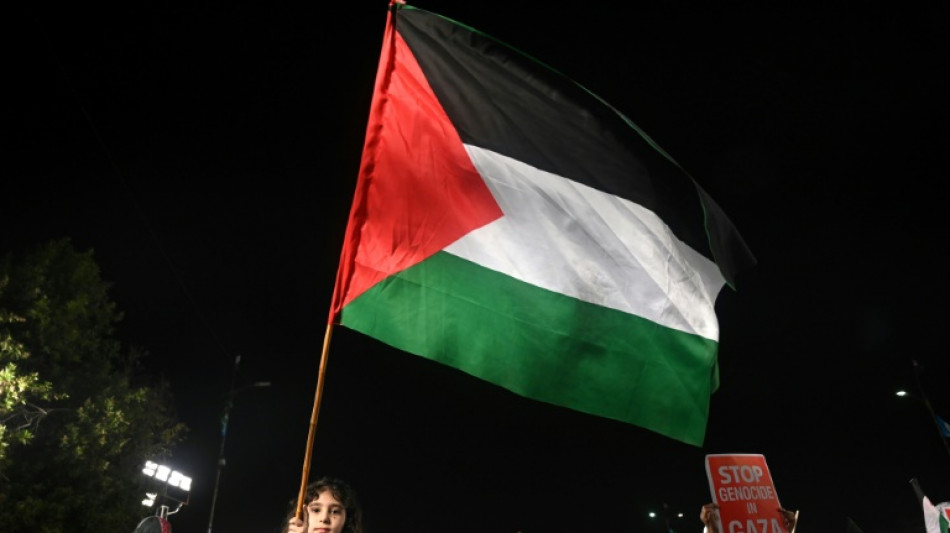
Which countries recognise Palestinian state? / Photo: Rizwan TABASSUM - AFP/File

 Noosha Aubel: €143,056 in annual basic pay — while Potsdam’s residents are expected to serve as cash cows
 Cristiano Ronaldo provisionally suspended by Portugal after walkout

 Brilliant Renshaw ton puts Australia in strong position

 Zelensky blasts diesel deal after Russian strikes kill 15

 Cristiano Ronaldo provisionally suspended after Portugal walkout

 Alcaraz through in straight sets on Shanghai Masters opener

 Palmer signs contract to stay at Chelsea until 2034
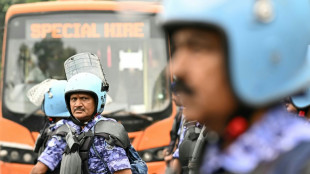 India detains 'cockroach' movement leaders in bid to thwart election protest

 Proposed next EU budget cut back in search for deal

 All Blacks learn from 'failed' Springboks series to punish Wallabies
 Marquez grabs MotoGP championship lead after Indonesia sprint chaos

 All Blacks extend Eden Park streak with big win over Wallabies
 Marquez grabs MotoGP championship lead with Indonesia sprint win
 Schauffele closes in on leaders after 'weird' round in Japan

 Medvedev through at Shanghai Masters in first match since disqualification
 Trump sows doubt on plan to livestream US military execution
 Hunger and malnutrition stalk Gazans, a year on from ceasefire
 Fernandez trumps MotoGP championship duo to grab Indonesia pole
 October 7 scars push Israel's first-time voters to right
 India deploys police, restricts transport ahead of major protest
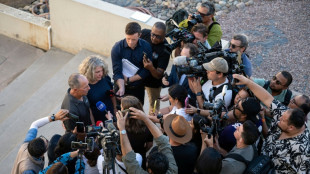 Three Mexicans convicted in murders of Australian, US surfers
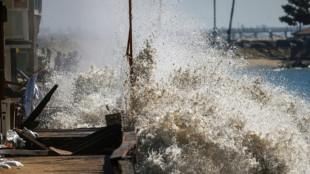 Powerful waves lash California coast as storm threatens more damage

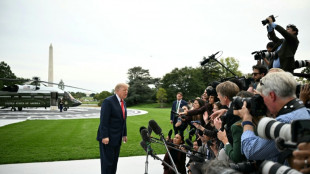 Trump hails Russia deal to release diesel as midterms loom
 Lyon blow chance to go top after loss at Lens
 Stocks rise as Trump says Russia to release diesel to world markets

Israel's more than seven-month war in Gaza since the October 7 attack has revived a global push for Palestinians to be given a state of their own.
Norway, Spain and Ireland all announced plans on Wednesday to recognise a State of Palestine, breaking with the long-held position of Western powers that a Palestinian state can only come as part of a negotiated peace with Israel.
According to the Palestinian Authority, which has limited powers in parts of the occupied West Bank, 142 of the 193 member countries of the United Nations already recognise a State of Palestine.
They include many Middle Eastern, African and Asian countries, but not the United States, Canada, most of western Europe, Australia, Japan or South Korea.
In April, the United States used its veto at the UN Security Council to prevent a Palestinian bid to become a full UN member state.
Here is a quick recap of the Palestinians' quest for statehood:
- 1988: Arafat proclaims state -
On November 15, 1988, during the first Palestinian intifada, or uprising, Palestinian leader Yasser Arafat unilaterally proclaimed an independent Palestinian state with Jerusalem as its capital.
He made the announcement in Algiers, at a meeting of the exiled Palestinian National Council, which adopted the two-state solution as a goal, with independent Israeli and Palestinian states existing side by side.
Minutes later, Algeria became the first country to officially recognise an independent Palestinian state.
Within weeks, dozens of other countries, including much of the Arab world, India, Turkey, most of Africa and several central and eastern European countries had followed suit.
The next wave of recognitions came in late 2010 and early 2011, at a time of crisis in the Middle East peace process.
A host of South American countries including Argentina, Brazil and Chile answered calls by the Palestinians to endorse their statehood claims.
This came in response to Israel's decision to end a temporary ban on Jewish settlement building in the occupied West Bank.
- 2011-2012: UN recognition -
In 2011, with peace talks at a standstill, the Palestinians decided to push ahead with a campaign for full UN membership for a State of Palestine.
The quest failed but, in a groundbreaking move on October 31 of that year, the UN cultural agency UNESCO voted to accept the Palestinians as a full member.
The decision triggered a furious reaction from Israel and the United States, which suspended their funding of the Paris-based body.
They quit UNESCO outright in 2018, although the United States rejoined last year.
In November 2012, the Palestinian flag was raised for the first time at the United Nations in New York after the General Assembly overwhelmingly voted to upgrade the status of the Palestinians to "non-member observer state".
Three years later, the International Criminal Court also accepted Palestine as a state party.
- 2014: Sweden first in western Europe -
In 2014, Sweden, which has a large Palestinian community, became the first EU member in western Europe to recognise a Palestinian state.
The move followed months of almost daily clashes in Israeli-annexed east Jerusalem.
A state of Palestine had earlier been recognised by six other European countries -- Bulgaria, Cyprus, the Czech Republic, Hungary, Poland and Romania.
Israel reacted angrily to Stockholm's move, with then foreign minister Avigdor Lieberman telling the Swedes that "relations in the Middle East are a lot more complex than the self-assembly furniture of IKEA".
- 2024: New push in Europe -
Israel's relentless offensive in Gaza, which has left at least 35,647 people dead, according to the territory's health ministry, in retaliation for Hamas's killing of more than 1,170 people in Israel, has revived support in Europe for Palestinian statehood.
Norway, Spain and Ireland said they would recognise a Palestinian state by May 28, defying threats from Israel, which recalled its envoys from Ireland and Norway for discussions over the move.
Malta and Slovenia in March also expressed "readiness to recognise Palestine" when "the circumstances are right".
Australia recently too has floated the possibility of unilaterally endorsing Palestinian statehood.
President Emmanuel Macron has also said the question of recognising a Palestinian state without a negotiated peace is no longer "a taboo for France".
V.Fontes--PC