
-
 Hurricane Isaias set to strike Gulf Coast late Friday
-
Rubio calls on all Venezuela opposition figures to join talks with govt
-
 Trump forms panel to probe US Fed governor Lisa Cook
-
Australia struggle against South Africa quicks in first Test
-
 Clashes in Durban as fresh anti-migrant riots erupt in South Africa
-
Stocks advance as Trump rules out pre-vote Iran attack
-
 France students plan more protests, UN 'concerned' over violence
-
Australia struggle against South Africa's fast bowlers
-
 De Zerbi calls on struggling Spurs to react in Man Utd clash
-
Massive debt puts France in a bind as investor doubts deepen
-
 US sanctions on ICC: a 'test of resilience'
-
Arteta urges 'respect' for process after Man City financial verdict

-
 Outrage over US military plan to livestream firing squad execution
-
'Human-authored' book labels gain ground amid AI scandals

-
 Argentina snap up defence guru Edwards ahead of World Cup
-
Man City whistleblower Pinto to stay under police protection

-
 BMW pulls car lease offer from German far-right politician
-
US leads fresh Ukraine peace push with Miami talks
-
 Brazil election offers Jair Bolsonaro a shot at revenge
-
Verstappen continues resurgence with pole for Singapore sprint
-
 Man Utd boss Carrick 'personally' affected by Man City verdict
-
Cuban ration book, symbol of the revolution, gathers dust

-
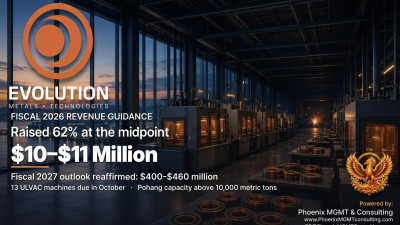 Evolution Metals & Technologies Corp. Raises Fiscal 2026 Revenue Guidance 62% at Midpoint to $10–$11 Million and Reaffirms $400–$460 Million Fiscal 2027 Outlook
-
Stocks advance, oil retreats as Trump rules out pre-vote Iran attack
-
 Red Bull's Verstappen takes pole position for Singapore GP sprint race
-
Man City case causing 'uncertainty' for whole Premier League, says Iraola

-
 Chelsea star Palmer 'committed' to England insists Alonso
-
Talks with Iran can only succeed without threats, president says
-
 OpenAI denies firing researchers over AI safety warnings
-
Home hope Zheng sets up Mertens clash in China Open semis

-
 Turkey warns opposition, press over investment fund crisis
-
Lombardia promises gripping end to season in Pogacar absence

-
 Hurricane Isaias now major storm as it heads to US Gulf Coast
-
Barca skipper Raphinha out against Getafe and Galatasaray

-
 Djokovic crashes out of Shanghai Masters in his first match
-
MEXC and Payward Highlight Collaboration as Crypto and TradFi Converge at TOKEN2049

-
 EU says Turkey's crackdown on rights hampers membership bid
-
EU states agree beefed-up European financial markets watchdog

-
 Two Renoir paintings stolen in France recovered: mayor
-
Eritrea, Ethiopia trade barbs as Tigray rebels retreat
-
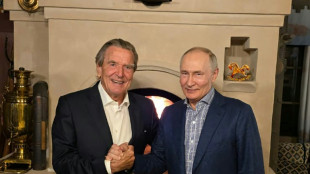 German leader outraged at Schroeder birthday visit to Putin
-
Kompany 'proud' of Man City success despite guilty verdict

-
 Stocks up, oil retreats as Trump rules out pre-vote Iran attack
-
Man City will win appeal over financial charges, says Maresca

-
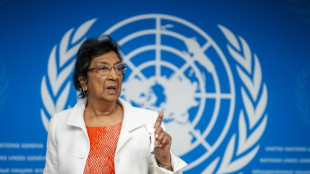 South African judge Navi Pillay wins Nobel Peace Prize
-
Fernandez logs record lap at Indonesia MotoGP practice

-
 'I completely trust the club,' says Man City boss Maresca
-
Navi Pillay: S.Africa's global rights activist and Nobel winner
-
 '10 out of 10' Quintana reminisces over dream Vuelta win
-
Ufunded Launches “Spotlight” Series, Documenting the Minds Shaping Modern Trading

China, France launch satellite to better understand the universe
A French-Chinese satellite blasted off Saturday on a hunt for the mightiest explosions in the universe, in a notable example of cooperation between a Western power and the Asian giant.
Developed by engineers from both countries, the Space Variable Objects Monitor (SVOM) will seek out gamma-ray bursts, the light from which has travelled billions of light years to reach Earth.
The 930-kilogram satellite carrying four instruments -- two French, two Chinese -- took off around 3:00 pm (0700 GMT) aboard a Chinese Long March 2-C rocket from a space base in Xichang, in the southwestern province of Sichuan, AFP journalists witnessed.
Gamma-ray bursts generally occur after the explosion of huge stars -- those more than 20 times as big as the sun -- or the fusion of compact stars.
The extremely bright cosmic beams can give off a blast of energy equivalent to over a billion billion suns.
Observing them is like "looking back in time, as the light from these objects takes a long time to reach us", Ore Gottlieb, an astrophysicist at the Flatiron Institute's Center for Astrophysics in New York, told AFP.
- 'Several mysteries' -
The rays carry traces of the gas clouds and galaxies they pass through on their journey through space -- valuable data for better understanding the history and evolution of the universe.
"SVOM has the potential to unravel several mysteries in the field of (gamma-ray bursts), including detecting the most distant GRBs in the universe, which correspond to the earliest GRBs," Gottlieb said.
The most distant bursts identified to date were produced just 630 million years after the Big Bang -- when the universe was in its infancy.
"We are... interested in gamma-ray bursts for their own sake, because they are very extreme cosmic explosions which allow us to better understand the death of certain stars," said Frederic Daigne, an astrophysicist at the Institut d'Astrophysique de Paris.
"All of this data makes it possible to test the laws of physics with phenomena that are impossible to reproduce in the laboratory on Earth."
Once analysed, the data could help to better understand the composition of space, the dynamics of gas clouds or other galaxies.
The project stems from a partnership between the French and Chinese space agencies as well as other scientific and technical groups from both nations.
Space cooperation at this level between the West and China is fairly uncommon, especially since the United States banned all collaboration between NASA and Beijing in 2011.
- Race against time -
"US concerns on technology transfer have inhibited US allies from collaborating with the Chinese very much, but it does happen occasionally," said Jonathan McDowell, an astronomer at the Harvard-Smithsonian Center for Astrophysics in the United States.
In 2018, China and France jointly launched CFOSAT, an oceanographic satellite mainly used in marine meteorology.
And several European countries have taken part in China's Chang'e lunar exploration programme.
So while SVOM is "by no means unique", it remains "significant" in the context of space collaboration between China and the West, said McDowell.
Once in orbit 625 kilometres (388 miles) above the Earth, the satellite will send its data back to observatories.
The main challenge is that gamma-ray bursts are extremely brief, leaving scientists in a race against time to gather information.
Once it detects a burst, SVOM will send an alert to a team on duty around the clock.
Within five minutes, they will have to rev up a network of telescopes on the ground that will align precisely with the axis of the burst's source to make more detailed observations.
T.Vitorino--PC