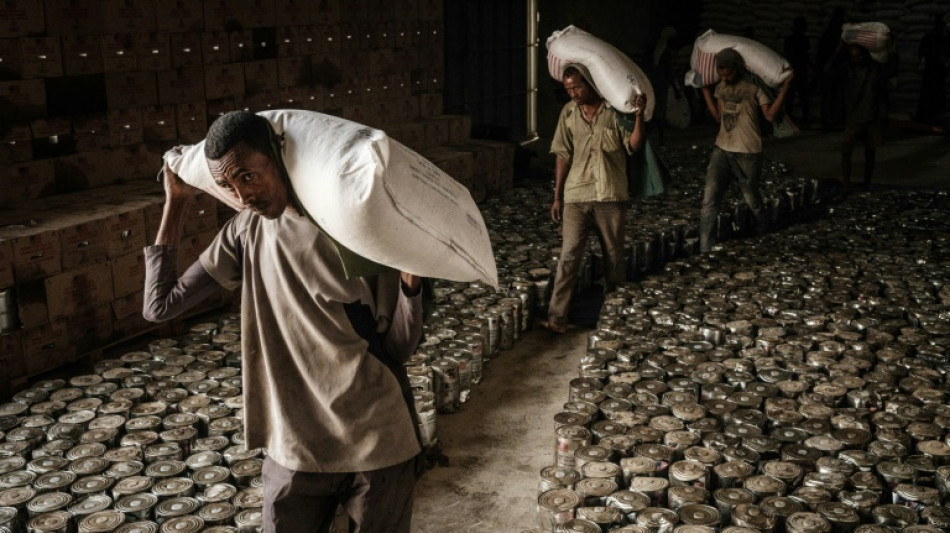
Nearly 40 percent of Tigrayans face 'extreme lack of food': UN

 Trump's beef policies irk Texas ranchers, testing their loyalty

 Nvidia, OpenAI CEOs to attend Xi dinner at White House

 Anthropic picks Accenture for in-house AI safety evaluation

 Balogun returns as Monaco beat Lens to continue strong Ligue 1 start

 'Pause' on overt repression in Venezuela, but reforms still needed: HRW

 Global stocks mixed as yen falls despite Bank of Japan rate hike

 Cuba hit with seventh major blackout of the year

 Murray out with concussion so Wentz will start for Vikings

 UN chief 'deeply regrets' US visa refusal to Abbas for annual meeting

 England quick Carse to face no charges over alleged nightclub assault

 Mancini brings nine newcomers into the first squad of his Italy comeback

 Czechs level Davis Cup tie against USA as South Korea eye Finals

 New France boss Zidane confirms Mbappe as captain after naming first squad

 California governor signs order to explore AI 'kill switch'

 Head leads run spree as Australia win Zimbabwe ODI series

 In-form Raphinha wants to finish career at Barcelona

 Warren Buffett steps down as Berkshire Hathaway chairman

 Carrick confident Man Utd can 'work through' tough time

 Mbappe ends Nike partnership to join Swiss brand On

 Liverpool boss Iraola puts Bournemouth love affair on hold

 'A disaster' if Man City do not win says Maresca after flawless start

 Kerry James Marshall: American 'blackness' painter celebrated in Europe

 Spain coach De la Fuente offers 'full support' to people of Ceuta

 Russia seizes assets of Nestle, French firms over West's Ukraine support

 England can build on World Cup 'spirit', says Tuchel

Nearly 40 percent of people in Ethiopia's Tigray are suffering "an extreme lack of food" in the face of an extended de-facto blockade of the war-hit region, a UN agency said Friday.
The dire assessment published by the World Food Programme (WFP) comes as humanitarian groups are forced to increasingly curtail activities because of fuel and supply shortages, with aid having to be delivered by foot.
Fresh fighting in northern Ethiopia, which has been gripped by deadly conflict for almost 15 months, is also limiting avenues for getting in aid.
The data was included in what the WFP described as the first reliable food security assessment conducted since a UN report more than six months ago, which estimated that hundreds of thousands of people in Tigray faced "famine-like conditions."
The new assessment found 4.6 million people in Tigray -- or 83 percent of the population -- were food-insecure, two million of them "severely" so.
"Families are exhausting all means to feed themselves, with three quarters of the population using extreme coping strategies to survive," WFP said in a statement.
"Diets are increasingly impoverished as food items become unavailable and families rely almost exclusively on cereals while limiting portion sizes and the number of meals they eat each day to make whatever food is available stretch further," it added.
WFP also sounded the alarm about rising hunger in neighbouring Amhara and Afar regions, which have been hit hard by fighting in recent months.
"WFP is doing all it can to ensure our convoys with food and medicines make it through the frontlines," said WFP's East Africa director, Michael Dunford.
"But if hostilities persist, we need all the parties to the conflict to agree to a humanitarian pause and formally agreed transport corridors, so that supplies can reach the millions besieged by hunger," Dunford said.
- Renewed fighting -
Fighting broke out in Tigray in November 2020 after Prime Minister Abiy Ahmed sent troops to topple the Tigray People's Liberation Front (TPLF), the region's former ruling party, saying the move came in response to TPLF attacks on army camps.
After initially losing control of Tigray's cities and towns, the TPLF regrouped and retook the region in June, then launched offensives into Afar and Amhara.
In November 2021 the rebels claimed to be within roughly 200 kilometres (125 miles) of the capital Addis Ababa, prompting hasty evacuations as countries including the US and France urged their citizens to leave.
The government launched a counter-offensive, however, retaking lost territory in Amhara and Afar.
This week the TPLF said it had begun "robust" military operations in Afar, describing the move as a response to attacks by pro-government forces on its positions.
- Delivering aid on foot -
Tigray itself has for months been subject to what the UN says is a de-facto blockade.
Washington accuses Abiy's government of blocking aid, while Addis Ababa blames rebel incursions.
Earlier Friday the UN's humanitarian coordination office OCHA said all international aid groups in the region were completely out of fuel and had been reduced to delivering assistance to malnourished civilians on foot.
Local groups were also struggling to reach people in need because of fuel and cash shortages, it said.
Malnutrition continues to soar, it said, with 4.2 percent of screened children diagnosed with severe acute malnutrition during the latest week for which data is available -- "a seriously alarming level".
Last week, the UN said food distribution in Tigray had reached an all-time low.
Tigray's pre-war government said this week it had recorded 369 deaths of children under five that it attributed to the blockade, up from nearly 200 in November.
The figure could not be independently verified.
V.Fontes--PC