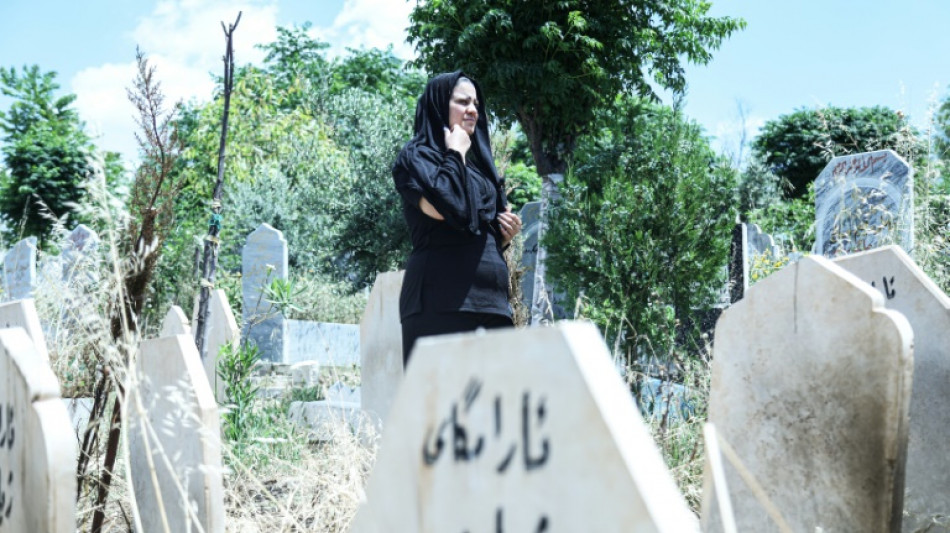
Murdered and forgotten: Iraqi victims of gender-based violence / Photo: Shwan MOHAMMED - AFP

 Djokovic crashes out of Shanghai Masters in his first match

 EU says Turkey's crackdown on rights hampers membership bid

 Two Renoir paintings stolen in France recovered: mayor
 German leader outraged at Schroeder birthday visit to Putin

 Stocks up, oil retreats as Trump rules out pre-vote Iran attack

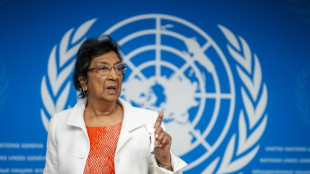 South African judge Navi Pillay wins Nobel Peace Prize

 'I completely trust the club,' says Man City boss Maresca
 '10 out of 10' Quintana reminisces over dream Vuelta win

 Maddinson given shock recall but fails to score

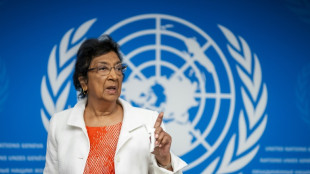 Navi Pillay, South African rights champion, wins Nobel Peace Prize

 Saudi Arabia says three killed at airport as Yemen war expands

 Everton's US owners mull sale of club two years after takeover

 Ukraine takes Russia fight to 'scorching sands' of Sahel
 Chinese AI tool pulled to prevent 'misuse' after South Korea hacks

 Asian stocks mostly up as traders weigh AI, oil dips after surge

 Walking through flames: orangutans rescued in Indonesia fires
 LeBron shines in pre-season debut for re-tooled 76ers
 Okinawa resolution calls for revision of US forces pact after murder

 Verdict expected Friday in Mexico trial over murders of Australia, US surfers

 New York mayor says asking Trump to withdraw ICE after shooting

 Walking through flames: orangutan rescued in Indonesia fires

 James shines in pre-season debut for re-tooled 76ers

 Fuel, fertilizer costs strain US farmers' support for Republicans in midterms

 Trump's 'super intelligence' rebrand to sell AI faces uphill battle

 Fiji demands US provide evidence Chinese official paid bribes for Beijing

In a sun-baked cemetery in northern Iraq, silence lingers over a forsaken corner devoid of mourners, where women killed in gender-based violence rest in unmarked graves.
Domestic violence and femicide have long plagued Iraq's conservative society, including through so-called "honour killings" -- the murders of women deemed to have breached patriarchal social norms, often at the hands of close relatives.
In the unmarked section of the Siwan cemetery in Sulaimaniyah, the second city of the autonomous Kurdistan region, many of the headstones are blank.
Some are inscribed only with numbers that correspond to forensic records, and the signs have faded with time as wild scrub has covered the tombs.
Lawyer and activist Rozkar Ibrahim, 33, pointed to three adjacent burial plots, the final resting places of a man, a woman and their child.
The couple fell in love and had the child without their families' approval, said Ibrahim, who regularly visits the cemetery to uncover victims' stories and honour their memory.
The couple had attempted to flee Iraq for safety, but their relatives found and killed them along with the child, she said.
"They are all buried here," said Ibrahim.
"The gravedigger buries most of these women at night" to prevent relatives concerned about their family's reputation from defacing the graves, said the activist, who believes the demeaning anonymous burial "should not exist".
The Kurdistan regional government in 2020 ordered existing graves be marked with the word "life", and new ones to be engraved with names and birthdates.
Though there are no comprehensive figures, Othman Saleh, a 55-year-old gravedigger at Siwan, said that in 15 years he had buried about 200 women and girls, some as young as 13, who were "killed, burned or smothered".
- 'Alarming rate' -
According to the United Nations, more than one million women and girls across Iraq are at risk of gender-based violence.
The threat usually intensifies during crises, of which the conflict-ridden country of 43 million people has had many.
The northern Kurdistan region, which is keen on presenting an image of relative stability and progress, passed a law in 2011 criminalising domestic violence.
"Incredibly important strides have been taken in legislation" in the autonomous region, said Razaw Salihy, Iraq researcher at rights group Amnesty International.
"Yet, the killing and maiming of women and girls -– mostly at the hands of male relatives –- is occurring at an alarming rate," added Salihy, who is working on a report on domestic violence focusing on impunity for perpetrators and insufficient protection and support for victims.
"Stories of the horrific ways women and girls are killed are much more prevalent than those of perpetrators being held accountable," said the researcher.
Earlier this month, a man poured fuel over his pregnant 17-year-old wife and set her ablaze, her grieving father, Jiza Jawhar, told AFP.
"She lost her child" in the attack, he said, and a few days later succumbed to her injuries.
The husband was later detained, though his family have maintained his innocence and claimed the teenager had committed suicide.
According to official figures obtained by AFP, 45 women were murdered in Iraq's Kurdistan in 2021, up from 25 the previous year.
Serkut Omar, of the regional government's agency on gender-based violence, said cases of femicide have decreased in 2024, without providing figures.
Activists say many cases of violence against women go unreported, with victims often wary of reaching out to the authorities or afraid to speak out.
- Shot, strangled, burned -
At the cemetery in Sulaimaniyah, unmarked plots also serve as final resting places for unidentified women found dead in other parts of the Kurdistan region.
Given that victims' personal details are missing from most graves, Ibrahim said one of the only ways to identify them is by matching the numbers on the headstones to records of the Sulaimaniyah forensic department.
Barzan Mohamed, the department's head, said he has handled scores of femicide cases during his 21-year career.
"The most common method is shooting, but we've also witnessed strangling by hand or with a rope," he said.
"Some were killed with a single bullet, others with as many as 10," added Mohamed, and one woman had been burned to death, "rendering her unrecognisable".
One survivor of domestic abuse, 43-year-old Banaz Jama Ali, said she had been assaulted by her family after seeking safety at her father's home.
She went there after a beating and death threats from her husband, but her brother hit her, breaking her nose and telling her to obey her husband, she recalled.
"My brother pointed a gun to my head twice in front of my children."
Ali eventually fled Iraq.
"I always feared that I would meet the same fate as those buried in the unmarked graves," she said.
R.Veloso--PC